

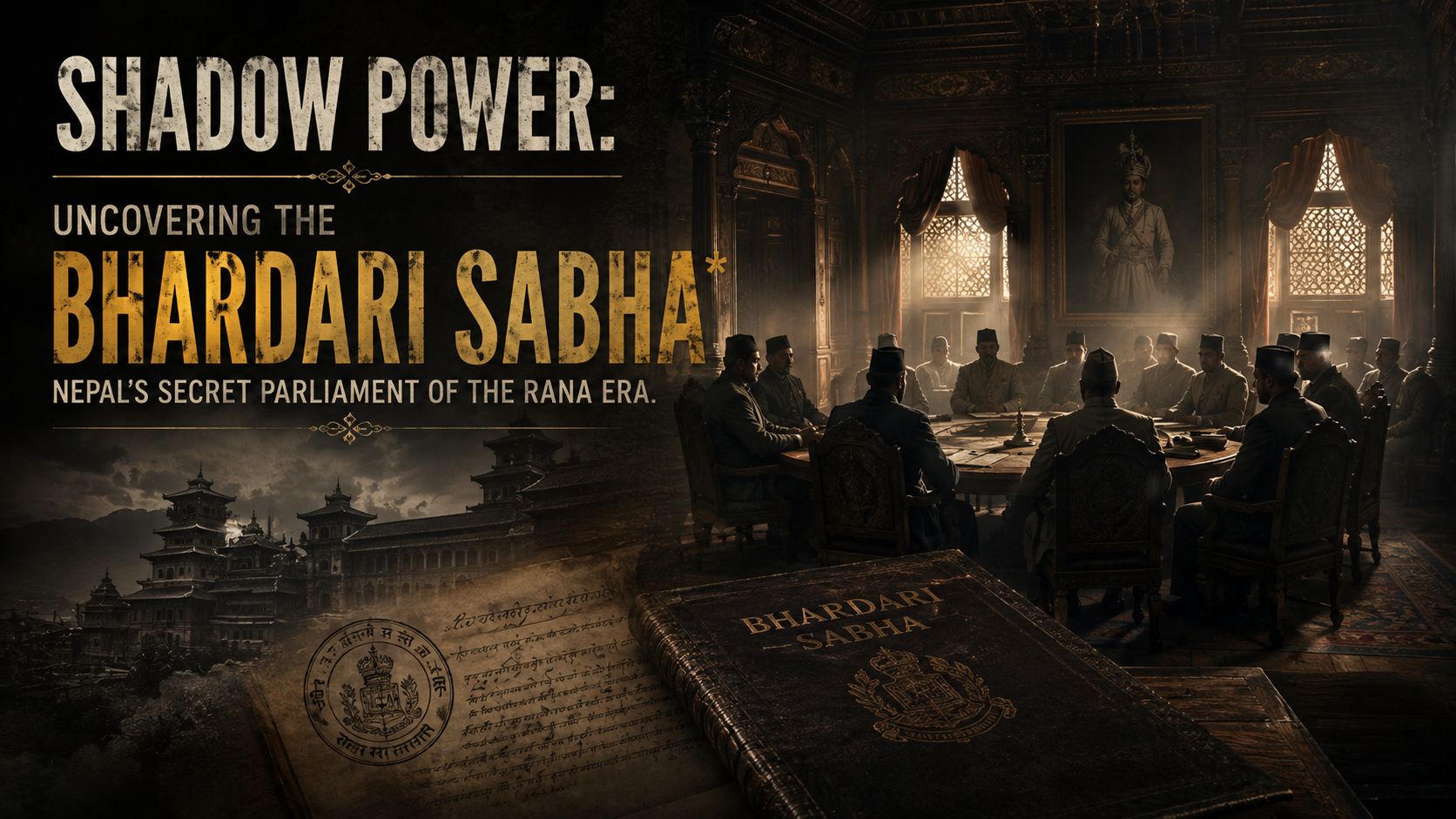
Imagine stepping through the ornate wooden doors of Singha Durbar in late 19th-century Kathmandu. Beyond the chandelier-lit halls and velvet drapes sits a council of elite men dressed in dark military uniforms, adorned with gold epaulettes and ceremonial feather-plumed headpieces.
This was the Bhardari Sabha (Council of Nobles), the shadowy and exclusive council that functioned as Nepal’s pseudo-parliament during the century-long autocratic rule of the Rana regime (1846–1951).
The Origins: From Ancient Assembly to Elite Syndicate : Before the rise of Jung Bahadur Rana, royal councils known as Bharadari had existed in various forms throughout Nepali history, often serving as advisory assemblies to the monarch. However, following the bloody Kot Massacre of 1846, Jung Bahadur seized effective control of the state, reducing the Shah Monarch to a largely ceremonial figurehead and establishing the hereditary Rana Prime Ministership.
To consolidate their authority and legitimacy, the Ranas repurposed the Bhardari Sabha as an official council of state. But make no mistake: this was neither a parliament elected by the people nor an institution designed to represent them.
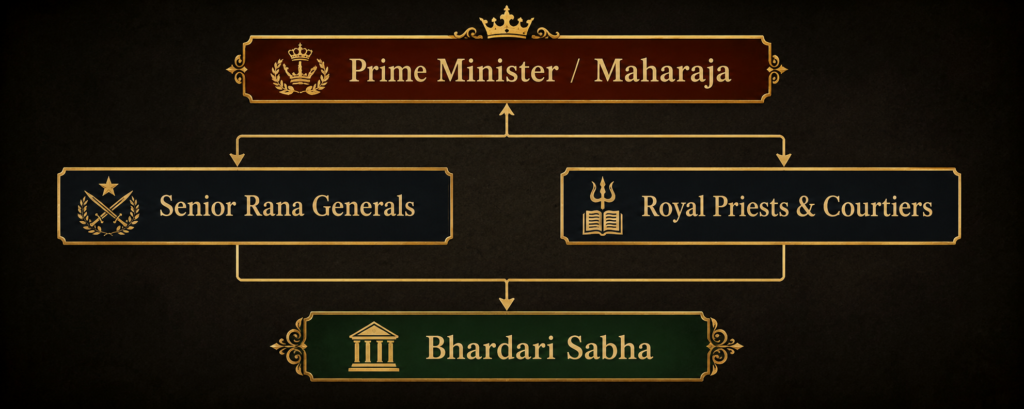
Inside the Chamber: Who Held the Cards? : Unlike modern democratic parliaments, whose members are chosen by citizens, the Bhardari Sabha was an exclusive circle of powerful state insiders.
- The Rana Family Elite: Senior Rana generals, brothers, sons and other members of the ruling family who occupied key administrative and military positions.
- Traditional Courtiers (Bhardars): High-ranking military officers, royal advisers and members of influential aristocratic families, including the Pande, Thapa, Basnyat and Rajopadhyaya families.
- Legal and Religious Scholars: Rajgurus (royal priests) and legal scholars who were consulted on matters of law, religion and the traditional Hindu legal order.
The Power Structure
The Illusion of Governance: How Did It Operate? : On paper, the Bhardari Sabha could be summoned to consider matters of major national importance, including:
- Promulgation of Major Laws: Most famously, the Muluki Ain of 1854, Nepal’s first comprehensive legal code, was discussed and formally endorsed through the state’s governing institutions and the aristocratic establishment.
- Succession and Royal Decrees: The formal recognition of royal Lal Mohars (red-seal decrees) and significant changes concerning royal succession.
- Foreign Policy and War: Matters relating to military policy, relations with the British Empire, and the endorsement or ratification of important agreements.
In practice, however, the assembly operated within the confines of Rana autocracy. Political debate was tightly controlled, while open opposition to the ruling Rana prime minister could carry severe consequences, including exile, imprisonment or even execution.
Rather than functioning as a representative legislature in the modern sense, the Bhardari Sabha helped provide the Rana regime with an appearance of institutional authority, legal formality and aristocratic consensus.
The Legacy: Why Does It Matter Today? : The Bhardari Sabha represents an important chapter in the evolution of governance in Nepal. It demonstrates how political power can be wrapped in elaborate institutions and formal procedures while remaining firmly concentrated within a narrow ruling elite.
For nearly a century, political authority remained largely in the hands of the Rana family and its network of military commanders, courtiers and loyal administrators.
It was only with the Revolution of 1951 (2007 BS) and the collapse of the Rana Regime that Nepal began a decisive transition towards representative government. Over time, this transformation helped lay the foundations for parliamentary institutions in which political representation increasingly shifted from courtly privilege towards the participation of the wider population.
The story of the Bhardari Sabha is therefore more than a tale of an obscure council from Nepal’s past. It is a reminder that a government can possess the appearance of institutions and consultation without necessarily being Representative or Democratic.