

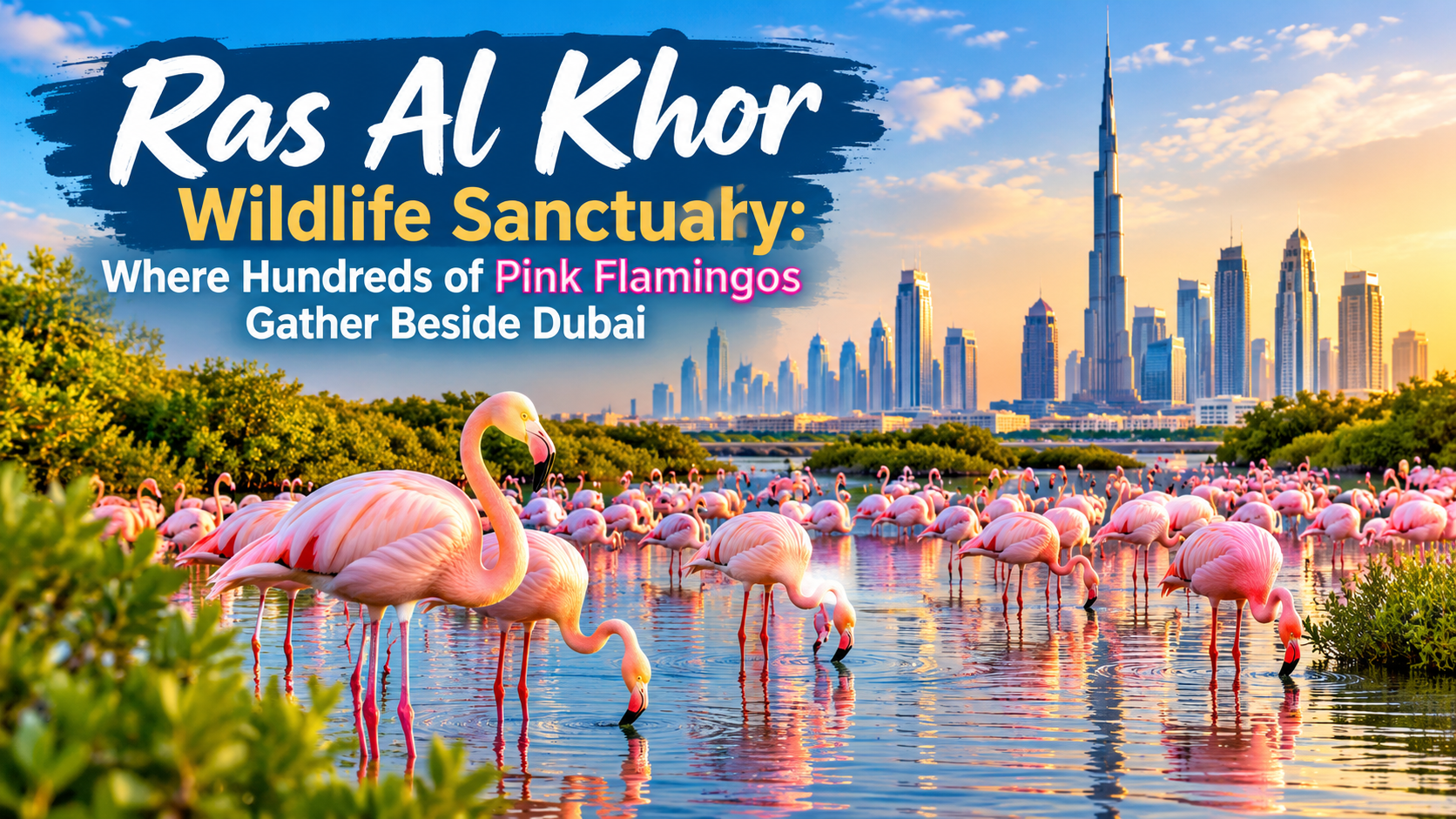
Just beyond the futuristic skyline of Dubai lies a surprisingly wild landscape where shimmering wetlands attract hundreds of elegant pink flamingos. This is Ras Al Khor Wildlife Sanctuary, one of the UAE’s most remarkable urban nature reserves.
For visitors expecting Dubai to be all skyscrapers, shopping centres and desert adventures, Ras Al Khor offers something completely different: a chance to watch wildlife with the city’s famous skyline in the distance.
A Wetland Next to One of the World’s Modern Cities: Ras Al Khor means “Cape of the Creek”, and the sanctuary occupies an important wetland area at the edge of Dubai Creek. Despite being surrounded by one of the world’s busiest urban environments, the reserve provides valuable habitat for birds and other wildlife.
Its mangroves, mudflats, lagoons and shallow waters create feeding and resting grounds for numerous species.
The remarkable part is the contrast: wild flamingos can be feeding in the wetlands while Dubai’s modern skyline rises behind them.
Why Are the Flamingos Pink?: The sanctuary is particularly famous for its greater flamingos. Their distinctive pink colouring comes largely from their diet. Flamingos consume organisms such as algae and tiny aquatic creatures containing natural pigments called carotenoids. These pigments contribute to the pink and reddish shades visible in their feathers.
Young flamingos, however, are generally much greyer and paler before developing their adult colouring.
A Haven for Migratory Birds: Ras Al Khor is far more than a flamingo-watching spot. The wetlands form an important stopover and feeding area for migratory birds travelling between different parts of Eurasia and Africa.
Depending on the season, visitors may encounter a variety of waterbirds and other species.
The sanctuary demonstrates something particularly interesting about urban conservation: a relatively small protected wetland can remain ecologically valuable even when a huge modern city grows around it.
What Makes Ras Al Khor Special?: The experience is not about trekking deep into remote wilderness. Instead, it is about seeing nature unexpectedly close to civilization.
One moment you are surrounded by Dubai’s roads and towering buildings; the next, you are watching flamingos standing quietly in shallow water. That unusual combination makes Ras Al Khor especially appealing to photographers, birdwatchers and travellers who want to discover a different side of the UAE.
When Should You Visit?: Early morning is generally a good time for wildlife watching because temperatures are more comfortable and birds can be active around the wetlands. Winter is also particularly interesting for bird watching, as the UAE becomes an important stopover and wintering area for migratory species.
For the best experience, bring binoculars, a camera with a suitable zoom lens, water and sun protection. The Dubai climate can be extremely bright and hot, even when the weather feels pleasant.
A Wild Corner of Dubai: Ras Al Khor Wildlife Sanctuary is a reminder that Dubai is not simply a city of glass towers and luxury developments. Hidden beside its urban landscape is a functioning wetland supporting an impressive variety of wildlife?
And then there are the flamingos.
Seeing hundreds of pink birds gathered across the water, with Dubai’s skyline providing the backdrop, is one of those scenes that feels almost surreal.
Ras Al Khor proves that wildlife and modern cities do not always have to exist worlds apart. Sometimes, the wild can be found just beyond the skyscrapers.