

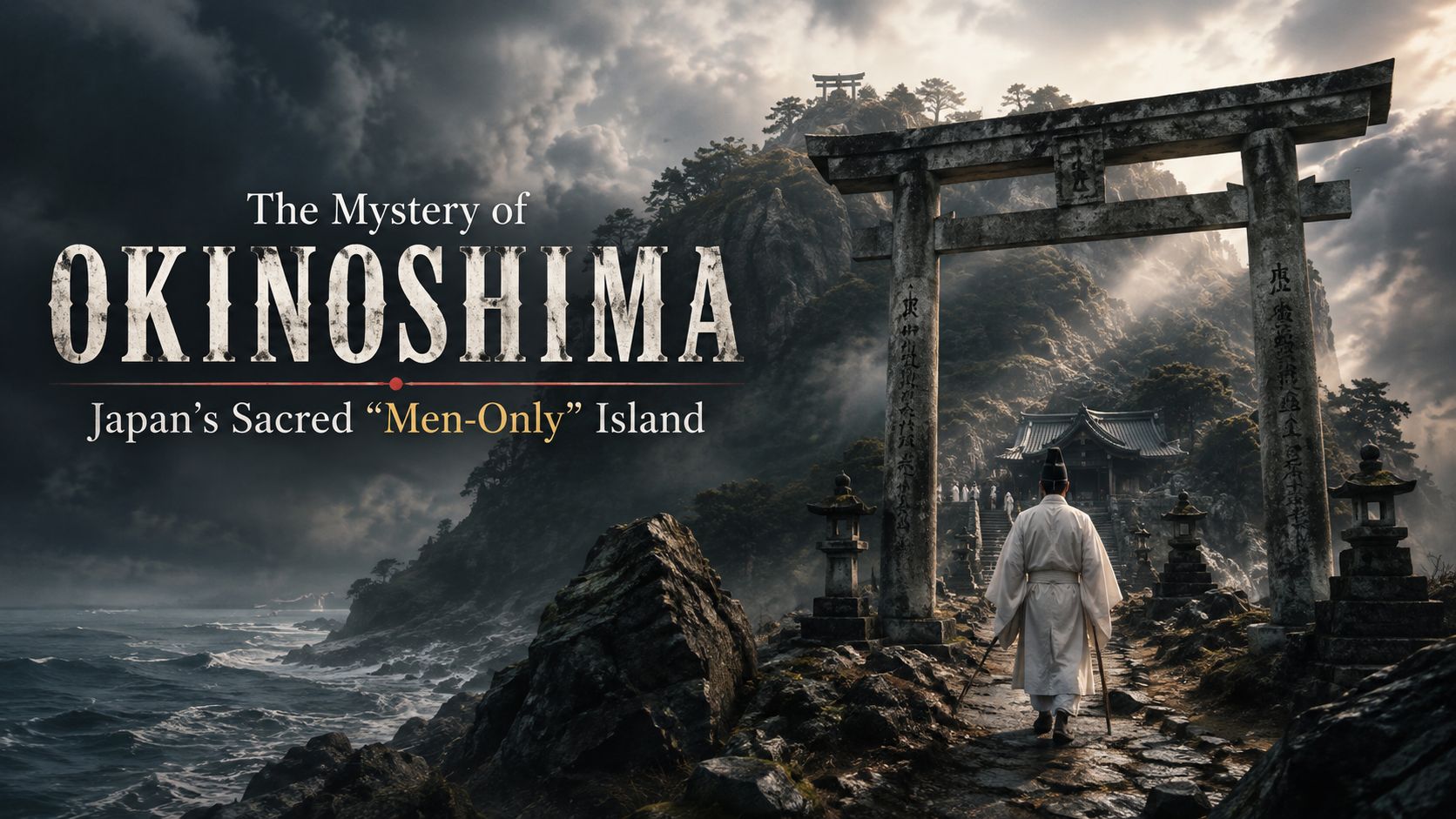
If you’ve scrolled through social media recently, you’ve likely encountered viral posts claiming there’s a mysterious Japanese island where women are strictly forbidden and visitors are sworn to total secrecy.
While many viral trends exaggerate the truth, these claims are rooted in real history. The location in question is Okinoshima (沖ノ島), a tiny, highly sacred island off the coast of Fukuoka Prefecture in Japan.
Okinoshima is an ancient Shinto holy site located in the Genkai Sea, roughly halfway between the Japanese mainland and the Korean Peninsula. Since the 4th century, it has served as a critical location for rituals praying for safe sea travel and trade relations.
In 2017, the island and its associated sites were officially designated as a UNESCO World Heritage Site due to the incredible preservation of ancient religious offerings and artefacts—over 80,000 of which are considered national treasures.
Fact-Checking the Viral Claims
| Claim | Status | The Explanation |
| Bans Women Completely | True | Shinto traditions strictly bar women from setting foot on the island. |
| Secrecy Mandatory | True | A fundamental rule forbids visitors from talking about anything they experience there. |
| Naked Purification Ritual | True | Men visiting the island were historically required to strip naked and bathe in the sea before going ashore. |
| Take Nothing Rule | True | Visitors are forbidden from removing anything from the island—not even a single pebble or blade of grass. |
Why are Women Banned from Okinoshima?
Despite the island’s primary shrine (Okitsu Shrine) being dedicated to Tagorihime, a female Shinto deity (kami), women have been prohibited from entering for centuries.
Religious scholars and local lore cite two main reasons:
- Shinto Concepts of Purity: Ancient Shinto tradition views blood—including menstrual blood—as a source of ritual impurity (kegare).
- Protection & Lore: Legends suggest the female deity guarding the island would become jealous of other women, bringing bad luck or harm to visitors. Historical accounts also point to the dangerous nature of seafaring in ancient times.
Can You Visit Okinoshima Today?
Short Answer: No—not even if you are a man.
- Past Rules: Until 2017, up to 200 men were permitted to visit the island for just a few hours on 27 May each year for a festival honouring sailors.
- Current Status: Following its UNESCO World Heritage listing, the head priests of Munakata Taisha closed the island to all tourists and outside visitors to protect it from environmental damage and preserve its sacred traditions.
Today, the only people allowed on Okinoshima are a small number of Shinto priests who live on rotation to guard the island, perform daily rituals, and maintain its ancient shrines.




In The Mystery of Okinoshima: Japan’s Sacred “Men-Only” Island, the section on while many viral trends exaggerate the truth, these claims are rooted in real history. The location in question was especially clear. Anyone researching Image tools may also want to look at Split Image; its focus is to s privately in your browser and download ordered pieces fast.
This was a useful look at The Mystery of Okinoshima: Japan’s Sacred “Men-Only” Island, especially the discussion of while many viral trends exaggerate the truth, these claims are rooted in real history. The location in question. AI Couple may also be useful to readers comparing AI couple photo generator; its focus is to make complex photo edits simple with AI — no design experience needed.