

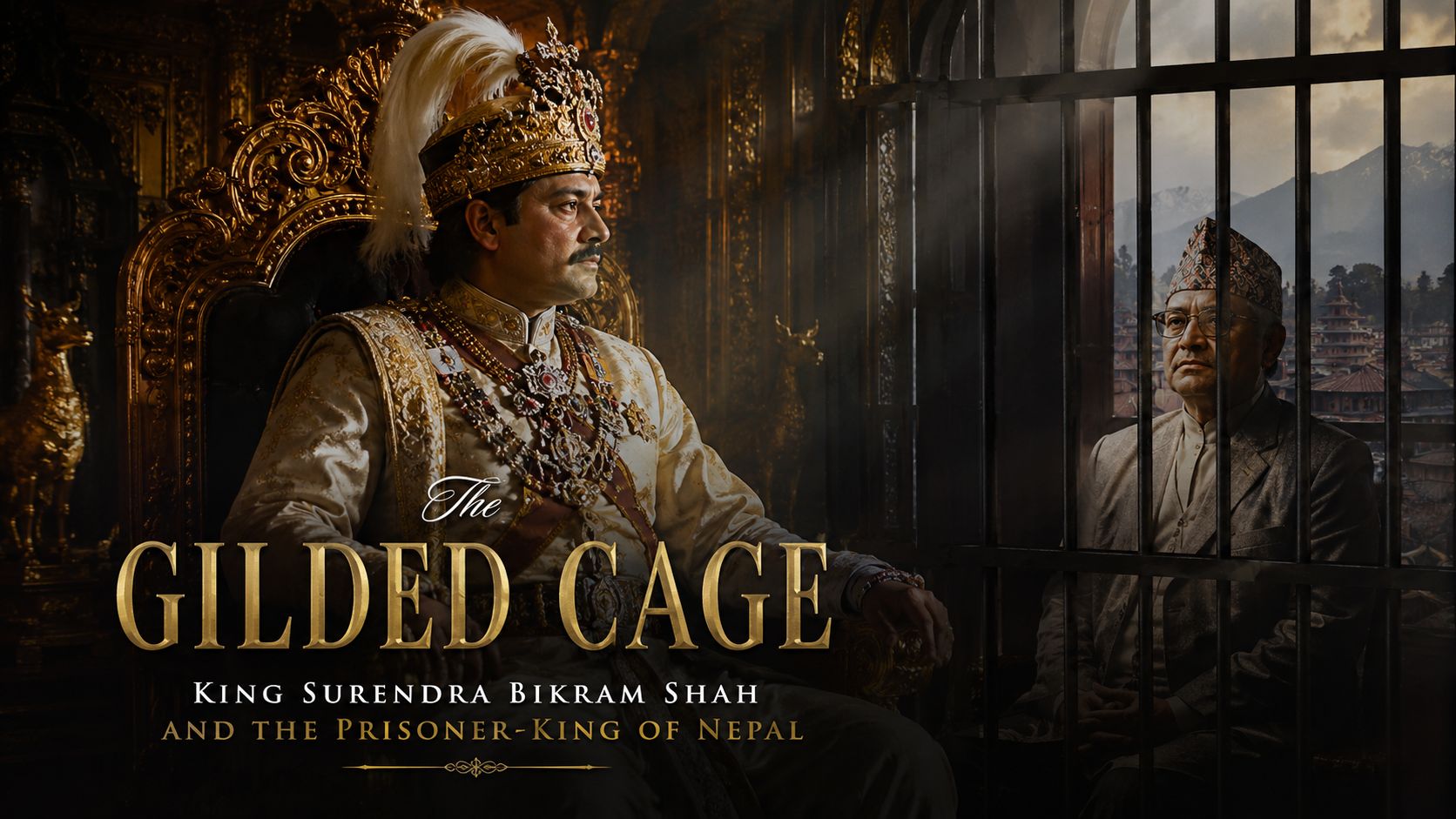
Imagine sitting upon a Throne Fashioned from Gold, surrounded by velvet and dressed in royal robes, wearing a crown adorned with precious jewels—yet possessing less real freedom than an ordinary man walking through the streets beyond the palace gates.
This was the tragic reality of King Surendra Bikram Shah, the 6th Shah Monarch of Nepal, whose reign from 1847 to 1881 represents one of the most remarkable chapters in Nepalese Royal History.
The Coup That Built a Gilded Prison : To understand Surendra’s fate, we must first look at the powerful figure standing behind the throne: Prime Minister Jung Bahadur Rana.
Following a period of violent court intrigue, most notably the Kot Massacre of 1846, Jung Bahadur Rana emerged as the dominant political and military figure in Nepal. He gradually consolidated control over the state while the authority of the Shah monarchy was greatly diminished. Jung Bahadur’s rise ultimately led to the removal of King Rajendra Bikram Shah, Surendra’s father, from effective political power. In 1847, Surendra succeeded his father and was placed upon the throne.
But his accession was hardly a triumph of royal authority. Instead, the young king inherited a crown whose political power had already been severely restricted.
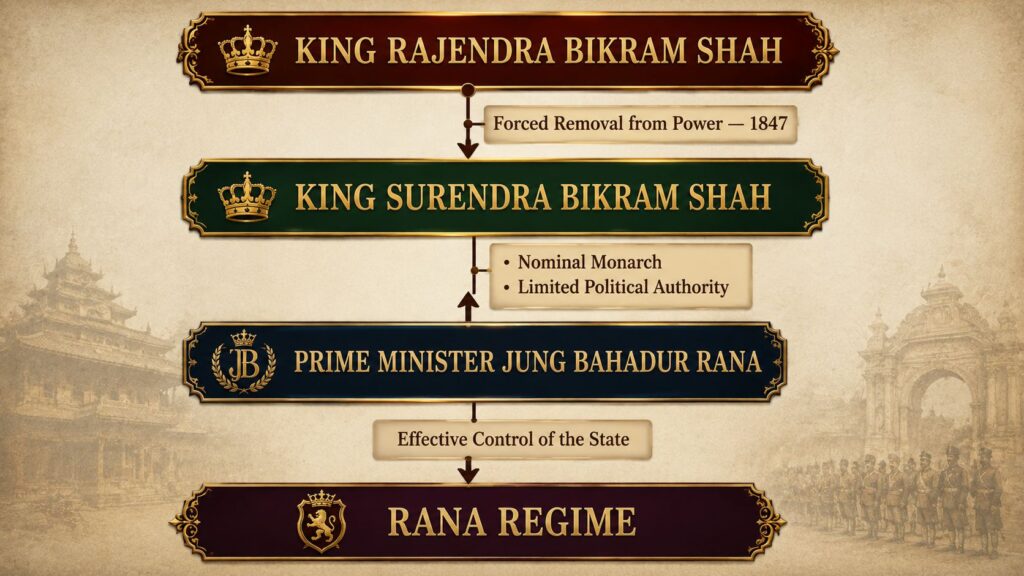
A “Prisoner of His Own Palace” : Although Surendra retained the prestigious title of Maharajadhiraja, meaning “King of Kings”, the effective control of government increasingly rested with the Rana prime minister. The Ranas dominated the administration, military and foreign affairs, while the Shah monarch’s role was reduced largely to one of formal and ceremonial authority.
Surendra therefore occupied a peculiar position: he remained the sovereign in name, but the real machinery of government was controlled by the Rana prime minister and his family.
Key Characteristics of His Reign : Limited Political Authority: Major matters of government, administration and military affairs were controlled by the Rana leadership rather than by the king himself.
Restricted Royal Influence: Surendra’s ability to intervene directly in affairs of state was severely constrained by the political power of the Rana regime.
The Rise of Hereditary Rana Rule: Surendra’s reign coincided with the consolidation of a political system in which the Rana prime ministership became hereditary. For more than a century, Rana prime ministers exercised effective control over Nepal while the Shah kings remained largely ceremonial figures.
Historical Significance : King Surendra’s story illustrates one of the great ironies of monarchy: a sovereign may possess the crown without possessing the power that normally accompanies it.
His reign was not defined Primarily by Military Conquests or Territorial Expansion, but by the dramatic transformation of Nepal’s political order. The Shah King remained on the throne, whilst effective authority increasingly belonged to the Rana Prime Minister.
For Surendra, the crown became something of a gilded cage—a symbol of supreme authority that concealed the reality of political power being exercised elsewhere. His story also helps explain the remarkable longevity of the Rana system, which dominated Nepalese Politics until the Revolution of 1951 (2007 BS) brought an end to Hereditary Rana Rule and began a new chapter in the country’s political history.