

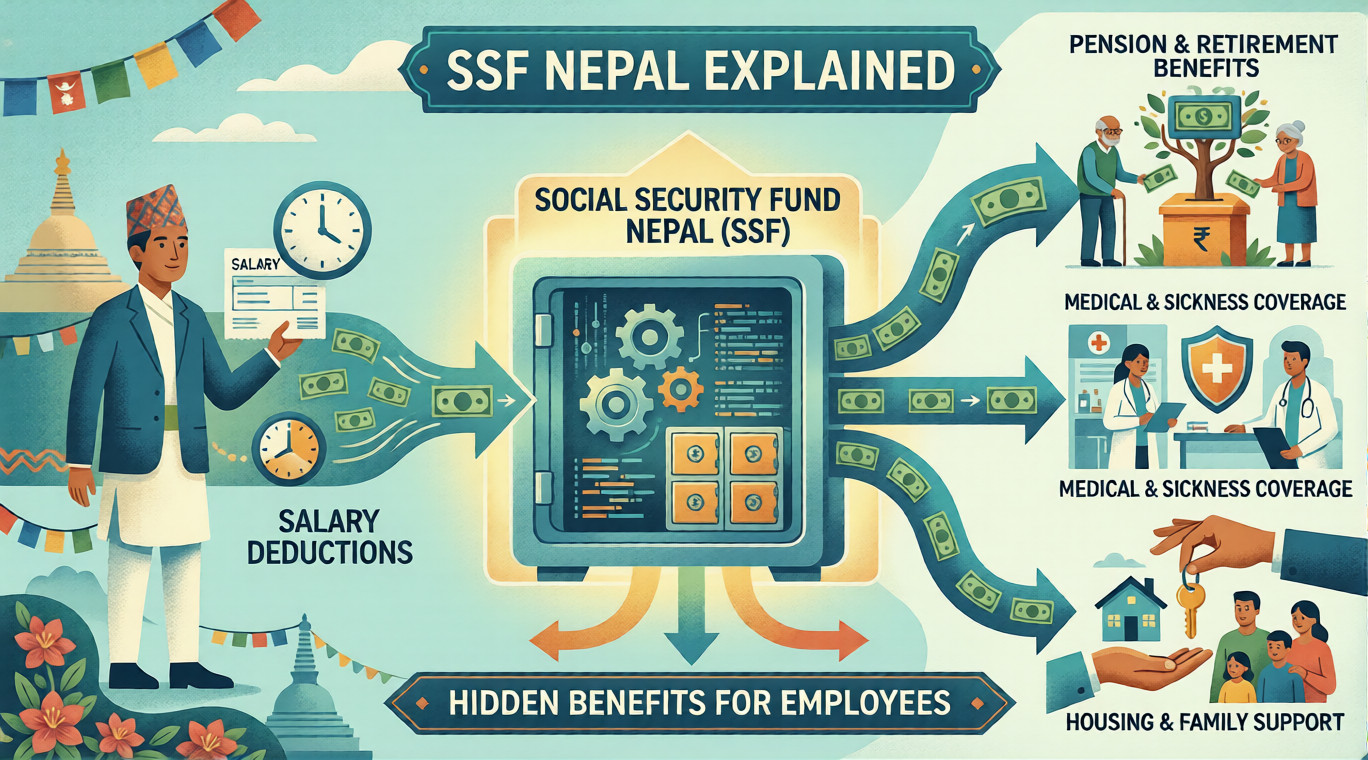
Social Security Fund in Nepal : In recent years, the concept of financial security for workers has taken on greater importance, particularly in developing economies where informal employment has long dominated. One such initiative is the Social Security Fund (SSF), a structured system designed to provide financial protection and long-term stability to employees working in the formal sector.
What is the Social Security Fund (SSF)? : The Social Security Fund is a government-backed programme that ensures workers receive financial benefits during key stages of their lives—such as retirement, illness, disability, or maternity. It operates on a contribution-based model, where both employers and employees regularly deposit a portion of earnings into the fund.
Unlike traditional savings schemes, the SSF is not merely about accumulation; it is about protection. It provides a safety net that supports individuals when they are unable to earn, thereby reducing financial vulnerability.
Is SSF Available in Nepal? : Yes, the Social Security Fund is fully available and operational in Nepal. It was formally introduced under the Social Security Act 2017 and is implemented nationwide, particularly targeting employees in the formal sector. Organisations registered with the government are required to enrol their workers and contribute to the scheme.
This marks a significant shift in Nepal’s labour system, moving from informal, unsecured employment towards structured social protection.
Who Falls Under the Formal Sector? : The formal sector includes employees working in registered companies, banks, industries, corporate offices, and other legally recognised institutions. These workers typically have written contracts, regular salaries, and defined working conditions.
Under SSF in Nepal:
- Employers must register their business and employees.
- Both parties contribute a fixed percentage of the employee’s salary.
- Contributions are managed centrally by the fund.
Key Benefits of SSF : The Social Security Fund in Nepal offers several benefits, structured under different schemes:
- Medical and Health Protection.
- Covers medical treatment costs and provides support during illness.
- Accident and Disability Protection.
- Offers compensation in case of workplace accidents or long-term disability.
- Maternity Protection.
- Provides financial support to female employees during maternity leave.
- Old Age Protection (Pension).
- Ensures income security after retirement, similar to a pension system.
- Dependent Family Protection.
- Supports family members in the event of a contributor’s death.
Why SSF Matters : For a country like Nepal, where many workers have historically lacked job security, the SSF represents progress. It encourages formal employment, improves workers’ confidence, and fosters a culture of long-term financial planning.
Moreover, it aligns Nepal with global labour standards, ensuring that workers are not left vulnerable in times of crisis.
Challenges and Considerations : Despite its advantages, the implementation of SSF has faced certain challenges:
- Limited awareness among employees and employers.
- Resistance from businesses due to additional financial obligations.
- Transition issues from previous provident fund systems.
However, with continued policy refinement and public education, these challenges are gradually being addressed.
Final Thoughts : The Social Security Fund in Nepal is more than a policy—it is a step towards economic dignity and stability for workers. While still evolving, it holds the promise of a more secure future for those employed in the formal sector.
For employees, it is an opportunity to safeguard their future. For employers, it is a responsibility that contributes to a more resilient workforce. And for the nation, it is a move towards sustainable social development.