

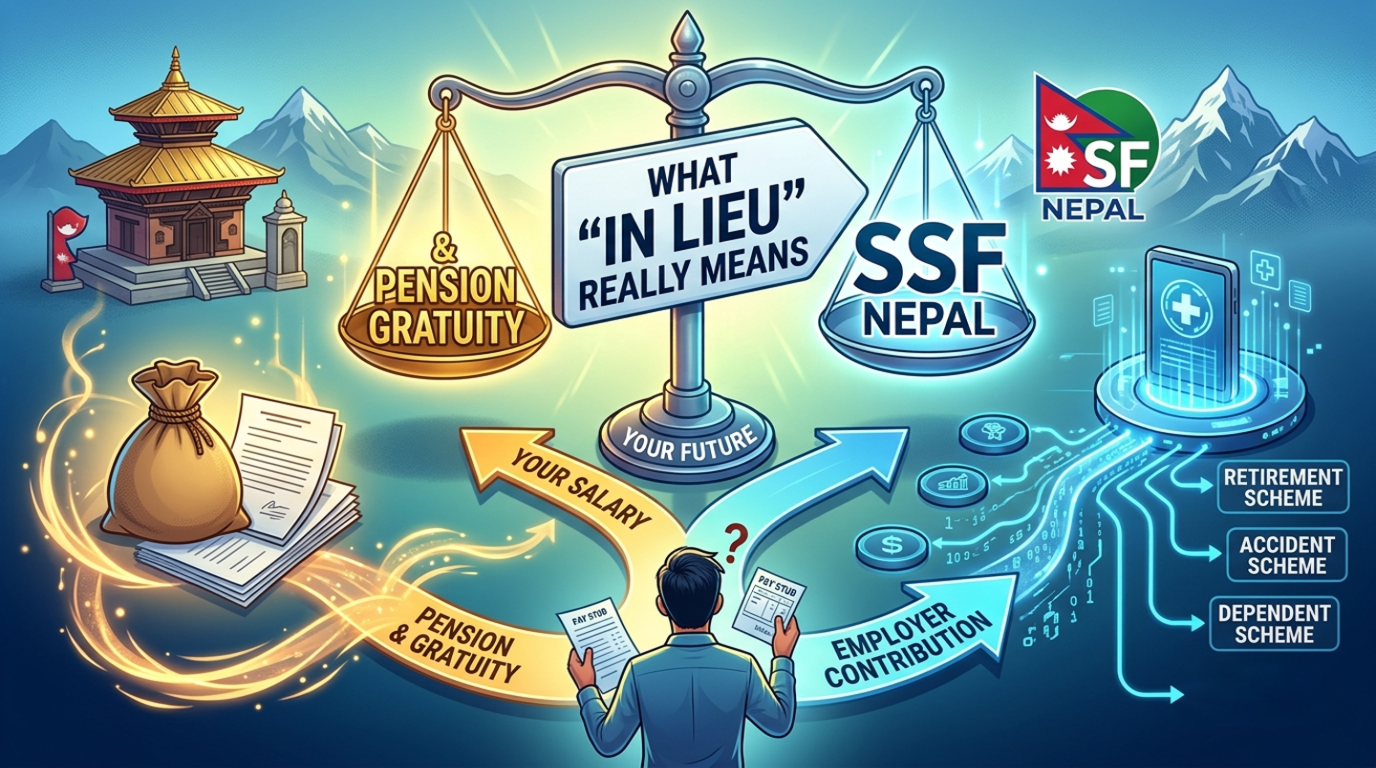
The phrases “Pension/Gratuity in lieu” and “Social Security in lieu” can be confusing, particularly in the context of Nepal’s Social Security Fund (SSF). Let’s unpack them clearly in a British, explanatory style.
Pension/Gratuity “in lieu” – what does it mean?: The term “in lieu” simply means “instead of”. So, when we say pension or gratuity in lieu, it refers to a situation where:
- An employee does not receive a traditional pension or gratuity from the employer,
- Because another system replaces it—such as a structured contribution scheme.
In older employment systems (particularly before SSF in Nepal) :
- Employees often received a lump sum gratuity after years of service, or
- A defined pension funded directly by the employer.
- Social Security “in lieu” – what replaces what?
In Nepal, the introduction of the Social Security Fund means: 👉 SSF contributions are provided in lieu of (instead of) traditional benefits like:
- Gratuity.
- Employer-managed pension schemes.
This means: Employers no longer need to separately manage gratuity or pension funds for employees enrolled in SSF. Instead, both employer and employee contribute to SSF, which then provides:
- Pension (old age protection).
- Medical benefits.
- Accident coverage.
- Family protection
Simple Comparison between Old System and New SSF System
Old System
- Employer pays gratuity at the end .
- Pension handled internally .
- Limited protection (mainly after retirement).
New SSF System
- SSF provides long-term benefits.
- Pension comes from SSF.
- Multiple protections (health, accident, family, retirement
Important Practical Meaning: If you are enrolled in SSF in Nepal:
- You are not entitled to separate gratuity or pension from your employer
- Because SSF replaces those benefits
- Your future benefits now depend on:
- Contribution amount.
- Contribution duration.
Final Thought : The phrase may sound technical, but the idea is straightforward; “Social Security in lieu” means a modern, centralised system replacing older, employer-based benefits like pension and gratuity. It shifts responsibility from individual employers to a national fund—aiming for broader, more secure protection for workers.