
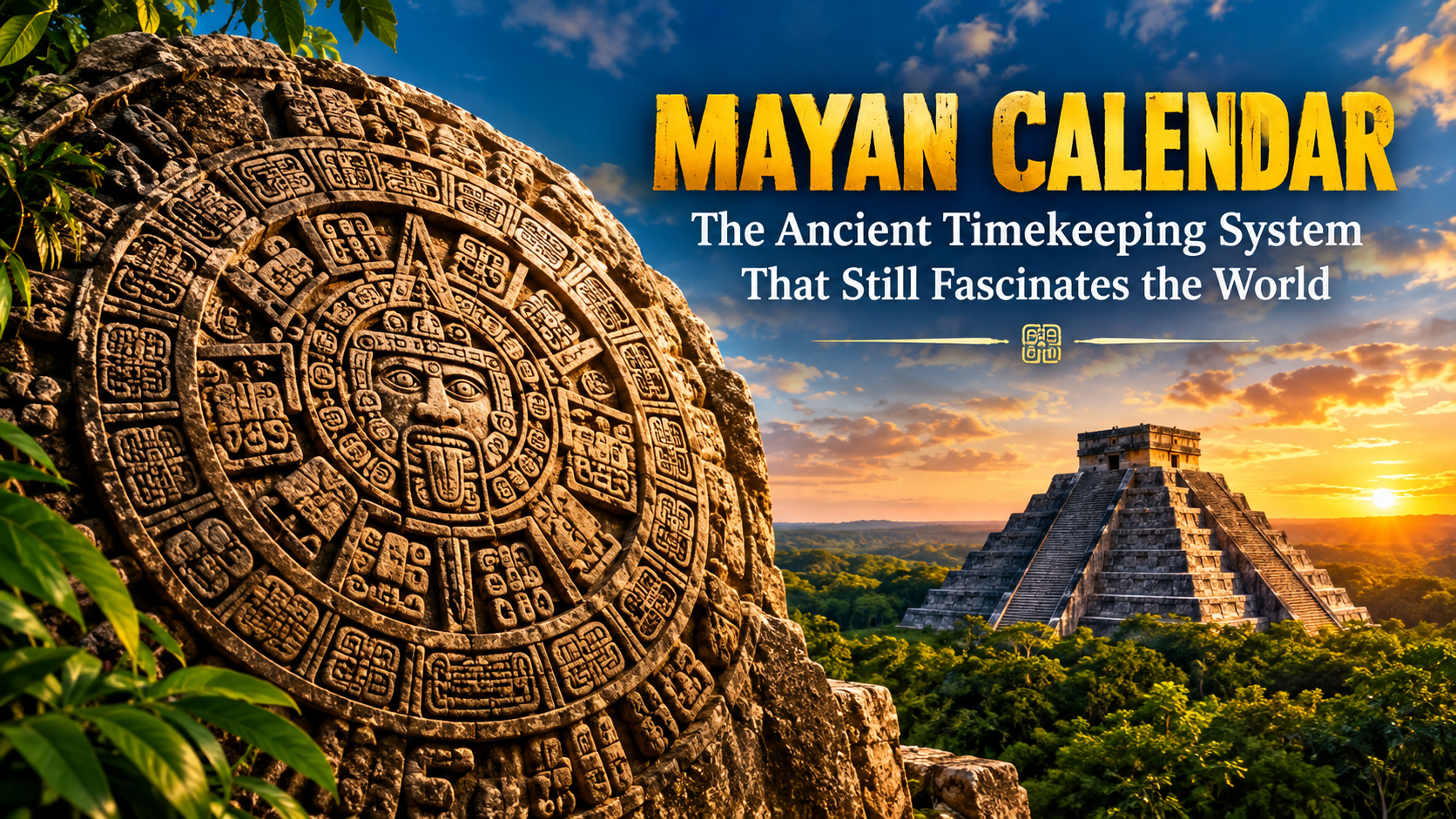
The Mayan Calendar, more accurately known as the Maya calendar, is one of the most fascinating timekeeping systems ever developed by an ancient civilisation. Created and refined by the Maya peoples of Central America, it combined astronomy, mathematics, religious traditions and the observation of natural cycles to organize everyday life and record historical events.
Even today, the Maya calendar attracts worldwide attention because of its remarkable complexity and the widespread myths surrounding the supposed end of the world in 2012. But what did this ancient system actually mean, how did it work, and why does it remain important?
What Is the Mayan Calendar? : The Maya calendar is a collection of interconnected calendar systems rather than a single calendar like the modern Gregorian calendar. The ancient Maya used different methods to measure sacred days, agricultural seasons and long periods of history.
According to historical accounts, calendar traditions in Mesoamerica developed over many centuries, with the Maya making important contributions to their use and refinement.
The system was closely connected to Maya society. It helped communities organize ceremonies, understand seasonal patterns and commemorate the achievements of their rulers.
Unlike a simple list of dates, the Maya calendar used repeating numerical cycles that worked together to provide different ways of identifying a particular day.
The Three Main Parts of the Maya Calendar:
- The Tzolk’in — The Sacred Calendar: The Tzolk’in consists of 260 days. It combines 13 numbers with 20 named day signs, creating a repeating cycle used for religious ceremonies and other traditional practices. This calendar remains culturally significant among some Maya communities today.
- The Haab’ — The 365-Day Calendar: The Haab’ follows a 365-day cycle, making it particularly useful for organising civic and agricultural activities. It contains 18 months of 20 days, followed by a five-day period called Wayeb’. Unlike the modern Gregorian calendar, it did not include a regular leap-day adjustment.
- The Long Count — Recording History: The Long Count was designed to record dates across much longer periods than the repeating calendar cycles. It counted days from a traditional creation starting point, allowing Maya inscriptions to record historical events, royal reigns and other significant occasions.
How Did the Mayan Calendar Work? : The ingenuity of the Maya system lies in the way its different cycles operated together. The Tzolk’in completed one cycle every 260 days, while the Haab’ completed one every 365 days. When the two calendars were combined, the same date combination repeated every 18,980 days, equivalent to 52 Haab’ years.
This period is known as the Calendar Round. Rather than relying on one date format, the Maya could identify a day through multiple calendar cycles. For recording events across longer periods, the Long Count provided an additional chronological framework.
Their mathematical approach demonstrates how carefully ancient Maya societies observed and organised time long before modern clocks and digital calendars existed.
Why Was the Mayan Calendar So Important? : For the Maya, time was not simply a way of knowing the date. It was closely linked to society, religion, agriculture and the natural world.
The calendar served several important purposes:
- Agriculture: Seasonal observations helped communities plan activities connected with planting and harvesting.
- Religious ceremonies: Sacred calendar cycles helped determine dates for traditional rituals.
- Astronomy: Observations of celestial movements contributed to Maya knowledge of recurring astronomical events.
- Historical records: Long Count inscriptions helped document royal achievements and significant events.
- Cultural identity: Calendar traditions continue to form part of the heritage of Maya communities.
The system reveals how mathematics, observation and cultural beliefs could combine to shape an entire civilisation.
Did the Mayan Calendar Predict the End of the World in 2012? : One of the biggest reasons the Maya calendar became famous around the world was the prediction that the world would end on 21 December 2012.
The speculation arose because a major cycle in the Long Count calendar was reaching a significant completion. Some popular interpretations transformed this calendrical milestone into a supposed prediction of a global catastrophe.
However, the calendar did not establish that the world would end in 2012. The completion of a major cycle was a calendrical event, not proof of an impending apocalypse. The date passed without the predicted worldwide destruction.
The episode demonstrates how ancient historical evidence can be misunderstood when separated from its original cultural context.
Is the Mayan Calendar Still Used Today? : Yes. Although the ancient political and social structures of the Maya civilization have changed, Maya peoples continue to live across parts of Mexico and Central America.
Certain traditional calendar practices remain in use, particularly the 260-day sacred calendar among some communities. Its significance varies between communities, but it continues to play a role in cultural identity and spiritual traditions.
This continuing use challenges the misconception that Maya civilisation belongs entirely to the distant past. Its descendants maintain living traditions that connect present-day communities with generations of cultural knowledge.
What Makes the Mayan Calendar Different from the Modern Calendar?
| Feature | Maya Calendar System | Gregorian Calendar |
| Structure | Multiple interconnected cycles | A single civil calendar |
| Main annual cycle | Haab’, 365 days | 365 days, with leap years |
| Sacred cycle | Tzolk’in, 260 days | No equivalent standard cycle |
| Long-term dating | Long Count | Numbered years and historical eras |
| Cultural role | Historical, agricultural and sacred uses | Primarily civil and international dating |
The comparison is simplified because the Maya system had several components with different purposes. Nevertheless, it illustrates why the two systems should not be treated as identical methods of measuring time.
Conclusion – An Extraordinary Legacy of Ancient Knowledge: The Mayan calendar is far more than an unusual collection of dates carved into stone. It represents centuries of mathematical development, astronomical observation, historical record-keeping and cultural tradition.
By combining the Tzolk’in, Haab’, and Long Count calendars, the ancient Maya developed a sophisticated system for tracking recurring cycles and recording historical events across long periods of time.
Its fame may have grown through the 2012 apocalypse rumours, but its real significance lies in the ingenuity of the people who developed and preserved it. The Maya calendar remains a powerful reminder that ancient civilisations could achieve remarkable intellectual advances without the technology available to the modern world.