

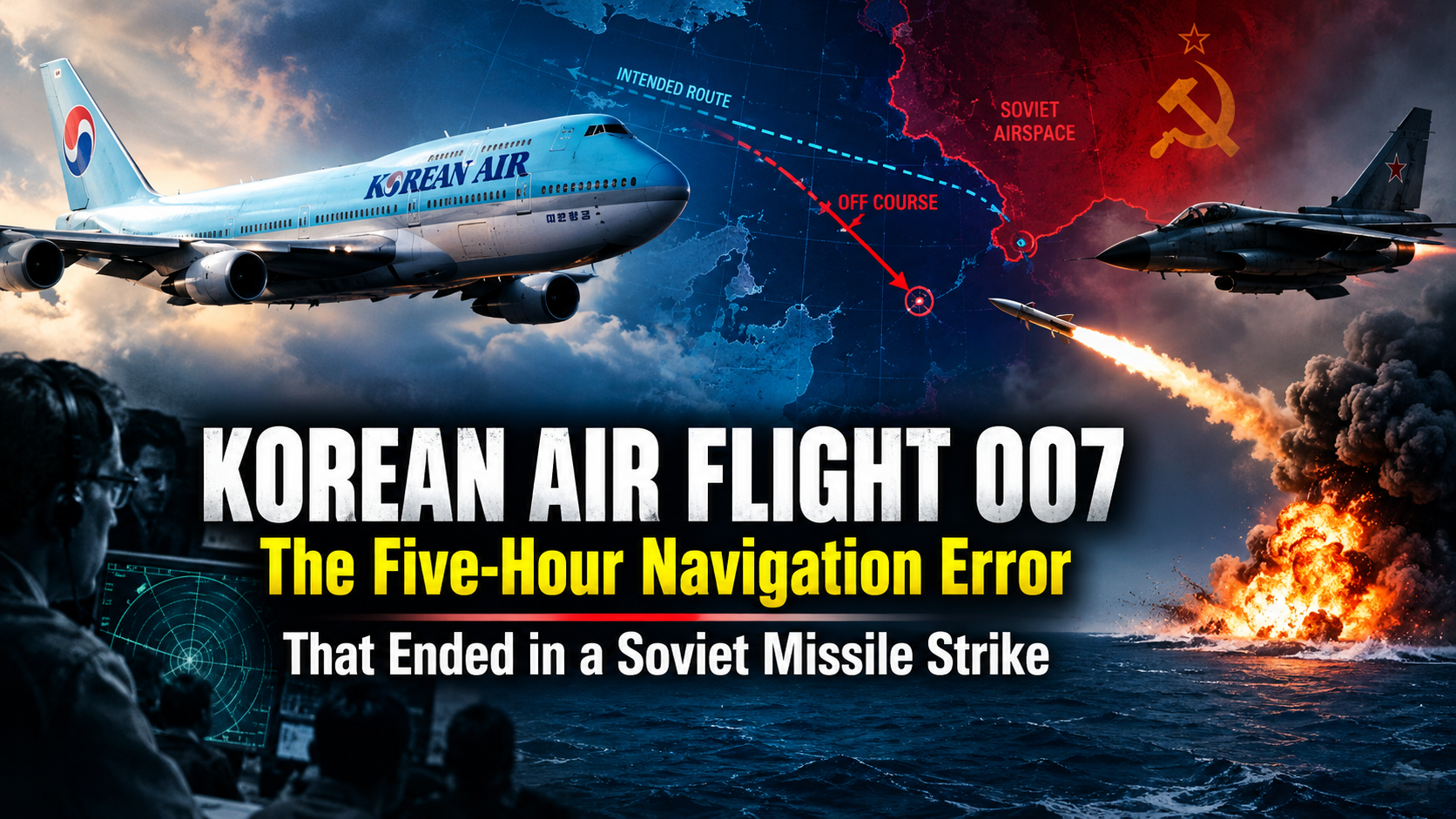
Introduction – A Routine Flight That Became a Global Tragedy: On 1 September 1983, Korean Air Lines Flight 007 was travelling from New York to Seoul, with a scheduled stop in Anchorage, Alaska. On board were 269 people, including passengers and crew, expecting an ordinary long-distance journey across the Pacific.
Instead, the aircraft entered Soviet airspace, was intercepted by Soviet fighter jets and was ultimately shot down over the Sea of Japan, killing everyone aboard.
The tragedy became one of the most shocking aviation disasters of the Cold War. What made the incident particularly disturbing were the role of navigation, military suspicion and a series of decisions that unfolded in an atmosphere of intense international tension.
But was the aircraft really flying on the wrong autopilot setting for five hours? : The answer is more complicated than the headline suggests, and understanding the details reveals how a navigation error could have such devastating consequences.
How Did Korean Air Flight 007 Go Off Course? : Flight 007 was a Boeing 747 passenger aircraft operating a long-haul route from Anchorage to Seoul. After departing Alaska, the aircraft was supposed to follow a planned route across the North Pacific, keeping clear of restricted Soviet military airspace.
However, investigators later concluded that the aircraft had strayed substantially from its intended flight path.
One leading explanation was that the aircraft’s autopilot had been left in a heading mode rather than being correctly set to follow the intended navigation route. In heading mode, the aircraft maintains a selected compass heading; it does not automatically correct its course to follow a sequence of programmed navigation points.
If the crew believed the aircraft was following the planned route when it was actually maintaining an incorrect heading, the deviation could continue for a considerable distance without being immediately recognized.
The aircraft’s navigation system, the crew’s monitoring procedures and the available flight information all became important questions in the investigation.
It is worth making one distinction: the exact sequence of cockpit actions and the crew’s awareness of the deviation have been debated. The claim that the aircraft simply remained on the wrong setting for precisely five hours is an oversimplification of a complex accident.
Why Didn’t the Crew Realize Something Was Wrong? : Modern aircraft have sophisticated navigation systems, satellite positioning and multiple ways to cross-check their location. In 1983, long-distance navigation relied on different technology and procedures, including inertial navigation systems, ground-based navigation aids where available, and careful monitoring of the aircraft’s position.
Flight 007 was equipped with an inertial navigation system intended to guide it along a planned route. However, if the aircraft was not correctly aligned with the intended navigation system, or if the crew failed to recognize that the aircraft was not following the expected track, the system could not necessarily protect the flight from every navigation mistake.
Several factors help explain why the deviation was so dangerous:
- A misleading sense of normality: The aircraft could continue flying smoothly, with no obvious physical warning that it was far from its intended route.
- Limited opportunities for cross-checking: Over remote ocean areas, pilots had fewer external navigation references than they would have over land.
- Cold War geography: The aircraft’s position was especially sensitive because the planned route passed near strategically important Soviet territory.
- Human and procedural factors: Flight crews were expected to cross-check instruments, navigation information and flight progress. The investigation raised serious questions about how these checks were performed.
The key lesson is that an aircraft can appear to operate normally while following the wrong path. Navigation safety depends not just on automated systems, but also on correct setup, independent checks and the crew’s awareness of the aircraft’s actual position.
The Soviet Union’s Response: From Interception to Disaster: As Flight 007 travelled further off course, it entered Soviet airspace over areas of considerable military importance. Soviet forces detected the aircraft and dispatched fighter jets to intercept it.
At the time, the Soviet Union and the United States were locked in a period of severe Cold War hostility. Soviet authorities were highly sensitive to possible surveillance flights, particularly near military installations and strategic regions.
The Soviet pilots attempted to identify and intercept the aircraft. However, the situation was complicated by darkness, limited visibility, the aircraft’s position and uncertainty about its identity and intentions.
Soviet forces did not treat the aircraft as an ordinary passenger flight that had accidentally crossed a border. Soviet decision-makers suspected a possible intelligence mission, although the aircraft was a civilian airliner.
A Soviet fighter pilot eventually fired a missile at Flight 007. The Boeing 747 was fatally damaged and crashed into the sea near Sakhalin Island. All 269 people aboard died.
The destruction of a civilian passenger aircraft was met with international outrage. The Soviet Union initially defended its actions and disputed aspects of the incident before later acknowledging that its military had intercepted and destroyed the aircraft.
Why Was the Incident So Important During the Cold War? : The destruction of Flight 007 was more than an aviation accident. It became an international crisis because it exposed the dangers of military suspicion, inadequate communication and the absence of trust between rival superpowers.
The United States condemned the Soviet action, while the incident intensified public hostility towards the Soviet government. The tragedy also increased pressure for improvements in international aviation safety and navigation.
One particularly significant outcome came in 1984, when the International Civil Aviation Organization adopted changes to international aviation rules concerning the interception of civilian aircraft. The incident helped strengthen the principle that military forces must exercise restraint when dealing with civil aviation.
The disaster also became part of the wider discussion about satellite navigation. In 1983, US President Ronald Reagan announced that the Global Positioning System (GPS), then under development for military purposes, would eventually be made available for civilian use. Flight 007 is often mentioned in discussions of that decision, although the development of GPS had begun well before the disaster.
Could This Happen Again Today? : Aviation technology has advanced considerably since 1983. Modern aircraft can use satellite navigation, more capable flight-management systems, improved air-traffic surveillance and better communication procedures to establish their position and follow planned routes.
Air traffic controllers also have tools to monitor flight progress and identify certain deviations. International rules and procedures governing the interception of civilian aircraft have developed further. Nevertheless, modern technology cannot eliminate every risk. Incorrect system settings, human error, equipment failures, communication problems and military conflicts can still create dangerous situations.
The wider lesson from Flight 007 remains relevant: automation is only as effective as its configuration, monitoring and the decisions made by the people using it.
Conclusion – A Tragedy Caused by More Than a Navigation Error: Korean Air Lines Flight 007 remains one of the most haunting reminders of how aviation mistakes can become catastrophic when combined with military suspicion and political tension.
The aircraft’s deviation from its planned route was central to the disaster, but the tragedy cannot be explained by a single incorrect switch in the cockpit. The circumstances also involved questions about navigation procedures, crew awareness, Soviet military decision-making and the extraordinary tensions of the Cold War.
The deaths of 269 people changed international attitudes towards civilian aviation safety and demonstrated the consequences of treating an unidentified aircraft as a military threat before its true nature had been established.
The lasting lesson is clear: Navigation systems must be checked, aircraft positions must be monitored, and civilian flights must be protected even when they stray into sensitive airspace.