
How can a country be founded in 1948 yet claim a history spanning thousands of years? The answer lies in the difference between the birth of a modern state and the much older history of the people, kingdoms, religious traditions and lands associated with it.
Israel is a fascinating example of how ancient history and modern politics can overlap. Its establishment as a state in the twentieth century was a defining moment, but the historical story behind it reaches back thousands of years.
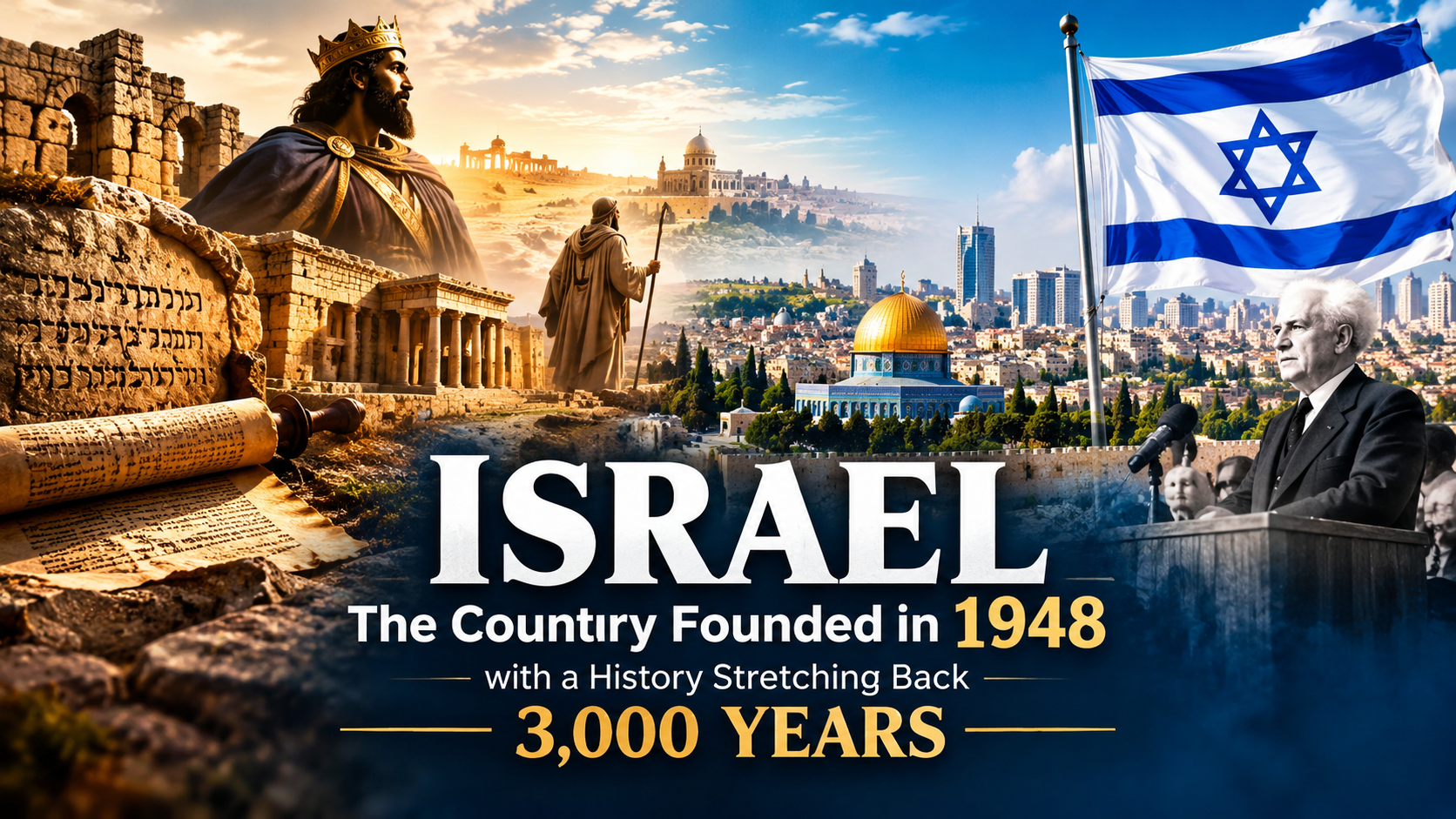
Israel Was Founded in 1948 — So Where Does the 3,000-Year Claim Come From? : On 14 May 1948, David Ben-Gurion declared the establishment of the State of Israel, shortly before the British Mandate for Palestine ended. This date marks the beginning of modern Israel as an independent state.
However, the region has a far older history. Ancient Israelite kingdoms emerged in the first millennium BCE, and Jerusalem became a major centre of political and religious life. Jewish communities maintained historical, cultural and religious connections with the land even during long periods when many Jews lived elsewhere.
The figure of 3,000 years is therefore a reference to ancient history and identity, rather than the age of the modern Israeli government or state.
The Ancient Kingdoms behind Modern Israel: The history associated with ancient Israel includes the kingdoms of Israel and Judah, which developed in the region during the first millennium BCE. Their stories appear in biblical texts and are also studied through archaeology and other historical evidence.
Jerusalem holds particular significance in Jewish history, while the wider region is deeply important to Christianity and Islam as well. Over the centuries, the land came under the control of several empires, including the Assyrians, Babylonians, Persians, Romans and Ottomans.
These changing rulers demonstrate that the region’s history cannot be reduced to a single kingdom, people or political identity. Different communities have lived there, built cities, developed religious traditions and maintained connections with the land.
What Happened Between Ancient Israel and 1948? : The period between ancient kingdoms and the establishment of modern Israel spans many centuries of political change.
Roman rule, the destruction of the Second Temple in Jerusalem in 70 CE, and subsequent developments contributed to major changes in Jewish life. Jewish communities continued to exist in the region, while others developed across Europe, North Africa and the Middle East.
Over time, the region became predominantly Arabic-speaking and was home to generations of Palestinian Arab Muslims and Christians, alongside Jewish communities and other groups. Ottoman rule lasted for centuries before the British took control following the First World War.
During the late nineteenth and early twentieth centuries, modern political Zionism grew, advocating the establishment of a Jewish national home. Jewish immigration increased, while Palestinian Arabs also developed their own national aspirations and opposed developments they viewed as threatening their political future and connection to the land.
The competing national movements, British policies, international diplomacy and growing violence shaped the events that led to 1948.
Why Is 1948 Such an Important Dates? : The establishment of Israel followed the United Nations partition proposal of 1947, which recommended separate Jewish and Arab states in the former British Mandate territory, with a special international arrangement for Jerusalem. Jewish leaders accepted the proposal, while Arab leaders rejected it.
Israel declared independence in May 1948, and war followed involving neighbouring Arab states and Palestinian Arab forces. The conflict brought about Israel’s establishment and expansion beyond the territory allocated to the proposed Jewish state under the partition plan.
For Israelis, independence is widely commemorated as the restoration of Jewish national self-determination. For Palestinians, the same period is remembered as the Nakba, meaning “catastrophe”, during which approximately 700,000 Palestinians fled or were expelled from their homes and became refugees.
Understanding both experiences is essential to explaining why the events of 1948 remain so significant and contested today.
Does Israel Really Have 3,000 Years of History? : The most accurate answer is that modern Israel dates from 1948, while the ancient history associated with the Jewish people and the kingdoms of Israel and Judah reaches back roughly 3,000 years.
These are two different historical claims. A modern state has defined institutions, borders, citizenship and a government. An ancient kingdom, by contrast, belongs to a different political era and cannot simply be treated as the same state continuing unchanged through every intervening century.
The land itself has an even longer history, with archaeological evidence of human settlement stretching back many thousands of years. Its past includes numerous peoples, cultures and political systems.
Final Thoughts: Israel’s story shows how the age of a country can mean different things depending on what is being measured. The modern State of Israel was established in 1948, but the historical, religious and cultural narratives connected with ancient Israel reach back around three millennia.
That distinction matters because history is not simply a question of dates. It also involves migration, identity, political power, religious tradition and the experiences of people whose stories sometimes overlap and sometimes conflict.
To understand Israel properly, it is necessary to recognise both its ancient historical connections and the complex events that led to the creation of the modern state — including the profound and continuing consequences for Palestinians.