

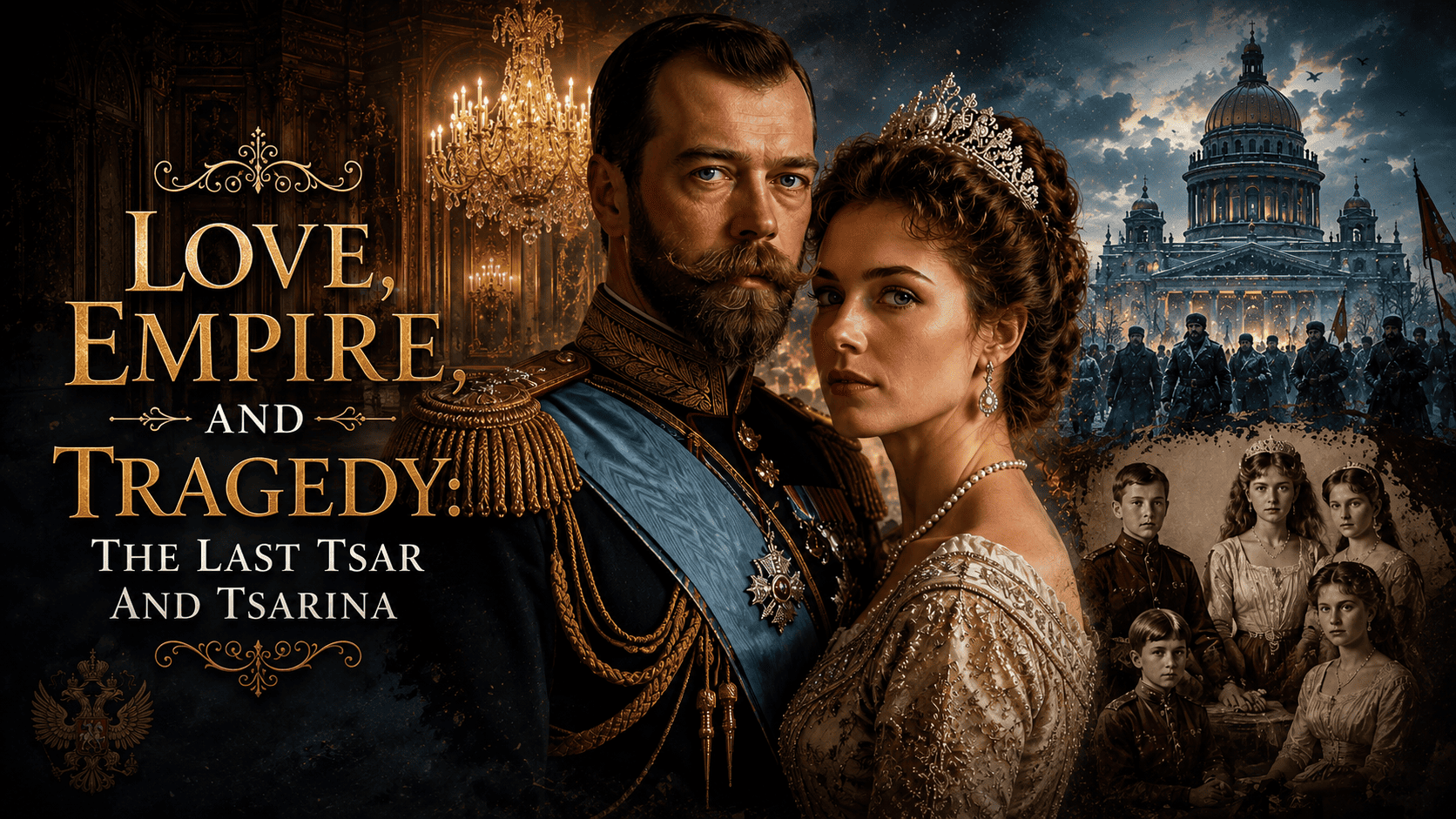
One of the most romantic, dramatic, and ultimately heartbreaking chapters in modern history: the story of Tsar Nicholas II and Empress Alexandra Feodorovna, the final rulers of Russia’s 300-year-old Romanov Dynasty.
Unlike typical dynastic matches arranged strictly for political leverage, their marriage is an absolute love match. Nicholas fell deeply in love with Alix of Hesse (a German princess and favorite granddaughter of Britain’s Queen Victoria) when they were teenagers. His parents initially opposed the match, preferring a French alliance, while Alix hesitated due to the requirement that she convert to Russian Orthodoxy. Yet Nicholas refused to entertain marrying anyone else, declaring he would rather become a monk than wed without love.
Part I:
- A Forbidden Romance : Long before Nicholas inherited the throne of the vast Russian Empire, he fell deeply in love with Princess Alix of Hesse, a granddaughter of Britain’s Queen Victoria.
- The Stumbling Blocks: Nicholas’s father, Tsar Alexander III, initially disapproved of the match, wanting his son to marry into French royalty for geopolitical alliance. Meanwhile, Alix was reluctant to convert from Lutheranism to Russian Orthodoxy.
- Love Prevails: Despite the pressure, Nicholas stood firm. In 1894, as Alexander III lay dying, the marriage was finalized. Alix converted, taking the name Alexandra Feodorovna.
They were utterly devoted to one another—a rarity in royal marriages of the era—writing passionate love letters in English and calling each other endearments until their final days.
Part II:
- The Weight of an Unyielding Crown: When Nicholas became Tsar in 1894 at age 26, he famously wept, confessing to a close friend: “I am not ready to be Tsar. I never wanted to become one. I know nothing of the business of ruling.”
- Key Challenges Facing the Couple: An Outdated Autocracy: Nicholas believed it was his sacred duty to maintain absolute autocratic power, resisting modern democratic reforms even as industrialization and social unrest swept across Russia.
- An Isolated Empress: Alexandra was deeply introverted, serious, and devout. Russian high society in St. Petersburg misread her shyness as coldness and arrogance, quickly turning the court against her.
Part III:
- The Secret Burden & The Mystic: The couple had four daughters—Olga, Tatiana, Maria, and Anastasia—before finally having a son, Alexei, the heir to the throne (Tsesarevich). However, Alexei inherited hemophilia through Queen Victoria’s lineage—a life-threatening blood disorder where even a minor bruise could cause fatal internal bleeding.
- Desperate Parents: To protect the monarchy and their son’s life, Nicholas and Alexandra kept Alexei’s condition a strict state secret.
- Enter Rasputin: Desperate to save her son, Alexandra turned to Grigori Rasputin, a Siberian peasant and self-proclaimed holy man who seemed uniquely able to calm Alexei and stop his bleeding episodes.
- Political Fallout: Rasputin’s massive influence over Alexandra—and by extension, government appointments while Nicholas was commanding troops during World War I—devastated the royal family’s reputation among the public and the nobility.
Part IV:
- The Downfall and Legacy: The combined weight of World War I, severe economic hardship, food shortages, and political paralysis culminated in the February Revolution of 1917.
- Abdication: Nicholas abdicated the throne in March 1917, ending three centuries of Romanov rule.
- Imprisonment: The imperial family was held under house arrest, first in Tsarskoye Selo, then exiled to Tobolsk, and finally taken to the Ipatiev House in Yekaterinburg.
- The Tragic End: On the night of July 17, 1918, in the midst of the Russian Civil War, Bolshevik forces executed Nicholas, Alexandra, their five children, and their remaining loyal servants in a basement room.