

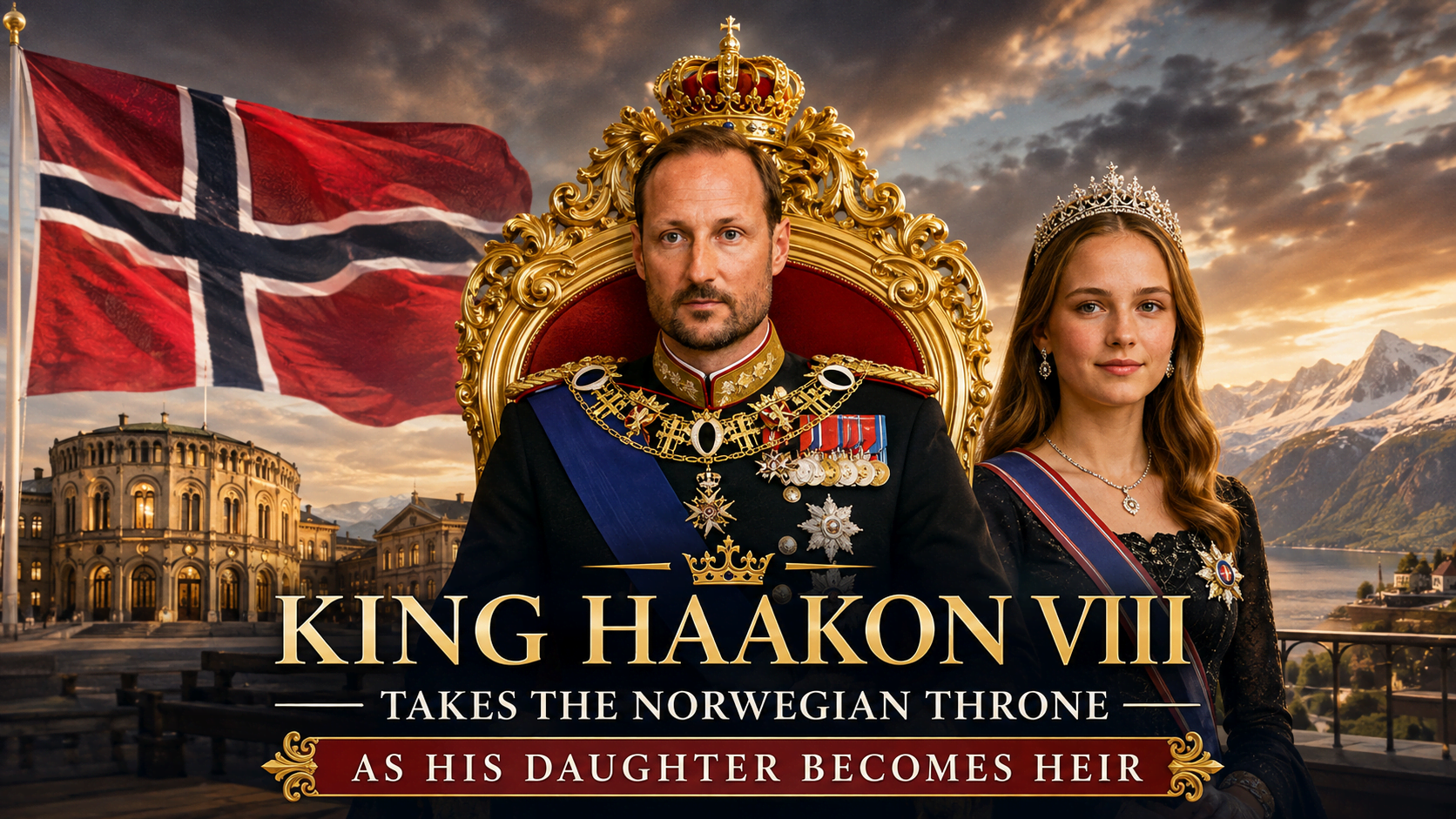
Norway has entered a remarkable new chapter in its royal history. Following the death of King Harald V, Crown Prince Haakon has succeeded to the throne as King Haakon VIII, while his eldest child, Princess Ingrid Alexandra, has become the new heir to the Norwegian Crown.
The moment shown in the image is particularly significant because it represents far more than a change of title. It marks the continuation of a constitutional monarchy built on tradition, democracy and the rule of law.
On 1 September 2026, King Haakon VIII took the constitutional Oath of Allegiance before the Storting, Norway’s Parliament. Under Norway’s Constitution, a monarch who succeeds to the throne must pledge to govern in accordance with the country’s Constitution and laws. The ceremony underlines an important point: the Norwegian King is not an absolute ruler but a constitutional head of state whose authority operates within the democratic framework of the nation.
A New King for a New Generation : Haakon’s accession brings another historic name back to the Norwegian throne. The title Haakon VIII follows the legacy of King Haakon VII, one of the most important figures in modern Norwegian history.
Yet the transition also carries a deeply personal dimension. The new King inherits not only the Crown but also the responsibility of representing a modern nation at moments of celebration, crisis and national reflection.
Norway’s monarchy has traditionally maintained a comparatively modest and approachable character, and the King’s oath before Parliament symbolises that the Crown remains connected to the democratic institutions of the country rather than standing above them.
Princess Ingrid Alexandra Becomes the New Heir : Standing beside this historic transition is Crown Princess Ingrid Alexandra, who is now next in line to the Norwegian throne.
Her position is especially important for the future. Norway’s succession rules give priority to the eldest eligible child under the modern system of succession, meaning that Ingrid Alexandra remains ahead of her younger brother in the line to the throne. If she eventually succeeds her father, she will become Norway’s first reigning queen for centuries.
This makes the present moment a genuine generational turning point: a new King has taken the throne, and the future Queen has moved into the position of heir apparent.
Why the Ceremony Before the Storting Matters : For some royal families, the image of a new monarch immediately brings thoughts of a lavish coronation. Norway follows a different path. The King’s appearance before the Storting is one of the most meaningful constitutional acts of the succession. The oath publicly confirms that the monarch accepts the limits and responsibilities established by the Constitution.
In simple terms, the ceremony sends a powerful message: “The Crown continues, but democracy remains supreme“.
King Haakon VIII’s accession was automatic upon the death of King Harald V, while the oath before Parliament formally expressed his commitment to uphold Norway’s Constitutional System.
A Historic Moment for Norway : The photograph therefore captures two generations of Norway’s Royal Future. At the centre is King Haakon VIII, beginning his reign during a period of national mourning and transition. Alongside him stands the future of the monarchy, Crown Princess Ingrid Alexandra, now the woman expected one day to inherit the Norwegian throne.
It is a moment shaped by history, family and constitutional tradition. One generation passes responsibility to the next, while Norway’s democratic institutions remain firmly at the heart of the monarchy.
King Haakon VIII has inherited the throne. Crown Princess Ingrid Alexandra has inherited the position of heir. And Norway has begun another historic chapter in the long story of its modern monarchy.