

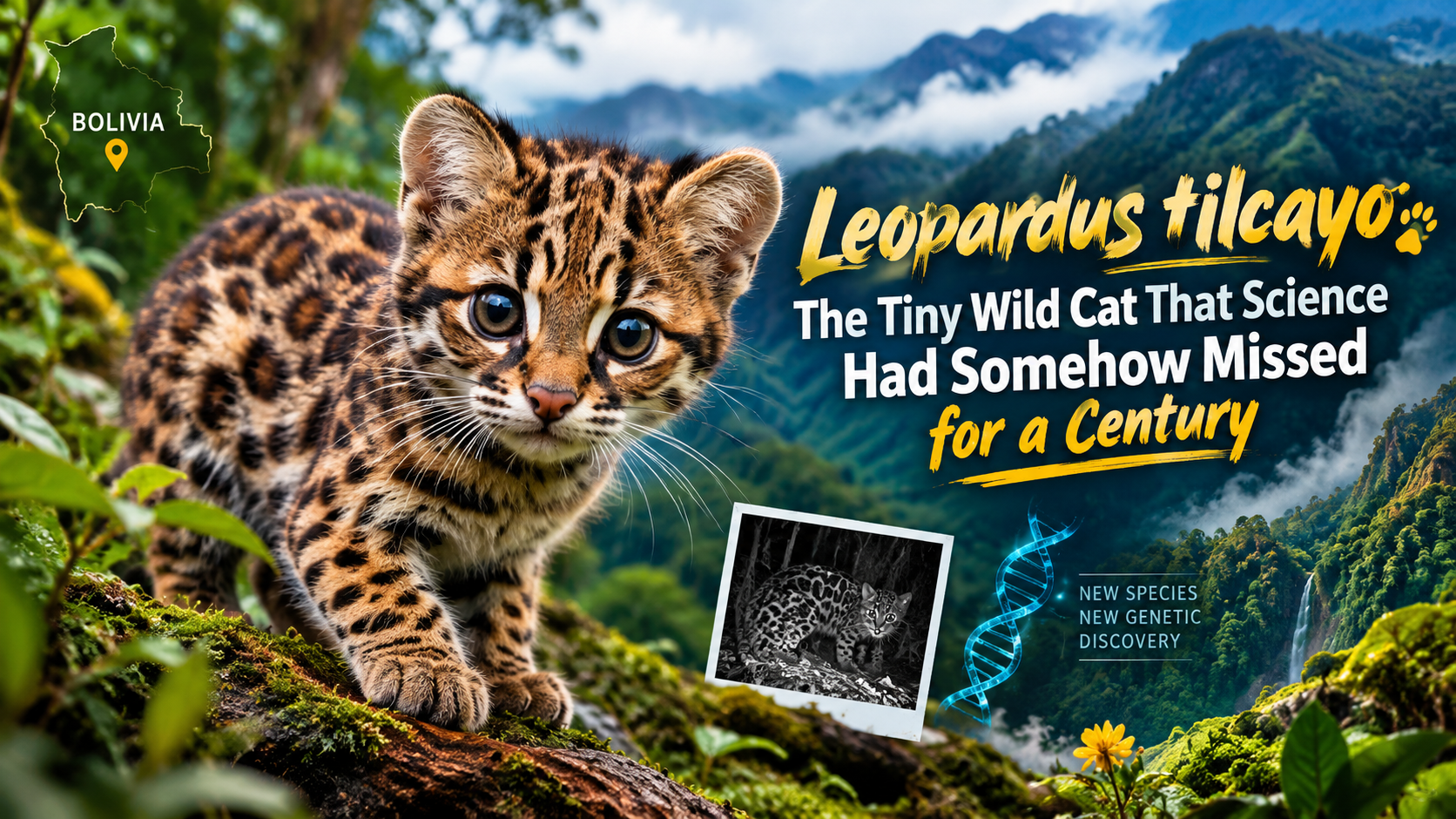
Deep in the misty Yungas cloud forests of Bolivia, scientists have identified a wild cat that looks almost as though someone shrank a leopard down to kitten size. Its scientific name is Leopardus tilcayo, and the discovery is being described as the first newly described living cat species in more than 100 years.
What makes the story even more fascinating is that this wasn’t simply a case of spotting an unfamiliar animal. Modern genetic science revealed that scientists had been underestimating the diversity of South America’s tiger cats.
Meet the Tilcayo: The tilcayo is a remarkably small wild feline. It is around 46 centimetres long and weighs roughly 1.4 kilograms, making it smaller than the average domestic cat. Its light-brown coat carries dark, irregular rosettes, while its rounded ears and distinctive facial features give it an unusually soft, almost teddy-bear-like appearance.
But beneath that adorable appearance is a genuine wild predator adapted to life in one of South America’s most complex mountain ecosystems.
The animal lives in the Bolivian Yungas, a humid cloud-forest region on the eastern slopes of the Andes, where the mountains meet the Amazon basin. This landscape is exceptionally rich in biodiversity, yet it is also increasingly affected by habitat loss, agriculture, fires and other human pressures.
The DNA Discovery That Changed the Story: The real breakthrough came through genetics. Researchers analysed genome data from 38 tiger cats and related specimens, including material from museum collections. Instead of representing one broadly distributed group, the animals revealed much greater genetic separation than scientists had previously recognised.
The research published in Current Biology concluded that South America’s tiger-cat complex contains five distinct species. One of those lineages is the newly recognised Leopardus tilcayo.
Genetic evidence indicates that the tilcayo lineage separated from its closest relatives roughly 1.4 million years ago. In other words, this isn’t simply a recently evolved cat hiding in the forest. Its evolutionary history stretches back deep into the Ice Age.
Why This Is Such a Big Scientific Deal?: New animal species are still being discovered regularly, but a new living species of cat is extraordinarily unusual.
The last newly described living feline species before the tilcayo was the pampas cat in 1923, according to reporting on the new study. That makes the formal recognition of Leopardus tilcayo a particularly notable moment in modern mammalogy and there’s an important distinction here.
Scientists did not merely take a known cat and give an existing subspecies a new name. The research identified the Bolivian animal as a previously unrecognised evolutionary lineage and formally described it as a species new to science.
The Mystery of “Tigrino”: The discovery has an intriguing human element too. In 2016, Bolivian biologist Paola Nogales-Ascarrunz encountered an unusual small cat at a wildlife refuge. At first, it appeared to be a tiger cat belonging to a species scientists already knew.
But something did not quite fit.
Its appearance, particularly its unusually large rosette markings, raised questions. Further investigation eventually led researchers towards genetic testing and, ultimately, the discovery of a completely separate species. The animal became known as “Tigrino”, and its story helped provide the crucial living evidence needed to investigate the mysterious lineage.
Remarkably, the only currently known living tilcayo is in protective care at Senda Verde Animal Refuge in Bolivia.
A Name from Local Knowledge: The scientific name Leopardus tilcayo also carries a connection to the people who live in the region.
“Tilcayo” was already a local name used for this type of cat. Rather than replacing that traditional designation, researchers retained it as the species’ common name. That detail is important because the animal wasn’t necessarily unknown to humans. It was unknown to formal science.
Local knowledge and modern genomics have therefore come together in an unusual scientific story: communities knew of the animal, while researchers had yet to establish that it represented a distinct species.
The Bigger Lesson: We Still Don’t Know Everything: Perhaps the most fascinating aspect of the tilcayo story is what it tells us about the natural world.
Scientists have sophisticated satellites, DNA sequencing, camera traps and enormous biological databases. Yet a small mammal living in a relatively accessible part of South America remained scientifically misidentified until recently.
The discovery suggests that biodiversity can be hidden not because an animal is invisible, but because closely related species can look remarkably similar. Genomics is now allowing researchers to uncover these hidden evolutionary boundaries and the implications go beyond taxonomy. If several animals previously treated as one species are actually different species, conservation assessments may need to change too. A species with a small geographic range could face very different risks from a much more widespread relative. Researchers have submitted information about the new species to the IUCN for consideration in future conservation assessments.
A New Species with an Uncertain Future: The discovery is exciting, but it also comes with a warning. The Bolivian Yungas is under pressure from deforestation, agriculture, fires and mining. Scientists still know surprisingly little about the tilcayo’s population size, behaviour and precise distribution.
That means discovering the species is only the beginning.
Before scientists can properly protect the tilcayo, they need to understand how many exist, where they live, what they eat, how they reproduce and how much suitable forest remains.
A Cat Hidden in Plain Sight: The story of Leopardus tilcayo is a reminder that scientific discovery does not always require exploring an untouched continent or finding a giant unknown creature. Sometimes, the breakthrough is a tiny spotted cat hiding among familiar relatives.
For more than a century, science had not formally named a new living cat species. Now, thanks to field observations, museum specimens and modern genome sequencing, the scientific record has gained a new member.
A little wild cat from Bolivia’s cloud forests has effectively reminded the world of something rather profound: Earth’s wildlife still has secrets left to reveal.