

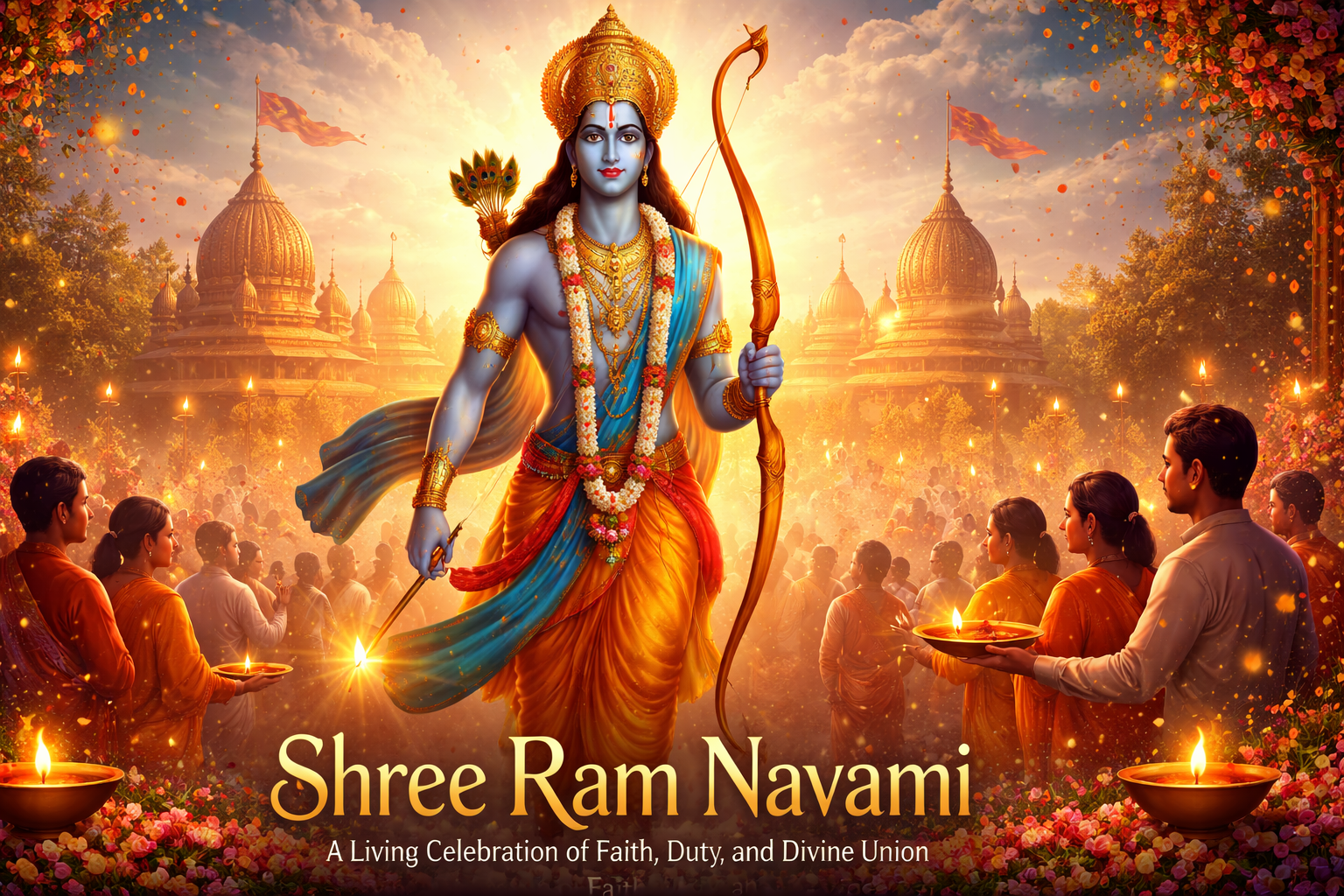
Shree Ram Navami is a deeply cherished Hindu festival marking the birth of Lord Rama, revered as the embodiment of righteousness, discipline, and ideal kingship. Celebrated with devotion across India, Nepal, and the wider Hindu world, the festival falls on the ninth day (Navami) of the bright half of the lunar month of Chaitra, usually in March or April. More than a simple remembrance of a divine birth, it is a reaffirmation of moral order and timeless values.
Whom and What Do We Credit? : The essence of Shree Ram Navami is rooted in the ancient epic, the Ramayana, traditionally attributed to the sage Valmiki. It narrates the life of Lord Rama, an incarnation of Lord Vishnu, who descended to restore balance in a world troubled by injustice and tyranny.
Rama is credited not merely as a warrior or king, but as Maryada Purushottam—the supreme upholder of duty and honour. His life reflects the ideals of truthfulness, loyalty, compassion, and responsibility. Devotees also honour Queen Kaushalya, his mother, and King Dasharatha, whose prayers and sacrifices led to Rama’s birth.
When and How Is It Observed? : Shree Ram Navami is observed on the ninth day of Chaitra’s waxing moon. The day typically begins with ritual bathing, followed by prayers, chanting of sacred texts, and fasting. Temples dedicated to Lord Rama are adorned with flowers and lights. Devotees gather to recite passages from the Ramayana, sing devotional hymns, and participate in processions. In places such as Ayodhya, believed to be Rama’s birthplace, grand celebrations unfold with special significance.
Many people observe a fast until noon, the moment believed to mark Rama’s birth. At that sacred hour, bells ring, conch shells are blown, and the atmosphere becomes one of joyous reverence.
Why Is It Still Celebrated Today? : In an ever-changing world, Shree Ram Navami continues to hold relevance because it represents values that transcend time. Lord Rama’s life is seen as a guide for ethical living—balancing duty with compassion, power with humility, and justice with mercy.
The festival serves as a moral compass, especially in societies seeking stability and harmony. It reminds individuals of the importance of integrity in both personal and public life. For many, it is not merely religious—it is cultural, philosophical, and deeply personal.
What Do People Do on This Day?
The day is marked by a blend of devotion and community spirit:
- Visiting temples and offering prayers.
- Reading or listening to the Ramayana.
- Participating in bhajans (devotional singing).
- Observing fasts and preparing simple, sattvic meals.
- Organising processions and cultural programmes.
- Acts of charity, such as distributing food to the needy.
In Nepal, especially in Janakpur and other sacred sites, the celebrations carry a distinctive local flavour, blending tradition with regional customs.
Why Do Some People Marry on Ram Navami? : An interesting cultural aspect of Shree Ram Navami is the belief that it is an auspicious day for marriage. This stems from the association of Lord Rama and Goddess Sita as the ideal divine couple.
Although their wedding is traditionally celebrated on Vivah Panchami, many still choose Ram Navami for weddings because:
- It symbolises purity, harmony, and commitment.
- The divine presence of Rama is believed to bless new beginnings.
- The day is considered astrologically favourable in many traditions.
- Couples marrying on this day often seek a relationship grounded in mutual respect, duty, and enduring love—qualities exemplified by Rama and Sita.
Conclusion: Shree Ram Navami is far more than a festival; it is a reflection of enduring ideals that continue to shape lives and communities. Through prayer, celebration, and thoughtful remembrance, people reconnect with values that offer guidance in both ordinary and extraordinary moments.
In honouring the birth of Lord Rama, devotees are, in essence, celebrating the possibility of righteousness within themselves—a timeless message that resonates across generations.