

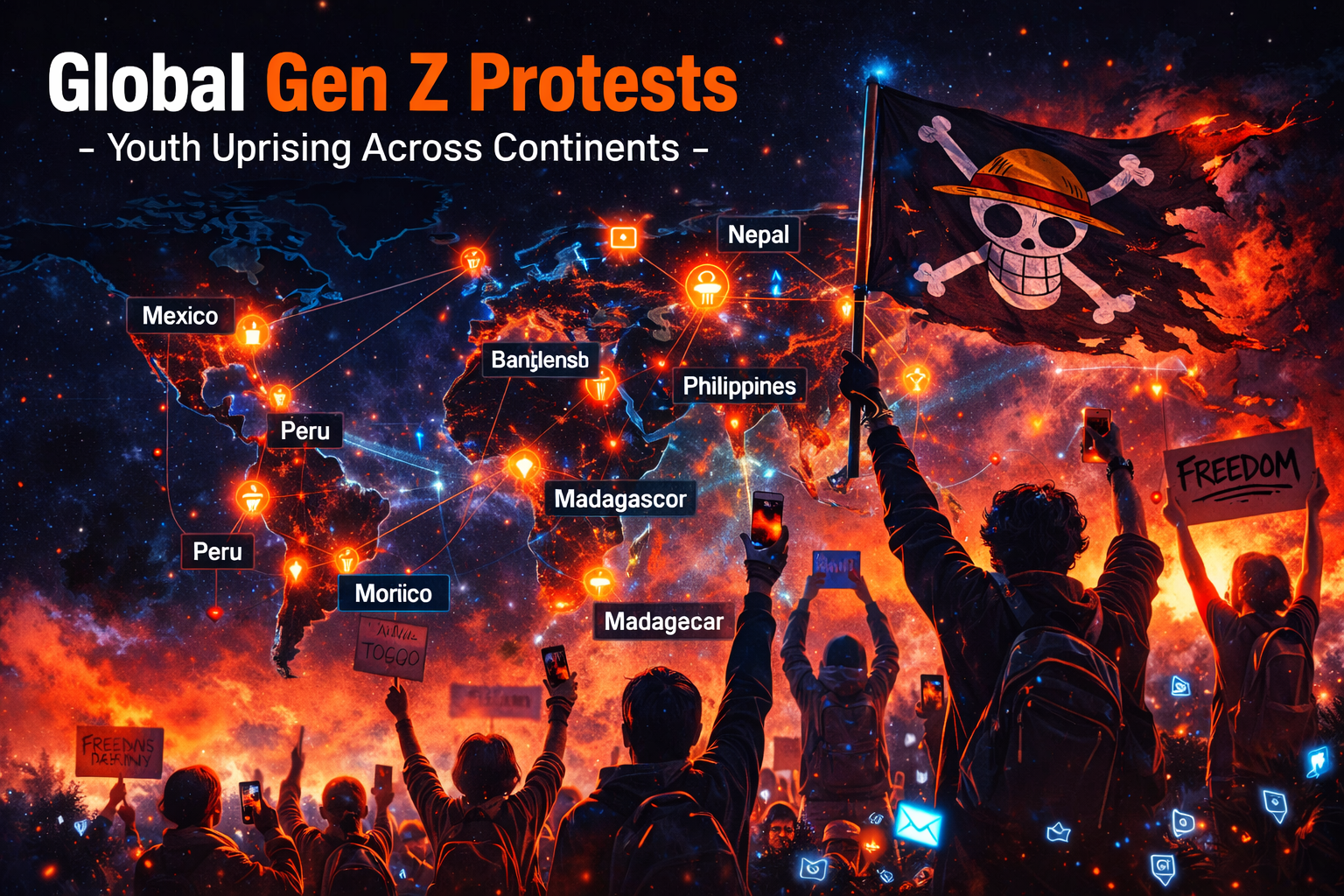
During the early 2020s, a new wave of youth-led political movements began emerging around the world. These movements are widely known as Generation Z protests, led mainly by people born between 1997 and 2012.
Unlike previous protest movements, these demonstrations are highly organised through social media platforms such as TikTok, Instagram, and Telegram. Many protests have also adopted the pirate flag from One Piece as a shared symbol of rebellion against corruption and authoritarian power.
The phenomenon has spread across several continents, from Asia and Africa to Latin America, with young people demanding political reform, economic fairness, and greater government accountability.
Below is a list of major countries where Gen Z protests have occurred, along with their timeline, causes, and current situation.
Countries Where Gen Z Protests Emerged
- Nepal: Started on September 2025
- Story: Youth protests erupted in Nepal after the government imposed restrictions on social media platforms and was accused of corruption and limiting freedom of expression. Thousands of young demonstrators gathered in Kathmandu and other cities demanding political reform and transparency.
- Outcome / Situation Now: The protests became one of the largest youth uprisings in the country and eventually contributed to the resignation of the prime minister and political reforms being discussed.
- Sri Lanka: Started on March–July 2022
- Story: In Sri Lanka, economic collapse caused severe shortages of fuel, food, and electricity. Young protesters occupied public spaces and organised demonstrations demanding accountability from the Rajapaksa government.
- Outcome / Situation Now: The protests forced President Gotabaya Rajapaksa to flee the country and resign, marking one of the most dramatic youth-led political upheavals in recent history.
- Bangladesh: Started on Summer 2024
- Story: Students in Bangladesh began protesting against corruption in civil-service recruitment and political authoritarianism. The demonstrations quickly escalated into a nationwide anti-government movement.
- Outcome / Situation Now: Prime Minister Sheikh Hasina resigned and fled the country, while an interim government was formed to stabilise the political system.
- Indonesia: Started on August 2025
- Story: In Indonesia, students protested against rising living costs and increases in government officials’ allowances. These demonstrations were among the first where protesters widely displayed the One Piece pirate flag as a protest symbol.
- Outcome / Situation Now: The protests pressured the government to replace several ministers and reconsider economic policies.
- Philippines: Started on September 2025
- Story: Youth protesters in Philippines marched against corruption involving billions of pesos in climate-related flood control projects. Tens of thousands of young people gathered in Manila demanding accountability.
- Outcome / Situation Now: The protests forced the resignation of a senior parliamentary leader and triggered investigations into corruption.
- Madagascar: Started on September–October 2025
- Story: Students and young activists in Madagascar protested against chronic shortages of water and electricity. Demonstrations spread across major cities and became highly politicised.
- Outcome / Situation Now: The unrest eventually led to the president leaving the country and the military taking power temporarily.
- Morocco: Started on September 2025
- Story: In Morocco, youth protests erupted over unemployment, poor public services, and government spending on infrastructure for the 2030 FIFA World Cup rather than healthcare and education.
- Outcome / Situation Now: Authorities responded with a crackdown, arresting thousands of protesters and bringing criminal charges against many participants.
- Peru: Started on October–November 2025
- Story: Young protesters in Peru organised demonstrations against rising crime, economic instability, and corruption. The movement quickly expanded nationwide.
- Outcome / Situation Now: The protests remain politically significant, with calls for pension reforms, better wages, and stronger government accountability.
- Mexico: Started on November 2025
- Story: In Mexico, Gen Z protests were triggered by the assassination of a local mayor and growing anger over drug-related violence and corruption.
- Outcome / Situation Now: Clashes between protesters and police occurred in several cities, leaving over 100 people injured, while the government accused political actors of manipulating the movement.
- Paraguay: Started on September–October 2025
- Story: Youth protests in Paraguay demanded the removal of officials and protested corruption and policy decisions affecting Indigenous communities.
- Outcome / Situation Now: The government reversed controversial policies and removed a senior official after several days of demonstrations.
Total Countries With Major Gen Z Protest Movements: Based on recent reports, at least 10 countries have experienced significant Gen Z protest movements. Countries with Major Gen Z Protest Movements:
Asia
- Sri Lanka – Economic crisis protests (2022)
- Bangladesh – Student uprising against quota system (2024)
- Philippines – Youth protests against corruption (2025)
- Nepal – Youth-led antigovernmental demonstrations (2025)
Africa
- Madagascar – Protests over power and water shortages (2025)
- Morocco – Gen Z 212 protests demanding reforms (2025)
- Togo – Youth protests over constitutional issues (2025)
Latin America
- Peru – Protests over insecurity and political instability (2025)
- Mexico – Youth protests triggered by political violence (2025)
- Paraguay – Demonstrations demanding anti-corruption reforms (2025)
These youth-driven protests spread across Asia, Africa, and Latin America, often organized through social media and driven by issues like corruption, unemployment, inequality, and political instability. These protests span Asia, Africa, and Latin America, showing a growing global trend of youth political activism.
Conclusion: The rise of Gen Z protests marks a shift in global political engagement. Young people are no longer passive observers but active participants demanding systemic change. Using social media networks and cultural symbols such as the flag from One Piece, these movements have created a shared identity across borders.
While each country faces different issues—ranging from corruption and unemployment to economic crises—the core message of Gen Z protesters remains the same: a demand for transparency, fairness, and a future shaped by the voices of the younger generation.




hello world
hello world