

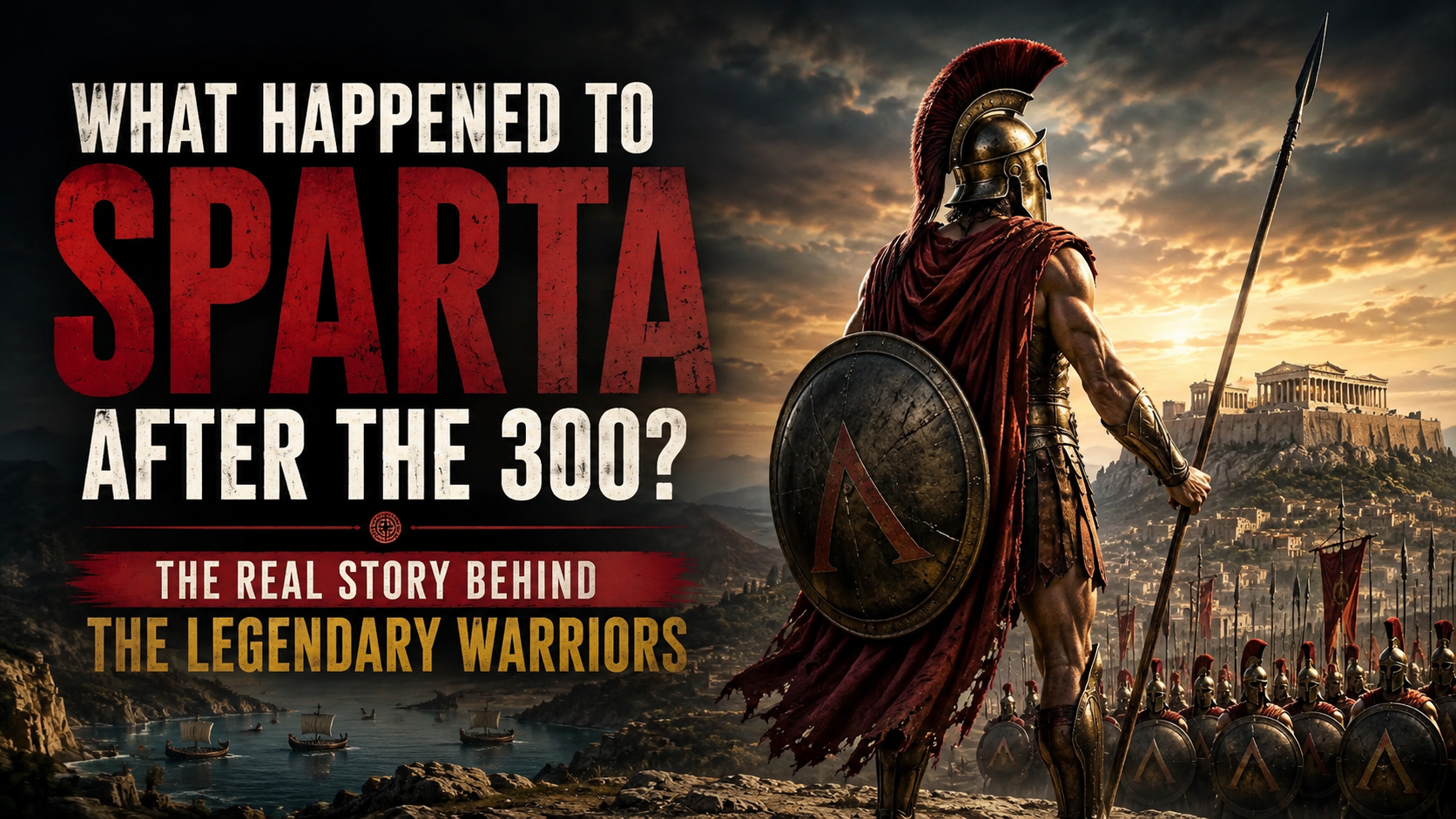
The story of the 300 Spartans is one of history’s most powerful tales of courage. A small force, led by King Leonidas, stood against the enormous Persian army at the Battle of Thermopylae in 480 BC. But the famous last stand was not the end of Sparta’s story.
So, what actually happened to Sparta after the 300 died? The answer is far more complicated than the films.
The 300 Were Gone, But Sparta Was Not Defeated: King Leonidas and his famous warriors died at Thermopylae, but their sacrifice bought valuable time for the rest of the Greek forces to prepare.
It is also important to remember that Leonidas did not fight entirely alone. Other Greek soldiers, including Thespians and Thebans, were present during the final stages of the battle. The legend of the “300” became famous because the Spartan warriors represented the military reputation and discipline of Sparta.
After Thermopylae, the Persian army continued south. For a moment, it appeared that Persia might conquer all of Greece.
Athens Was Destroyed, But the Greeks Continued Fighting: The Persian forces marched deeper into Greece and captured Athens. Much of the city was destroyed after many Athenians had already evacuated. However, the Greek alliance was not finished.
Themistocles and the Athenian navy played a crucial role in convincing the Greek forces to fight at sea. Later in 480 BC, the Greeks achieved a decisive victory against the Persian fleet at the Battle of Salamis. This was a major turning point. The massive Persian invasion had begun to lose momentum.
Sparta Returned to the Battlefield: Although Sparta lost King Leonidas, it remained one of the strongest military powers in Greece. The Spartans reorganised and continued fighting alongside other Greek city-states. The following year, in 479 BC, a united Greek army confronted the remaining Persian forces at the Battle of Plataea.
Spartan commander Pausanias played a leading role in the Greek victory. The Battle of Plataea effectively ended the main Persian invasion of mainland Greece. In other words, the sacrifice at Thermopylae was not a final defeat. It became part of a much larger war that eventually ended with a Greek victory.
Sparta Became Even More Famous After the Persian Wars: The death of Leonidas created a legend. For generations, Sparta was remembered as the city whose warriors chose death rather than surrender. Their military culture became famous throughout the ancient world.
Spartan society was built around discipline, obedience and military training. Spartan boys entered the demanding agoge system, where they were trained to become soldiers and citizens of the state. But beneath the image of perfect warriors, Sparta had serious weaknesses.
Its society depended heavily on the labour of the helots, an oppressed population forced to work the land. Sparta’s military strength was also difficult to maintain because its population of full Spartan citizens gradually declined. The legend was powerful. The reality was more complicated.
Sparta Later Fought Athens in the Peloponnesian War: After the Persian threat faded, the old alliance between the Greek city-states began to fall apart. Sparta and Athens became rivals.
Athens developed into a powerful naval empire, while Sparta remained the dominant land-based military power. Their competition eventually led to the long and devastating Peloponnesian War.
The war lasted from 431 BC to 404 BC. Eventually, Sparta defeated Athens. For a brief period, Sparta became the leading power in Greece. It was perhaps the greatest political and military success in Spartan history.
But Sparta’s Golden Age Did Not Last: Winning the Peloponnesian War did not secure Sparta’s future. The city-state became involved in conflicts across Greece and struggled to maintain its military dominance. Sparta also faced the growing power of Thebes. Then came one of the most important moments in Spartan history.
In 371 BC, the Spartan army suffered a devastating defeat at the Battle of Leuctra against Theban forces led by Epaminondas. For centuries, Sparta’s army had been considered nearly unbeatable.Leuctra shattered that reputation.
Thebes later invaded Spartan territory and helped free many of the helots who had supported Sparta’s economy for generations. Sparta survived—but it never fully recovered its former dominance.
What Became of Sparta?: Sparta did not disappear immediately after the age of Leonidas. It continued to exist for centuries, experiencing periods of victory, power, decline and political change. Eventually, like the rest of Greece, it fell under the influence of larger powers, including Macedonia and later Rome. But Sparta’s greatest legacy was never its empire. It was its reputation.
The story of Leonidas and the 300 transformed Sparta into something larger than an ordinary ancient city-state. Their stand at Thermopylae became a symbol of resistance, sacrifice and courage against overwhelming odds.
The Legacy of the 300: The real story is perhaps more remarkable than the simplified legend. The 300 did not save Greece alone. They were part of a wider Greek resistance involving many city-states, soldiers and naval forces. Yet their final stand became the emotional symbol of the entire conflict.
Sparta survived the 300. It fought again. It defeated Athens. It ruled Greece for a time. Then, slowly, the city that had built its identity around military supremacy discovered that even the strongest warriors could not defeat history forever.
The 300 died at Thermopylae. But the story of Sparta continued for centuries—and eventually became one of the greatest legends ever inherited from the ancient world.