

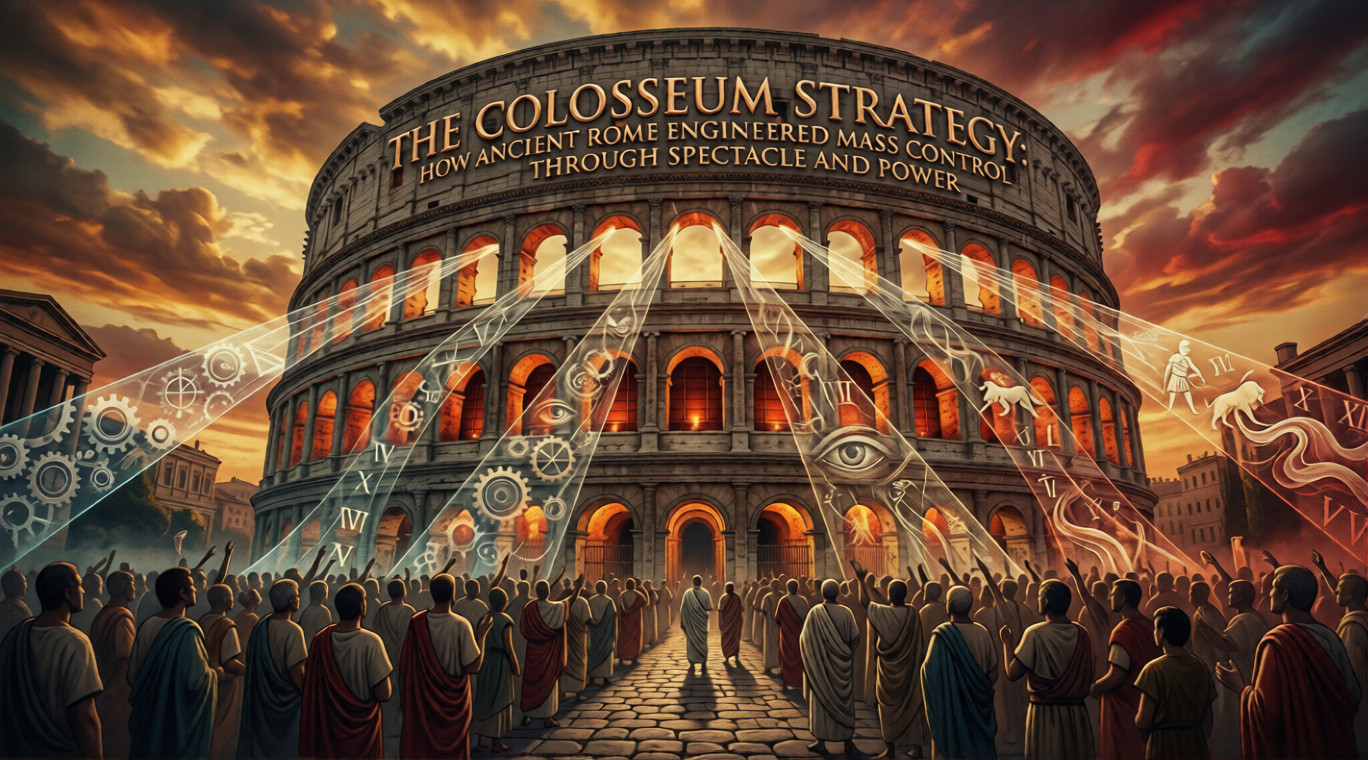
Most people picture the Colosseum as the ancient world’s grand arena of spectacle — roaring crowds, gladiators clashing, lions pacing beneath the sun. It’s the sort of image that feels almost cinematic. But the truth is rather less straightforward, and far more telling about the society that built it.
The Colosseum wasn’t just about entertainment. In fact, to describe it that way is a bit like calling a modern parliament building “a place for chatting.” Technically true, but it misses the point entirely.
Power, Not Pastime: When construction began under Emperor Vespasian around 70 AD, Rome was emerging from a period of political chaos. The empire needed stability — or at least the appearance of it. And what better way to demonstrate control than through something vast, permanent, and unmistakably public?
The Colosseum was, in essence, a statement: Rome is back, and Rome is in charge.
Funding came largely from spoils of war, particularly from the Roman victory in Judea. So even before the first stone was set, the building itself was already tied to dominance and conquest. It wasn’t merely a venue; it was propaganda in stone.
The Crowd as a Tool: Yes, there were games — gladiatorial contests, animal hunts, staged battles. But these events weren’t organised purely for amusement. They were carefully orchestrated displays designed to reinforce social order. The emperor sat above, the elite nearby, and the masses below. Everyone knew their place. The spectacles reinforced that hierarchy in a way no speech ever could.
There’s also the well-known Roman approach of “bread and circuses” — keeping the population content with food and distraction. But it wasn’t about generosity. It was about control. A well-fed, entertained public is far less likely to question authority.
Violence with a Message: The brutality inside the Colosseum wasn’t incidental — it was the point. Executions, for instance, were often staged as part of the programme. Criminals might be killed in elaborate re-enactments of myths.
It sounds grotesque to modern sensibilities, but to the Romans, it reinforced justice, power, and consequence. The state didn’t just punish — it performed punishment.
Engineering Prestige: Even the architecture tells a story. The Colosseum could hold tens of thousands, featured complex underground systems, and had retractable awnings to shield spectators from the sun. It was a marvel of engineering. But again, this wasn’t innovation for comfort alone. It was a demonstration: Rome could bend nature, organise chaos, and build on a scale no rival could match.
So, Was It Entertainment?: In part, yes — people did go there to watch, to cheer, to be swept up in the spectacle. But reducing the Colosseum to “entertainment” is like calling a crown “just a hat.” It was theatre, certainly. But it was also politics, intimidation, social structure, and imperial messaging — all rolled into one immense, enduring structure.
And perhaps that’s what makes it so fascinating today. Not the fights or the crowds, but the realisation that behind every roar of approval was a carefully managed system, designed to keep an empire exactly where it wanted to be.