

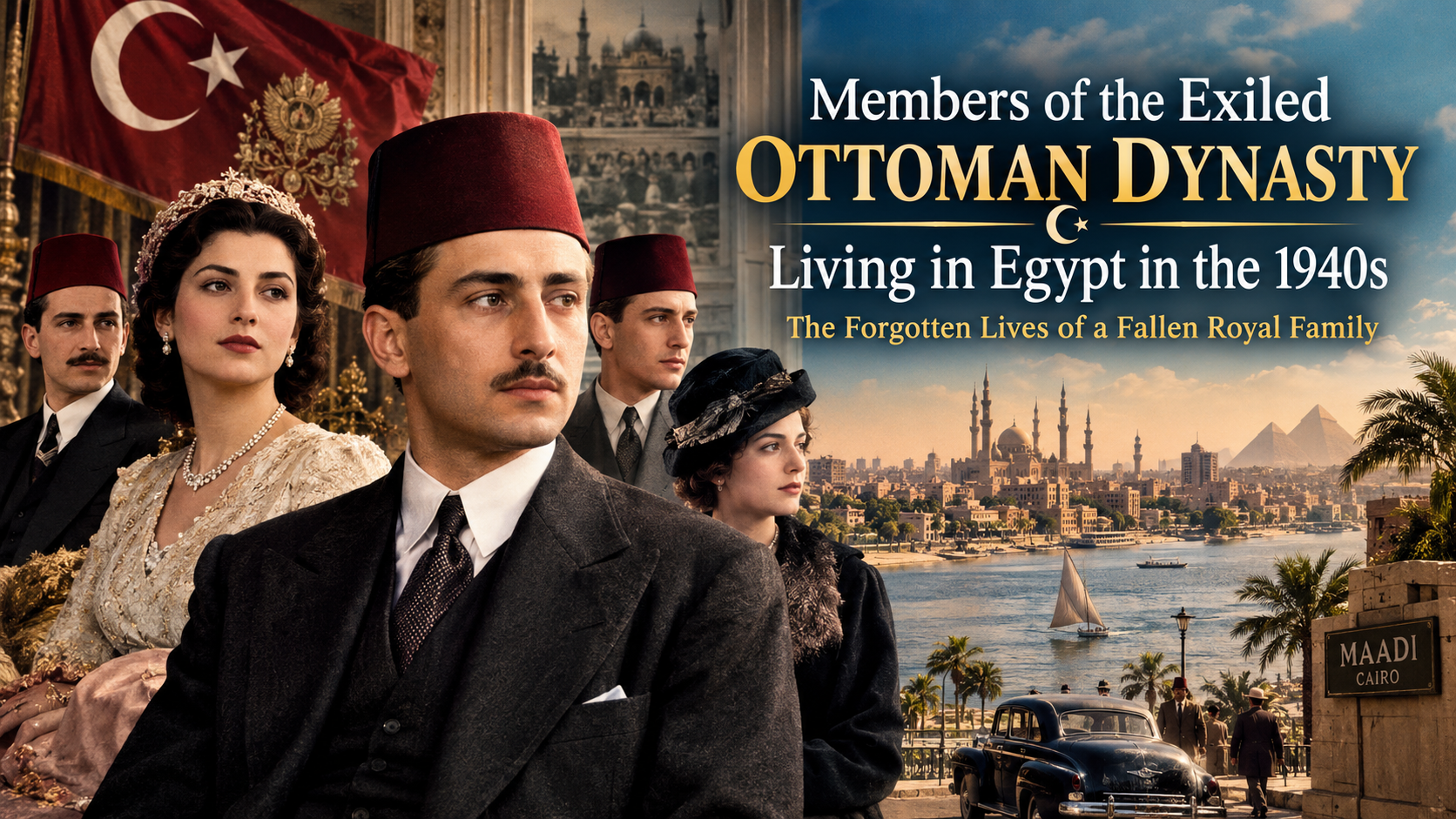
The 1940s were a remarkable period in the history of the Middle East. While the world was engulfed in the Second World War, members of one of history’s most powerful royal dynasties were trying to rebuild their lives far from the palaces, ceremonies and imperial authority their ancestors had once enjoyed.
These were the exiled members of the Ottoman dynasty, the family that had ruled the Ottoman Empire for centuries. After the Turkish Republic abolished the sultanate in 1922 and ordered the imperial family into exile in 1924, some Ottoman princes and princesses eventually found refuge in Egypt, particularly in Cairo and Alexandria.
Egypt offered more than a place to live. Its cultural connections with the former empire, established communities and royal connections made it an important destination for displaced aristocrats. Yet, despite their distinguished ancestry, these exiles had to adjust to a world in which their royal titles no longer carried the political power they once had.
Their story is one of lost privilege, family loyalty, cultural identity and the struggle to preserve a royal heritage after the end of an empire.
Why Were Ottoman Princes and Princesses Forced into Exile? : To understand why Ottoman royals were living in Egypt during the 1940s, we must return to the collapse of the Ottoman Empire.
For centuries, the Ottoman dynasty had governed a vast territory spanning parts of Europe, Asia and Africa. The sultan was not merely a monarch but also, for much of the empire’s later history, a figure associated with the Islamic caliphate.
However, the empire weakened during the nineteenth and early twentieth centuries. Its defeat in the First World War accelerated the crisis, while the Turkish nationalist movement led by Mustafa Kemal Atatürk established a new political order.
In November 1922, the Ottoman sultanate was abolished. The caliphate followed in March 1924, when the new Turkish Republic ordered members of the imperial dynasty to leave the country.
According to historical accounts, 156 members of the dynasty were directly affected by the 1924 exile measures. Their departure scattered the family across Europe and the Middle East. Some settled in France, Italy and Lebanon, while others eventually made their homes in Egypt.
For these individuals, exile meant much more than leaving their birthplace. They were separated from familiar homes, possessions, social networks and the country that had once placed their family at the centre of political life.
Why Did Egypt Become a Home for the Exiled Ottoman Dynasty? : Egypt was a natural destination for some Ottoman exiles because it had deep historical connections with the Ottoman world. Although Egypt had become a British-controlled protectorate in 1914 and formally gained independence in 1922, it retained its own monarchy under the Muhammad Ali dynasty. Cairo remained an important centre of education, diplomacy, commerce and Islamic scholarship.
Alexandria, meanwhile, was a cosmopolitan Mediterranean city where people from different countries and backgrounds lived alongside one another.
These circumstances helped some displaced Ottoman royals establish new lives. The presence of an Egyptian king and a socially prominent aristocracy also meant that royal ancestry remained familiar within certain circles.
One important example was Şehzade Ömer Hilmi, a son of Sultan Mehmed V. After the 1924 exile, he lived in several places, including Beirut and Nice, before settling in Alexandria, where he died in 1935. His family connections continued into the following decade.
Egypt was therefore not simply a temporary stopping point for every exile. For some, it became a permanent home, even as memories of Istanbul and the vanished empire remained part of family life.
The Important Ottoman Royals Who Lived in Egypt during the 1940s: Several members of the former imperial family became part of Egypt’s small but distinctive Ottoman émigré community. Their experiences differed, but they shared a connection to a dynasty that had lost its throne.
1. Prince Ömer Faruk Efendi (1898–1969): Ömer Faruk, a son of the last Ottoman caliph, Abdülmecid II, became a prominent figure among the exiled dynasty in Egypt. After arriving from southern France, he settled with his wife, Sabiha Sultan, in Maadi, a leafy suburb of Cairo.
Historical accounts describe him as an influential figure within the Ottoman community in exile. Although he no longer possessed imperial authority, his family position made him an important link between the scattered descendants of the former ruling house.
2. Prince Şehzade Mahmud Namık (1913–1963): Mahmud Namık was a grandson of Sultan Mehmed V and the son of Şehzade Ömer Hilmi. His family eventually settled in Egypt after spending time in Lebanon and France.
By the early 1940s, he was living with his wife in Maadi, Cairo. Their son, Ömer Abdülmecid, was born in Alexandria in 1941.
Mahmud Namık’s later life included political controversy and imprisonment under Egypt’s republican government, although those events took place after the decade covered here. His story illustrates how the descendants of a deposed dynasty could remain entangled in the politics of their adopted country.
3. Prince Şehzade Mahmud Şevket (1903–1973): Mahmud Şevket, a grandson of Sultan Abdülaziz, also settled in Cairo after the 1924 exile. His home became a meeting place for Turks living in Egypt, including students and intellectuals. He was connected with religious scholars and prominent visitors, demonstrating that the exiles’ lives were not limited to family gatherings or memories of palace life.
His experience offers a glimpse of how Cairo became a centre of social and cultural connections for some displaced Ottoman figures.
Other members of the extended dynasty and their relatives also lived in Egypt. Their circumstances varied, and not every Ottoman prince or princess enjoyed the same level of financial security or social influence.
Life in Maadi – A Small Ottoman World within Cairo: One of the most fascinating aspects of this history is the role played by Maadi, a residential suburb south of central Cairo.
During the 1940s, Maadi was known for its greenery, villas and international residents. Within this setting, members of the Ottoman dynasty established homes and maintained relationships with other Turkish-speaking and Ottoman-connected families.
The area offered a degree of privacy away from the pressures of public life. Family visits, social gatherings and friendships helped preserve a sense of community among people who had once belonged to an imperial establishment.
The Ottoman presence in Maadi was not entirely isolated from Egyptian society. The community interacted with local residents, Egyptian aristocrats and people with Turkish-Ottoman family backgrounds.
Yet it would be misleading to imagine that the exiles recreated the Ottoman court in its former glory. They could preserve customs, relationships and memories, but they could not restore the political system that had sustained their ancestors.
Maadi’s history provides an unusually vivid example of how displaced elite attempted to maintain its identity in a new home.
Did the Exiled Ottoman Royals Still Live Like Kings? : The answer was complicated. Some members of the dynasty retained valuable social connections and could live comfortably, at least for a time. Others faced financial uncertainty, dependence on relatives or the difficulty of rebuilding their lives abroad.
Their former titles still carried symbolic significance within royal and aristocratic circles, but they no longer guaranteed wealth, influence or security.
The contrast was striking. Their parents and grandparents had lived within a political system built around palaces, imperial appointments and court traditions. The younger generation had to find its place in a world of republics, modern national identities and changing political loyalties.
Some maintained close links with other exiles. Others adapted to local life, pursued private interests or moved between countries in search of stability.
The experience was not identical for every individual. Nevertheless, exile transformed the meaning of royal identity: ancestry remained, but the power once attached to it had largely disappeared.
Egypt during the Second World War – An Uncertain Place of Refuge: Egypt during the 1940s was not an untouched sanctuary. The country was strategically important to Britain and the Allied war effort, particularly because of the Suez Canal and the routes connecting Europe, Africa and Asia. Military activity and international political tensions affected everyday life.
Cairo and Alexandria were also meeting places for diplomats, soldiers, foreign residents and displaced European royalty. Alexandria, in particular, welcomed several European royal figures during and after the war, including members of the Greek royal family.
For the Ottoman exiles, this international environment offered opportunities to maintain relationships and remain connected with events beyond Egypt. But it also meant that they were living in a region where political circumstances could change rapidly.
Their position was unusual: they belonged to a dynasty that had once governed an empire, yet they were now residents of a country with its own monarchy, its own political interests and a complicated relationship with British influence. Egypt provided a home, but it could not restore the world they had lost.
The Difference between Ottoman Exiles and Egypt’s Own Royal Family: It is important to distinguish the exiled Ottoman dynasty from Egypt’s ruling royal house.
Egypt was ruled during the 1940s by King Farouk, who belonged to the Muhammad Ali dynasty. The Ottoman princes and princesses living in Egypt were members of a different family, displaced after the abolition of the Ottoman sultanate.
Although both dynasties had historical connections, they did not share the same political status.
The Egyptian monarchy remained in power until the revolution of 1952, when Farouk abdicated and went into exile. The Ottoman dynasty, by contrast, had already lost its throne decades earlier.
This distinction helps explain why Egypt could offer refuge to former Ottoman royals while maintaining its own monarchy. The Ottoman exiles were not rulers of Egypt, nor did their presence mean that the Ottoman Empire was being restored.
Instead, they formed part of a wider international community of displaced aristocrats whose former positions had been swept away by political change.
What Happened to the Ottoman Dynasty After the 1940s? : The end of the Second World War did not bring the Ottoman Empire back into existence. The dynasty’s members continued to live across several countries, building new lives while maintaining family connections.
A further turning point came in 1952, when Egypt’s monarchy was overthrown. This changed the political environment for royal families and aristocrats who had found a home there.
Some members of the Ottoman diaspora remained in Egypt, while others eventually relocated elsewhere. Mahmud Namık’s later imprisonment and the departure of Mahmud Şevket after the Egyptian revolution illustrate the difficulties that could arise as the political landscape changed.
Over subsequent decades, members of the Ottoman family pursued careers, raised families and lived increasingly ordinary lives outside the political structures of the old empire.
The exile did not erase their ancestry, but it permanently changed how that ancestry shaped their daily existence.
Conclusion: The Forgotten Ottoman Royals of 1940s Egypt. The story of the exiled Ottoman dynasty in Egypt is more than a tale of princes and princesses who lost their palaces. It is a window into the enormous political changes that reshaped the Middle East during the first half of the twentieth century.
In Maadi and other Egyptian communities, former Ottoman royals attempted to preserve family traditions, friendships and a sense of belonging. Figures such as Ömer Faruk Efendi, Mahmud Namık and Mahmud Şevket show how the dynasty’s history continued long after its political authority had ended.
Their experiences remind us that the fall of an empire does not end the lives of the people who once belonged to it. Instead, its consequences follow families across borders and generations.
By the 1940s, the Ottoman Empire was a memory, but its descendants were still living, working and raising families in Egypt. Their story captures a remarkable historical transition: from the imperial courts of Istanbul to the quieter streets of Cairo, where a fallen dynasty tried to find a place in a rapidly changing world.