

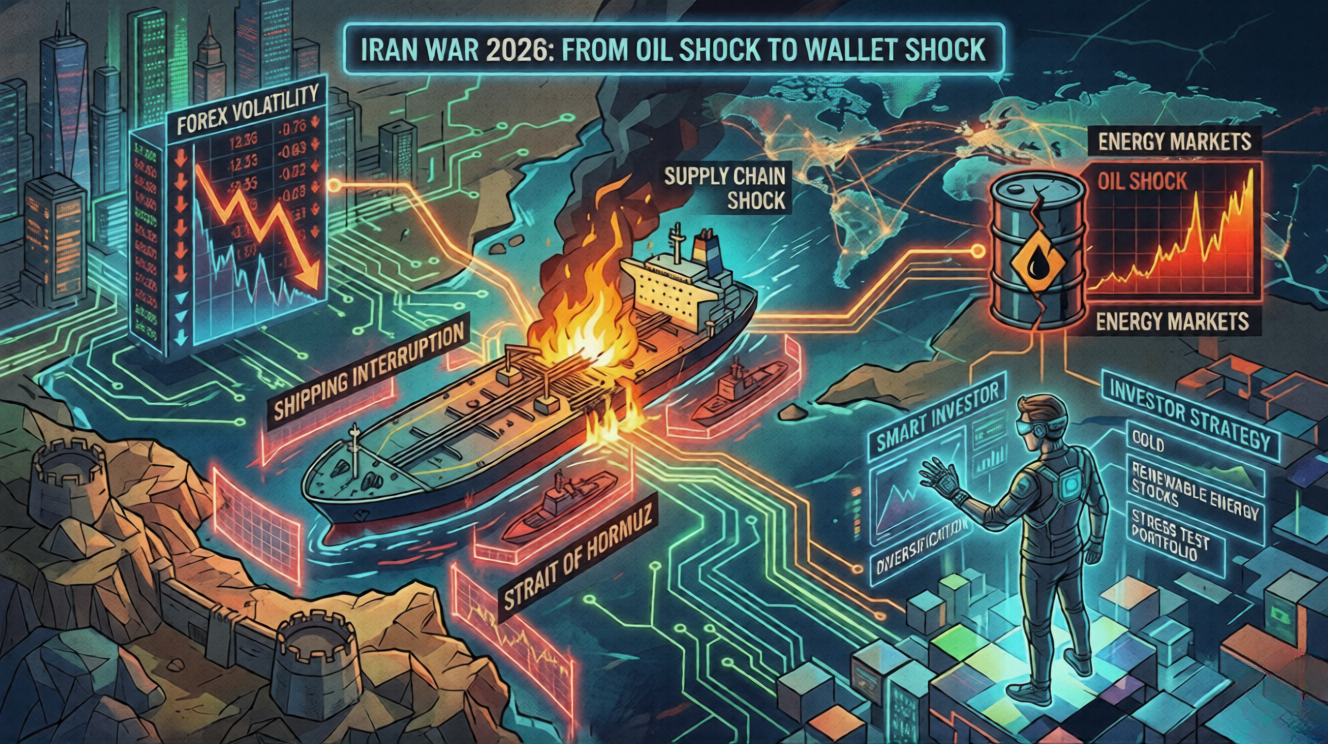
There are Wars that Rage on Maps… and then there are wars that quietly seep into your wallet, your petrol tank, your weekly groceries. The ongoing Iran Conflict belongs firmly to the latter. It is not merely a regional quarrel – it is, in effect, a Financial Tremor felt from London Cafés to Kathmandu Kitchens.
Let’s unpack it – not like a textbook, but like a traveller observing a storm rolling across continents.
The Strait That Controls the World : At the heart of this economic drama lies a narrow stretch of water: the Strait of Hormuz. It sounds obscure, almost forgettable but it carries roughly one-fifth of the world’s oil supply.
Now imagine placing a cork in that bottle. That is precisely what this war has flirted with. Disruptions here have already driven oil prices sharply upwards—jumping from around $70 to well above $100 per barrel, with spikes even higher in moments of panic. And oil, as ever, is the beginning of the story – not the end.
Inflation: The Silent Invader – When oil sneezes, the global economy catches a cold.
- Transport costs rise.
- Food becomes pricier (fertiliser depends on energy).
- Electricity bills swell.
- Manufacturing slows.
We are witnessing a creeping return of a word economists utter with dread: stagflation—a blend of high inflation and weak growth. Even wealthy nations are feeling the pinch. Households are cutting back, delaying purchases, and quietly recalculating survival budgets. It’s not dramatic. It’s worse—it’s persistent.
Supply Chains: A World Slightly Off-Balance – War in Iran is not just about oil tankers. It is about the invisible web of global trade:
- Fertilisers disrupted → food insecurity rises.
- Industrial gases affected → chip production slows.
- Airspace closures → travel and logistics strained
Entire industries from textiles to pharmaceuticals are feeling squeezed as input costs surge. It’s rather like removing a single cog from a clock and watching the whole mechanism hesitate.
Markets, Nerves, and Speculation : Financial markets, those famously emotional creatures, have reacted accordingly:
- Stock markets wobble.
- Bonds fluctuate.
- Investors retreat to “safe” assets
There is a growing sense that markets initially underestimated the war’s duration and depth. And markets dislike nothing more than uncertainty—except perhaps prolonged uncertainty.
Winners and Losers (Yes, There Are Both) : Curiously, not everyone loses equally.
- Likely Losers:
- Oil-importing countries (India, Nepal, much of Europe).
- Low-income nations facing food inflation.
- Small businesses reliant on stable costs.
- Potential Winners:
- Energy exporters outside the conflict zone.
- Certain commodity traders.
- Nations able to reroute supply chains cleverly
War, in economic terms, redistributes pain more than it creates uniform suffering.
The Bigger Picture: Not Just About GDP : Interestingly, some economists argue the direct impact on global GDP may appear modest—because the Middle East contributes only a small share of total global output.
But that misses the point. The Real Danger lies in Chokepoints and Psychology:
- Chokepoints (like Hormuz) disrupt supply.
- Psychology fuels panic, speculation, and hoarding
And together, they create something far more potent than numbers suggest.
A Whisper of the 1970s : There is an eerie echo of the 1970s oil crisis:
- Sudden energy shocks.
- Inflation spirals.
- Policy confusion.
Some analysts now warn this could become the largest oil supply disruption in modern history. History, it seems, rarely repeats but it does rhyme, often expensively.
Final Thought : A War Beyond Borders
The Iran war is not confined to battlefields. It is being fought:
- At petrol pumps.
- In supermarket aisles.
- Inside central bank meeting rooms.
It reminds us of a simple, slightly uncomfortable truth: In a globalised world, no war is truly distant. Even if you never glance at a map of the Middle East, you may still feel its consequences—quietly, persistently each time you pay for fuel, food, or the future.