
On the evening of 14 April 1865, American President Abraham Lincoln attended a performance at Ford’s Theatre in Washington, DC. The American Civil War was drawing to a close, and Lincoln had survived years of political turmoil and national bloodshed. Yet, on what should have been a peaceful night at the theatre, a shocking lapse in presidential security helped create an opportunity for one of the most notorious assassinations in history.
The story is often told in a single chilling line: Lincoln’s guard went next door for a drink while the President watched the play. Behind that claim lie a wider story of poor security arrangements, a determined assassin and a nation about to lose its leader just days after the Confederacy’s major defeat.
But what actually happened that night, and how much responsibility did the President’s protection detail bear? The Night America Lost Its President.
Who Was the Guard Responsible for Lincoln’s Safety? : The officer at the centre of this story was John Frederick Parker, a Washington police officer assigned to accompany Lincoln to Ford’s Theatre.
Presidential protection in 1865 was very different from what we recognize today. There was no dedicated Secret Service presidential protection detail like the one established in later years. The Secret Service itself was created on 14 April 1865, initially to combat counterfeiting rather than protect the President.
Parker’s assignment was therefore part of a much less formal security system. Nevertheless, his absence from the entrance to Lincoln’s box would become one of the most debated details of that terrible night.
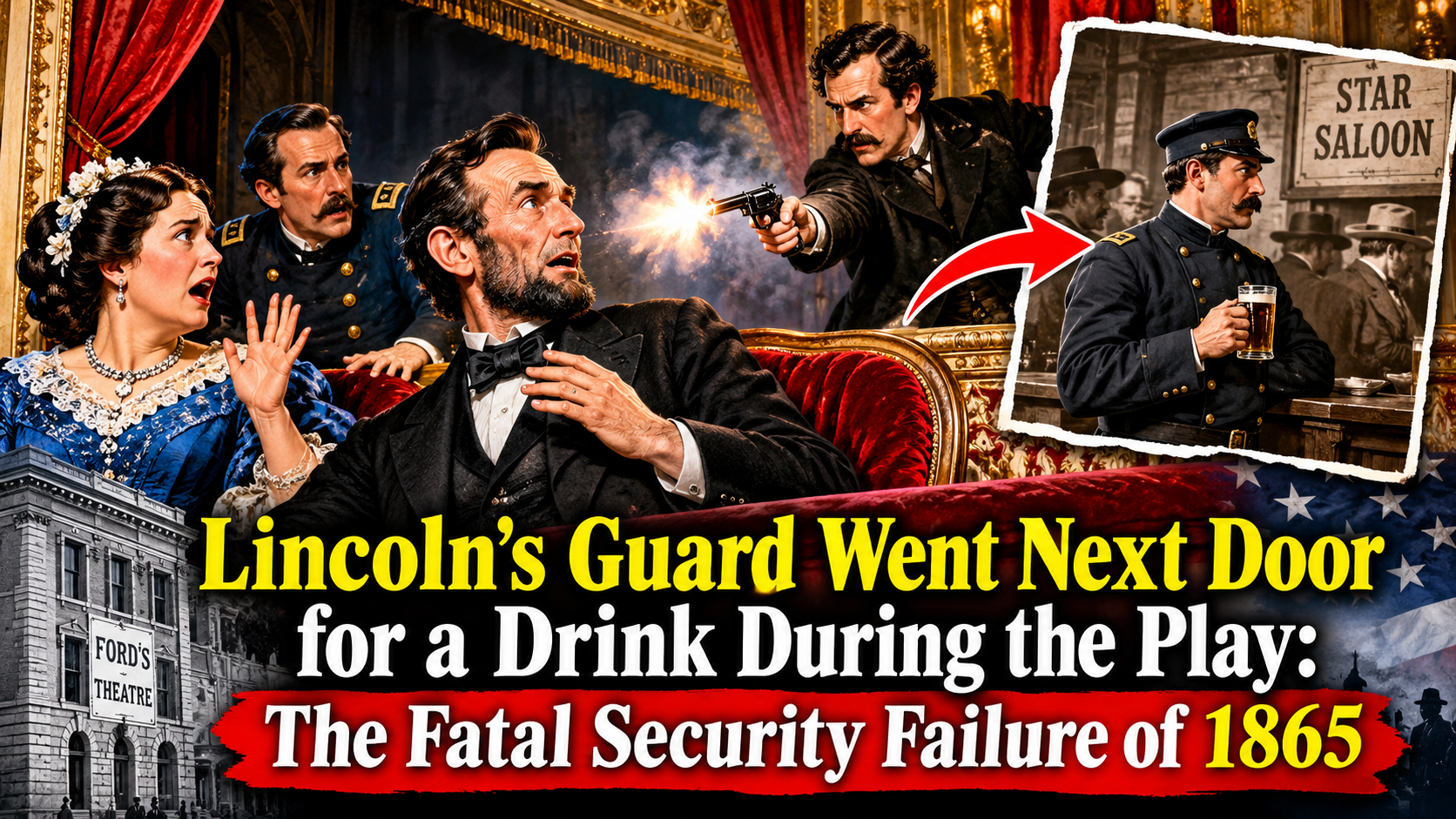
The Drink at the Star Saloon: During the evening performance of Our American Cousin, Parker reportedly left his position outside the presidential box to watch the play from another part of the theatre.
During the interval, accounts indicate that he went to the nearby Star Saloon with Lincoln’s coachman and messenger for a drink.
Here is the important historical distinction: Parker’s visit to the saloon is supported by historical accounts, but his exact whereabouts at the moment of the shooting remain uncertain. The US National Park Service confirms that there is no definitive evidence establishing whether he was still at the saloon or had returned to the theatre.
That uncertainty matters. The popular version of the story often presents every detail as settled fact, when historians cannot reconstruct Parker’s movements with complete confidence.
John Wilkes Booth Enters the Theatre: The man who would change American history was John Wilkes Booth, a well-known stage actor and Confederate sympathizer. On 14 April 1865, Booth entered Ford’s Theatre with a plan to assassinate Lincoln. During the third act of the play, at approximately 10.15 pm, he approached the presidential box and fired a pistol at the President’s head.
Booth then attacked Major Henry Rathbone, who was accompanying Lincoln and his guests, before leaping from the box onto the stage and escaping through the theatre. Lincoln was carried across the street to a boarding house, where he died the following morning, 15 April 1865.
The President’s death shocked a country emerging from four years of devastating civil war.
Could the Guard Have Prevented the Assassination? : It is tempting to imagine that a guard standing outside the box would automatically have stopped Booth. However, history does not allow us to know that with certainty.
Parker’s absence created an obvious security weakness, but Booth was a recognized actor, and the arrangements around the presidential party were informal. Other people were also positioned near the entrance, and the precise sequence of events that allowed Booth to reach Lincoln remains an important part of the historical investigation.
The incident exposed several weaknesses:
- Insufficient protection: Lincoln did not have the continuous, specialized protection expected of a modern head of state.
- Poor access control: Booth was able to reach the presidential box during the performance.
- Unclear responsibilities: The duties of those accompanying the President were not governed by today’s formal protective procedures.
- A failure to anticipate the threat: The security arrangements did not prevent a determined attacker from reaching the President.
The lesson is not simply that one officer went for a drink. It is that a security system relying on informal arrangements can fail when its responsibilities and safeguards are inadequate.
Was John Parker Punished? : Following the assassination, Parker faced a police charge alleging neglect of duty. However, the charge was dismissed in June 1865, and he continued serving with the Washington police force until 1868.
The surviving historical record does not provide a complete account of his actions that night. The US National Park Service notes that no transcript of the hearing has survived, meaning historians have no definitive record of John Parker’s explanation.
His story remains controversial because the outcome was so catastrophic, yet the evidence does not establish that his absence alone caused Lincoln’s death.
How Lincoln’s Assassination Changed Presidential Security? : Lincoln’s assassination became one of the most significant turning points in American political history. It demonstrated the vulnerability of the presidency at a moment when the country was already struggling to recover from civil war.
However, modern presidential protection did not appear overnight. The Secret Service was not permanently assigned to presidential protection until 1901, following the assassination of President William McKinley.
Today, the story of Ford’s Theatre is studied not merely as a tale of an absent guard, but as an example of why security requires clear responsibilities, careful planning and protection proportionate to the risks.
Final Thoughts – A Drink, an Empty Position and a Moment That Changed History: The claim that Lincoln’s guard went next door for a drink is rooted in historical accounts, but the full story is more complicated than the familiar headline suggests.
John Parker’s movements remain partly uncertain, and no one can prove that his presence would have prevented Booth’s attack. What is clear is that Abraham Lincoln was assassinated in a theatre where presidential protection was far less developed than it would become in later generations.
On that April evening in 1865, a night of entertainment turned into a national tragedy. The story endures because it raises a question that remains relevant more than 160 years later: how can a leader be protected when the people responsible for their safety do not have the systems, training and procedures needed to meet the threat?