

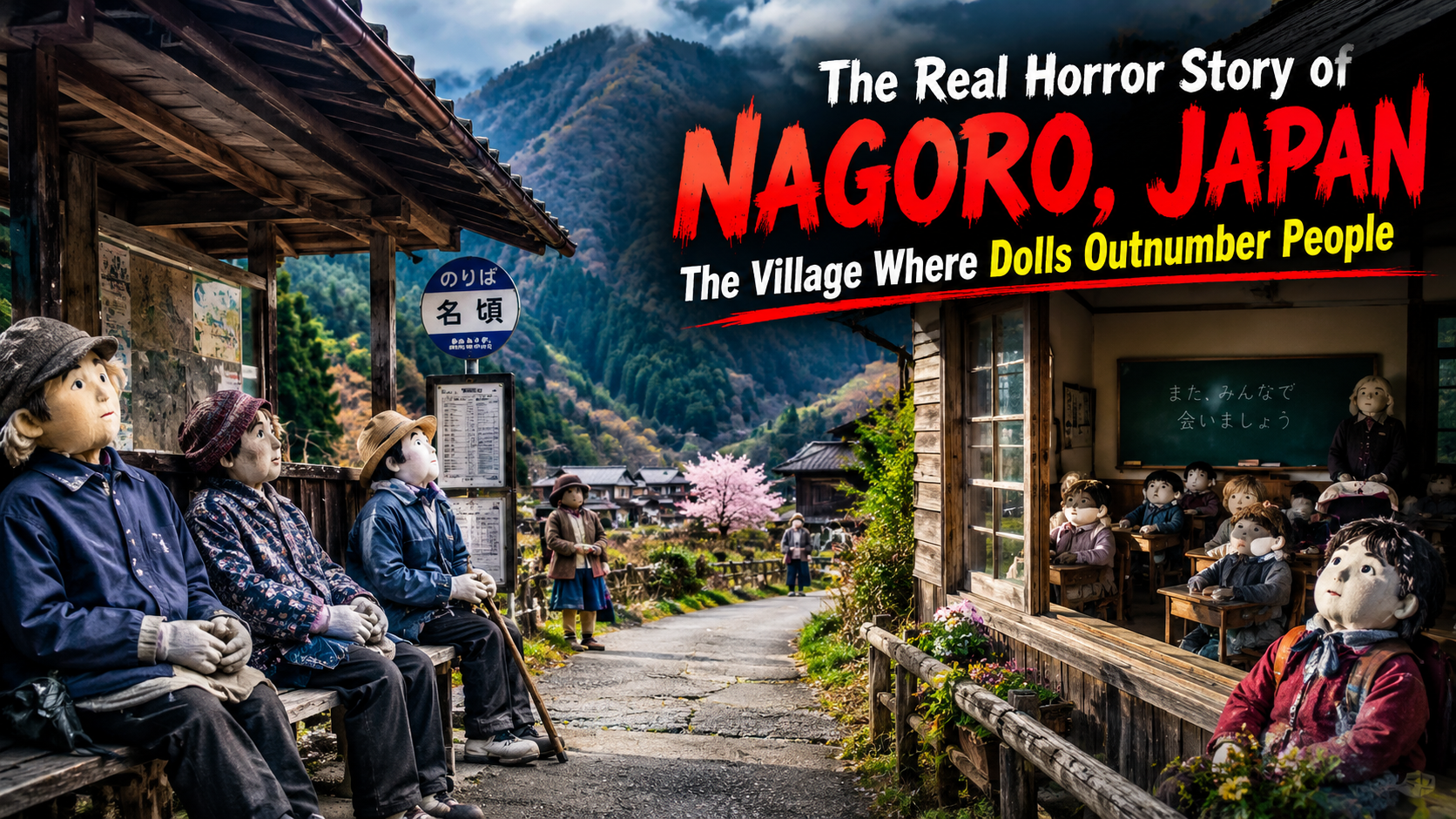
Imagine travelling deep into the Japanese mountains and arriving at a village where people appear to be waiting at bus stops, working in fields and sitting together outside their homes. At first glance, everything seems normal. But as you get closer, you notice something deeply unsettling.
Nobody is moving. Nobody is speaking. And those people you thought you could see are not human beings at all.
Welcome to Nagoro Scarecrow Village, one of Japan’s strangest and most haunting destinations. Hidden in the remote Iya Valley on the island of Shikoku, this tiny settlement has become famous for its hundreds of life-sized handmade dolls, many created to represent people who once lived there.
Although the village is often described online as a real-life horror location, its true story is even more powerful than a traditional ghost tale. It is a story of loneliness, disappearing communities and one woman’s unusual attempt to keep the memory of her hometown alive.
The village that looks as though time has stopped: Nagoro was once a much livelier mountain community, with hundreds of people living and working in the area. Over the years, however, residents moved away in search of opportunities, while others grew old and passed away. The village gradually lost much of its population.
Today, Nagoro is widely known for its remarkable collection of scarecrows, which are arranged throughout the settlement as if everyday life were still continuing. Some sit outside houses, others wait at bus stops, and many appear to be working in fields or gathering inside the village’s former school.
The unsettling part is how realistic some of the figures appear from a distance.
A visitor might see what looks like an elderly farmer sitting beside the road. Another figure might appear to be watching the street from a wooden porch. Inside a classroom, dolls arranged at desks can create the impression that a lesson is about to begin.
But the silence gives everything away.
There is no conversation, no movement and no ordinary bustle of village life. The figures remain exactly where they have been placed, their expressions frozen while the world around them continues to change.
The woman behind Japan’s creepy doll village: The story of Nagoro’s unusual transformation centres on a Japanese woman named Ayano Tsukimi.
When Ayano returned to her hometown in around 2002 after spending years in Osaka, she found that the community she remembered was gradually disappearing. Many people had moved away, and others had died. The village no longer had the same lively atmosphere as it had during her childhood.
Her unusual project began with something simple.
Ayano wanted to protect the seeds in her vegetable garden from birds, so she made a scarecrow using old clothes and materials. She modelled it on her father, and the result looked remarkably lifelike. Some neighbours even mistook the figure for a real person and greeted it as they passed.
That reaction gave her an idea.
Rather than leaving the village to become a place of empty houses and fading memories, she began creating more figures inspired by former residents and people who had left the area.
Over the years, her work grew into an extraordinary collection of hundreds of handmade figures. The dolls became a visual reminder of the community that had once existed there.
What began as an ordinary scarecrow project eventually transformed Nagoro into one of Japan’s most unusual tourist attractions.
The abandoned school that looks frighteningly alive: One of the most unsettling locations in Nagoro is its former school.
Imagine opening the door to a quiet classroom and finding rows of life-sized figures sitting behind desks. At the front stands a teacher, while the pupils appear to be waiting for a lesson to begin.
The scene looks almost ordinary, yet something feels terribly wrong.
These are not children who have returned to school. They are handmade figures created to preserve the memory of a time when the building served a living community. The school eventually closed because there were too few pupils, and Ayano filled parts of the empty building with her creations.
For visitors who enjoy exploring abandoned places, this is the sort of scene that stays in the imagination long after they have left.
The figures do not move, blink or speak. Their stillness creates an atmosphere that feels strangely disconnected from the modern world.
Yet the school is not evidence of a supernatural event. Its eerie appearance comes from the contrast between the familiar setting of a classroom and the artificial people who now occupy it.
Why does Nagoro feel like a real horror film?: There are several reasons why Nagoro has become popular with people fascinated by creepy places and unsettling travel destinations.
- Life-sized figures: Many dolls are dressed in everyday clothing and positioned like ordinary residents, making them easy to mistake for real people at first glance.
- Mountain isolation: Nagoro lies deep within the Iya Valley, surrounded by steep landscapes and winding roads.
- The silence: With far fewer living residents than in the past, the village can feel unusually quiet.
- The empty school: Classrooms filled with motionless dolls create an unsettling contrast between childhood memories and abandonment.
- The feeling of being watched: Some figures are positioned beside roads, outside buildings or near windows, where their fixed expressions can make visitors feel as though they are being observed.
These features explain why photographs of Nagoro often circulate on social media with descriptions such as Japan’s haunted village or the village of living dolls.
However, it is important to separate atmosphere from evidence. There is no reliable evidence that the dolls are haunted or that supernatural events occur there. The village’s unsettling reputation is based on its appearance and the emotional story behind it, rather than proven paranormal activity.
The saddest truth behind the horror: Perhaps the most disturbing thing about Nagoro is not the dolls themselves. It is what they represent.
Japan has many rural communities affected by ageing populations, falling birth rates and the movement of younger residents towards larger cities. Nagoro illustrates how these changes can transform a once-busy settlement into a much quieter place.
The dolls are reminders of people, who once worked, studied, travelled and spent time together in the village. Their positions recreate fragments of ordinary life: someone waiting for a bus, a farmer working outdoors or children sitting in a classroom.
The figures cannot replace the people who are gone, but they preserve something of the village’s identity.
Ayano’s project therefore has two sides. To some visitors, the dolls look frightening. To others, they are touching works of art that celebrate the memories of a disappearing community.
In that sense, Nagoro is not simply a horror attraction. It is also a quiet reflection on ageing, memory and the passage of time.
Is Nagoro really haunted?: The short answer is that Nagoro is a real place, but its haunted reputation is not supported by reliable evidence of ghosts.
The village is home to handmade scarecrows created by Ayano Tsukimi, and official Japanese tourism sources describe it as a destination combining local art, history and community. Visitors can explore the settlement respectfully and see the figures arranged around the village and its former school.
The horror comes from the experience of seeing human-shaped figures in a place where there are fewer people than you might expect.
If you visit, remember that Nagoro is still a real community, not a deserted film set. Respect residents’ privacy, avoid entering private property and take care when photographing the dolls.
Final thoughts: Japan’s village of dolls, Nagoro may look like something from a supernatural horror film, but its true story is far more human.
One woman began making a scarecrow to protect her crops. That simple act developed into a remarkable collection of figures representing the memories of a changing village.
Today, the dolls stand in fields, beside roads and inside an old school, giving Nagoro an atmosphere unlike almost anywhere else in Japan.
The real horror of Nagoro is not that the dolls might come alive. It is that the people they represent cannot return and perhaps that is why this tiny Japanese village leaves such a lasting impression: beneath its strange appearance lies a story about a community trying not to be forgotten.