

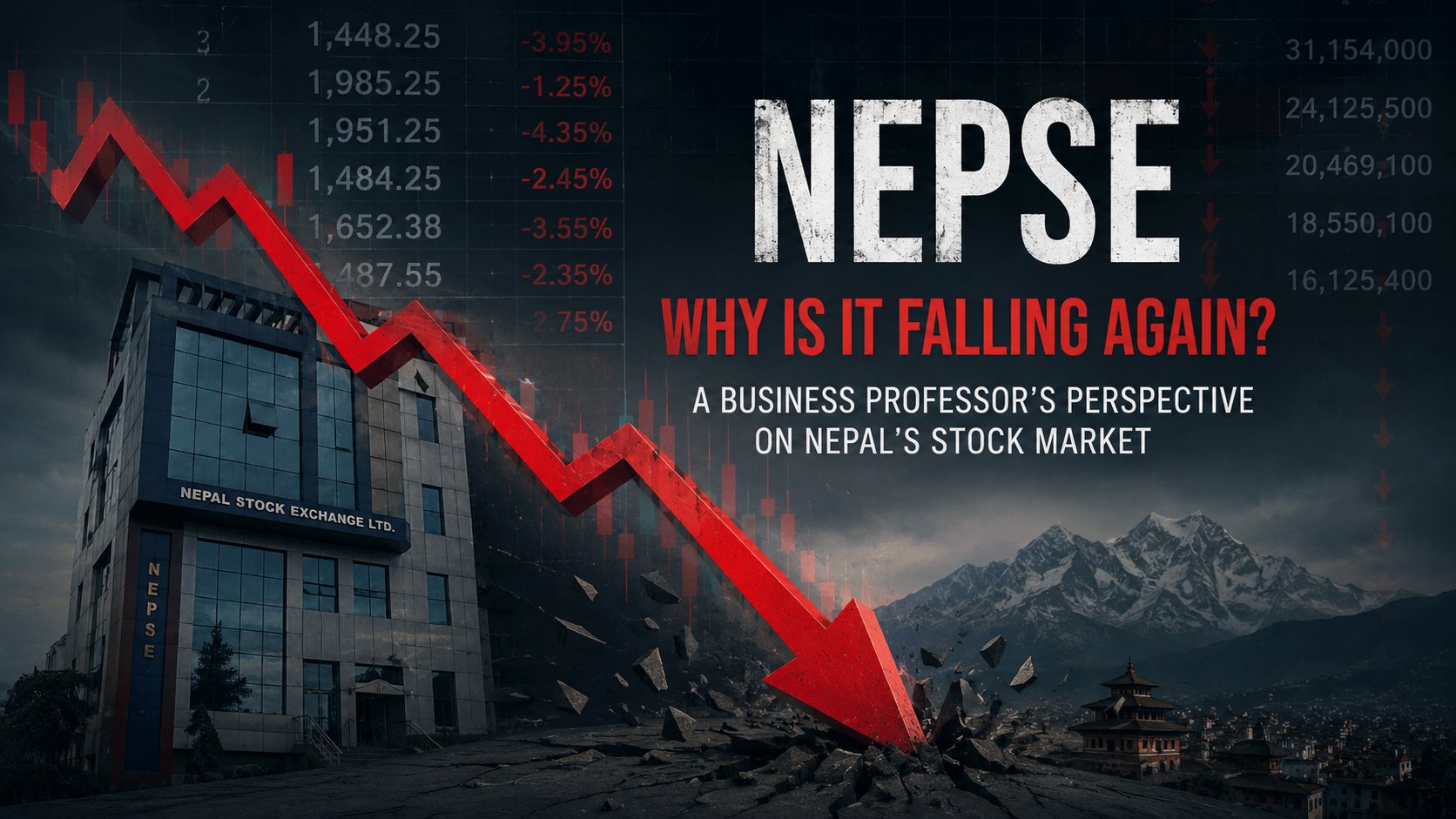
By viewing the market through the lens of economics, finance, and investor psychology rather than daily headlines. For many retail investors in Nepal, the persistent decline in the Nepal Stock Exchange (NEPSE) has become more than a financial concern—it has become an emotional one. Every few weeks, optimism returns, only to be replaced by another wave of selling. This repeated pattern raises an important question: “Why does NEPSE continue to struggle despite occasional positive news?“
The answer cannot be reduced to a single event or government policy. Financial markets are complex systems where economic conditions, investor expectations, liquidity, corporate earnings, regulation, and psychology interact simultaneously. Looking only at daily price movements misses the deeper structural issues. This article examines the current weakness in NEPSE from a business and investment perspective.
The Stock Market Is Not the Economy : A common misconception is that a country’s economic growth automatically leads to rising share prices. In reality, stock markets respond primarily to future expectations, not current conditions.
Investors continuously ask:
- Will company profits improve?
- Will interest rates fall?
- Will lending increase?
- Will liquidity improve?
- Will confidence return?
If the answer to these questions remains uncertain, share prices often weaken even when economic indicators show gradual improvement. In Nepal’s case, expectations have remained fragile for an extended period.
Liquidity : The Lifeblood of Every Bull Market. No stock market can sustain a long-term rally without sufficient liquidity. Liquidity simply means the availability of money that investors are willing to commit to financial assets.
When banks possess abundant deposits and actively extend loans, investors gain easier access to capital. More money enters the market, increasing demand for shares.
However, when liquidity tightens:
- Lending slows,
- Borrowing becomes expensive,
- Investors preserve cash,
- Trading activity declines.
Even fundamentally strong companies struggle to attract buyers under these conditions. This is one of the principal reasons why NEPSE has lacked sustained upward momentum.
Interest Rates Continue to Shape Investor Behaviour : Interest rates compete directly with the stock market. When bank fixed deposits offer attractive and relatively risk-free returns, many investors prefer guaranteed income over uncertain capital gains. Institutional investors, retirees, and conservative households often reallocate funds from equities into deposits. This migration reduces demand for shares.
Although interest rates fluctuate over time, investor behaviour does not change overnight. Confidence usually returns only after market participants become convinced that borrowing costs will remain favourable for a prolonged period.
Investor Psychology Has Become Increasingly Defensive : Markets rarely move purely because of numbers. Human behaviour plays an equally important role. After experiencing repeated corrections, investors gradually become cautious.
Instead of asking: “Which company offers long-term value?” also many begin asking: “Should I sell before prices fall again?“
This psychological shift creates a self-reinforcing cycle.
- More sellers lead to lower prices.
- Lower prices create greater fear.
- Greater fear encourages additional selling.
The result is a market that struggles to establish lasting upward momentum.
Retail Dominance Creates Greater Volatility : One defining characteristic of NEPSE is its heavy reliance on retail investors. Unlike mature markets where pension funds, insurance companies and global institutional investors provide stability, Nepal’s market remains largely driven by individuals.
Retail investors often react more quickly to:
- Rumours,
- Political Developments,
- Social Media Discussions,
- Short-Term Price Movements.
This does not imply irrationality. Rather, it reflects limited access to professional research and investment analysis. Consequently, market sentiment can change rapidly, increasing volatility.
Banking Sector Performance Influences the Entire Market : Banks occupy a dominant position within NEPSE. Because financial institutions represent a significant proportion of market capitalisation, weakness within banking frequently affects the entire index.
Banks themselves face several challenges:
- Slower Credit Expansion,
- Pressure on Profitability,
- Regulatory Requirements,
- Cautious Lending Practices,
- Changing Monetary Policy.
Even if other industries perform reasonably well, underperformance within banking can suppress the broader market index.
Expectations Often Exceed Reality : Financial markets price expectations rather than announcements.
Suppose investors expect:
- Lower Interest Rates,
- Major Policy Reforms,
- Increased Government Spending,
- Stronger Economic Growth.
If these expectations are not fulfilled quickly, disappointment follows. Prices then adjust downward—not necessarily because conditions have deteriorated, but because reality falls short of optimism. This phenomenon has appeared repeatedly within NEPSE over recent years.
Political Stability Matters More Than Daily Politics : Markets dislike uncertainty more than unfavourable news. Frequent changes in government, delayed policy implementation, and uncertainty surrounding economic reforms make long-term investment decisions more difficult.
- Businesses postpone expansion.
- Investors delay commitments.
- Foreign capital becomes cautious.
The consequence is reduced confidence across financial markets.
Limited Institutional Participation Restricts Market Depth : Developed stock markets benefit from significant participation by:
- Pension Funds,
- Sovereign Wealth Funds,
- Mutual Funds,
- International Asset Managers,
- Insurance Companies.
These institutions invest systematically rather than emotionally.They often purchase quality companies during market declines, helping stabilise prices. Nepal’s capital market still lacks this depth. As a result, selling pressure can overwhelm buying interest more easily.
Corporate Earnings Remain the Ultimate Driver : In the long run, share prices follow corporate profitability. If companies consistently generate:
- Higher Earnings,
- Stronger Dividends,
- Expanding Business Operations, their intrinsic value gradually increases.
However, if earnings growth slows because of weaker economic activity or reduced lending, investors become reluctant to pay higher valuations. No amount of optimism can permanently override disappointing financial performance.
Why Many Investors Continue to Lose Money? : A recurring mistake among retail investors is confusing speculation with investment.
Many participants purchase shares because:
- Prices have already risen,
- Friends recommend them,
- Social Media predicts rapid gains.
Very few examine:
- Financial Statements,
- Earnings Quality,
- Valuation,
- Competitive Position,
- Long-Term Growth Prospects.
When market sentiment changes, speculative positions often suffer the largest losses.Successful investing requires patience, analysis, and disciplined decision-making.
Could NEPSE Recover? : History suggests that every prolonged bear market eventually ends. Recovery usually begins when several conditions improve simultaneously:
- Banking Liquidity Strengthens,
- Interest Rates become supportive,
- Credit Growth Accelerates,
- Investor Confidence Returns,
- Corporate Earnings Improve,
- Government Policy becomes more predictable.
Importantly, recoveries often begin before economic improvement becomes obvious. Markets tend to anticipate recovery rather than wait for confirmation.
Final Thoughts : The current weakness in NEPSE should not be interpreted as evidence that Nepal’s capital market lacks potential. Instead, it reflects the interaction of constrained liquidity, cautious monetary conditions, subdued investor confidence, limited institutional participation, and uncertainty regarding future economic growth.
Markets move in cycles. Periods of excessive optimism are followed by phases of pessimism. Neither lasts forever. For long-term investors, the essential lesson is not to predict every short-term movement but to understand the underlying economic forces that drive market behaviour. Those who base decisions on business fundamentals rather than emotion are generally better positioned to benefit when the cycle eventually turns.
In investing, patience is rarely exciting, but it is often the characteristic that distinguishes successful investors from disappointed speculators.




Không chỉ giao diện đẹp mà thop tv apk download còn có nhiều trò chơi đa dạng, chơi lâu cũng không cảm thấy nhàm chán. TONY07-08
Thanks for sharing. this topic is becoming more important in 2026. Keep up the great work!
Its like you read my mind You appear to know so much about this like you wrote the book in it or something I think that you can do with a few pics to drive the message home a little bit but instead of that this is excellent blog A fantastic read Ill certainly be back