

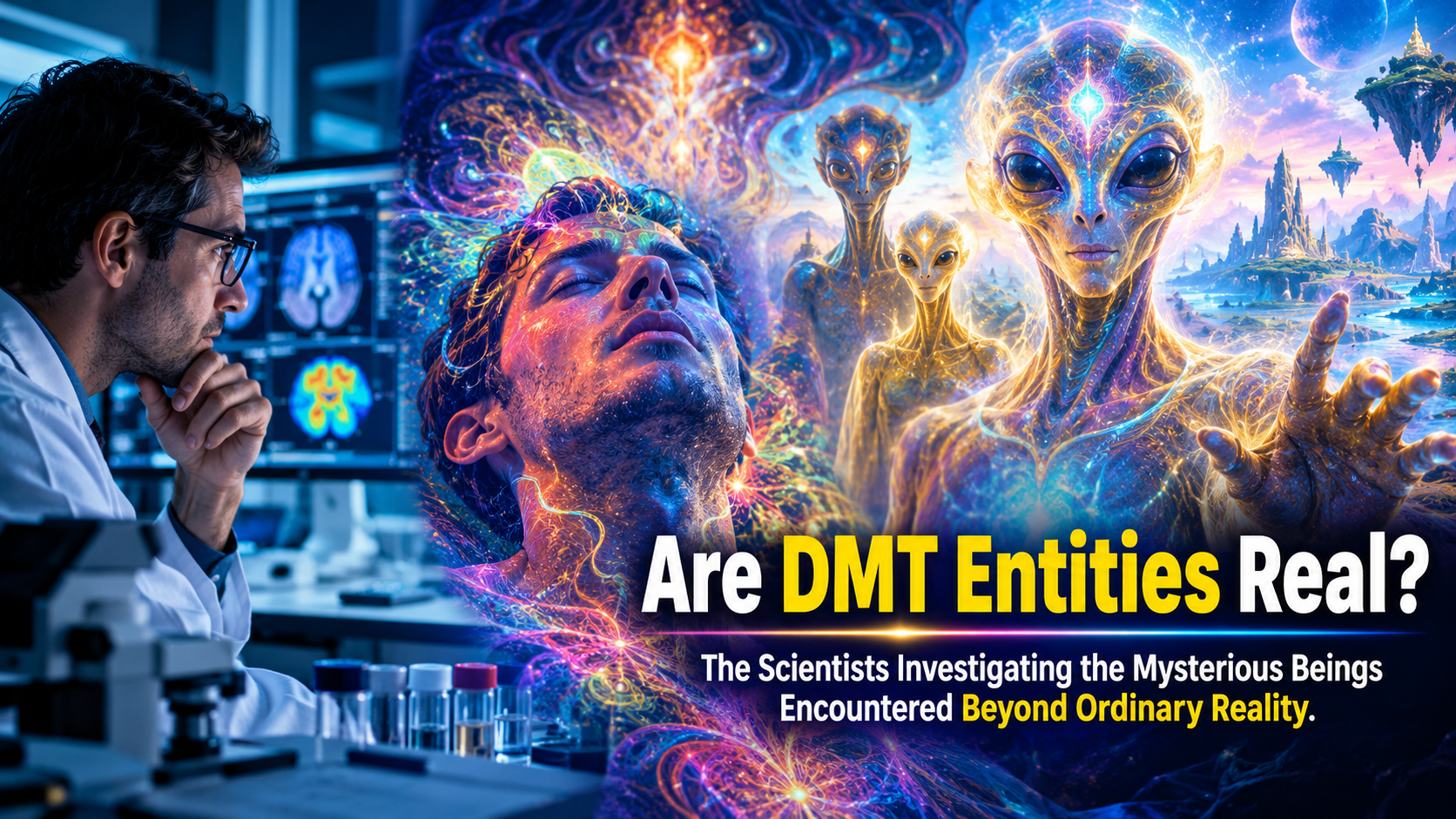
Imagine entering a world in which strange beings appear to communicate with you, display seemingly impossible knowledge and behave as though they have existed long before your arrival. For many people who report experiences with DMT, a powerful psychedelic substance, this is not simply a dream or an ordinary hallucination. They describe encounters that feel astonishingly real, as if they have briefly crossed a boundary into another form of existence.
Now, a fascinating scientific question has emerged: Could the mysterious entities people encounter during DMT experiences be more than products of the human brain?
Researchers investigating consciousness, psychedelic experiences and the nature of reality are exploring why these encounters can feel so vivid, convincing and independent of the individual experiencing them. However, there is an important distinction between studying these experiences scientifically and proving that the beings exist outside the mind.
What Is DMT, and Why Does It Attract Scientific Interest? : DMT, short for N,N-dimethyltryptamine, is a naturally occurring psychedelic compound found in certain plants and produced in trace amounts in some biological systems. It can produce intense changes in perception, thought, emotions and a person’s sense of identity.
When people experience its powerful effects, some report entering extraordinary environments filled with intricate patterns, unfamiliar landscapes and apparently intelligent beings. These figures are sometimes described as guides, communicators, machine-like creatures or mysterious presences that seem to possess their own intentions.
What makes these accounts particularly intriguing is the confidence with which some individuals describe their encounters. They may feel that they have visited a separate reality rather than experienced a change in their own consciousness.
Yet a powerful feeling of certainty is not, by itself, evidence that an experience corresponds to an external reality. Understanding why the brain can generate such convincing experiences is one of the central challenges for researchers studying consciousness.
Why Do People Report Meeting Apparently Intelligent Beings? : DMT experiences vary considerably from person to person, but reports of encountering seemingly autonomous entities have attracted particular attention.
Some individuals describe beings that appear to communicate through images, emotions or a rapid exchange of information. Others report intricate surroundings that seem organised, responsive and far more elaborate than an ordinary dream.
There are several possible explanations for these experiences:
- Altered perception: DMT changes the way the brain processes sensory information and constructs a person’s conscious experience.
- The brain’s pattern recognition: Human beings naturally search for meaning, intention and familiar forms, even when information is unfamiliar or ambiguous.
- Dream-like processes: Psychedelic states may involve aspects of imagination, memory and internally generated experiences that resemble vivid dreaming.
- The sense of another mind: The brain can generate a powerful impression that a presence has its own identity, intentions and knowledge.
These possibilities do not make the experiences unimportant. Rather, they offer scientific starting points for investigating why the encounters feel so different from ordinary thoughts or dreams.
Can Scientists Actually Prove That DMT Entities Are Real? : The word real is the key to understanding this debate. If someone reports encountering a being during a DMT experience, the experience itself is a real event in that person’s conscious life. Scientists can investigate what the individual perceived, how the experience affected them and what changes occurred in the brain.
However, a much stronger claim would be that the being exists independently of the person’s brain and can be encountered by other people under controlled conditions.
To investigate that possibility, researchers would need evidence that goes beyond personal testimony. For example, they might test whether different participants independently report the same unusual information, whether that information can be verified, and whether the results are more accurate than chance would predict.
Carefully designed experiments would also need to account for prior knowledge, suggestion, shared cultural expectations, memory errors and the possibility of participants influencing one another.
At present, reports of DMT entities do not establish that these beings exist as independent external life forms. The scientific question remains open to investigation, but extraordinary claims require reliable, reproducible evidence.
The Connection Between DMT and the Mystery of Consciousness : One reason this subject attracts serious interest is that it touches on a much bigger question: how does the human brain create the experience of being aware?
Consciousness involves more than receiving information from the senses. The brain also combines memories, expectations, emotions and interpretations to construct a coherent experience of the world.
Psychedelics can significantly alter this process. Research into compounds such as DMT may help scientists understand how ordinary perception, the sense of self and the feeling of encountering another mind arise.
Some researchers and philosophers have also questioned whether consciousness can be fully explained by current scientific models. These discussions are important, but they do not demonstrate that psychedelic experiences provide access to another dimension or an independently existing civilisation.
The most productive approach is to investigate what can be measured while remaining open to evidence that challenges existing explanations.
Why is DMT Encounters Sometimes Described as More Real than Reality? : A striking feature of some psychedelic experiences is the feeling that they possess a level of clarity, significance or emotional intensity beyond everyday life.
People may describe unfamiliar environments as incredibly detailed. An encounter may seem purposeful, and a perceived message may feel as though it has been delivered by an independent intelligence.
One possible explanation is that altered brain activity changes the way perception; emotion and the sense of certainty interact. When an experience is unusually vivid and emotionally powerful, it can feel more convincing than an ordinary memory or dream.
This helps explain why people may remain deeply affected by an encounter long after the substance’s immediate effects have ended.
Nevertheless, how real an experience feels and whether its apparent source exists independently are two different questions. Scientists must examine them separately rather than treating subjective certainty as proof.
Could Different People Be Encountering the Same Beings? : This is one of the most interesting questions surrounding DMT research. Some people report figures or environments that appear similar to those described by other users. Such similarities have encouraged speculation that individuals might be encountering a shared realm.
But similarities between personal accounts can have several explanations. Human brains have common structures, people draw upon overlapping cultural imagery, and reports shared online may influence what others expect to encounter.
A stronger test would involve independently collecting detailed reports from participants who have not been exposed to one another’s descriptions. Researchers could then compare the accounts using pre-established criteria, ideally with assessors who do not know which participants belong to which experimental groups.
If participants repeatedly identified the same unusual information under carefully controlled conditions, that would justify further investigation. Even then, scientists would need to establish what the findings actually demonstrated before concluding that an external realm or its inhabitants had been discovered.
Similarity alone is intriguing, but it is not conclusive proof.
What Does This Mean for the Future of Scientific Research? : DMT research could contribute to several important areas of science, including the study of consciousness, perception, memory and the psychological effects of altered states.
Researchers may also investigate how the brain creates the impression of interacting with another intelligent presence. Such work could help explain why certain experiences feel social, meaningful and independent, even when ordinary sensory contact with another person is absent.
However, the subject must be approached carefully. DMT is a powerful psychedelic, and its effects can be psychologically intense. It should not be treated as a proven method of communicating with external beings, and attempts to investigate these claims should take place within appropriate ethical and safety frameworks.
The real scientific opportunity is not to assume that the most extraordinary interpretation must be correct. It is to design experiments capable of distinguishing between competing explanations.
Conclusion: A Fascinating Mystery, Not Yet a Scientific Breakthrough. The possibility that DMT encounters might reveal something unexpected about consciousness is undeniably fascinating. The vivid beings described by some users raise difficult questions about perception, identity and the way the mind constructs reality.
But there is currently no conclusive scientific evidence that these entities are independent beings existing outside the human mind. Their apparent intelligence, the intensity of the encounters and similarities between personal accounts are reasons to investigate the phenomenon, not proof of an unseen civilization.
Perhaps the most valuable question is not simply whether DMT entities are real. It is how the human brain can produce an experience that feels so much like meeting another intelligent being.
Answering that question could reveal important insights into consciousness itself, regardless of whether future research supports the more extraordinary claims.
For now, the mystery remains compelling—but the distinction between an unforgettable experience and a verified discovery is essential.