
Spain is a country where extraordinary landscapes, ancient villages and dramatic coastlines come together to create some of Europe’s most unforgettable travel experiences. Beyond the famous attractions of Barcelona, Madrid and Seville lies another side of Spain, filled with hidden corners that look as though they belong in a fantasy film.
From houses built beneath enormous rock formations to turquoise natural pools and spectacular mountain walkways, these destinations reveal why Spain is such a remarkable place for curious travellers.
If you are searching for unusual places to visit in Spain, planning a European holiday or simply dreaming of your next adventure, these eight destinations deserve a place on your travel bucket list.
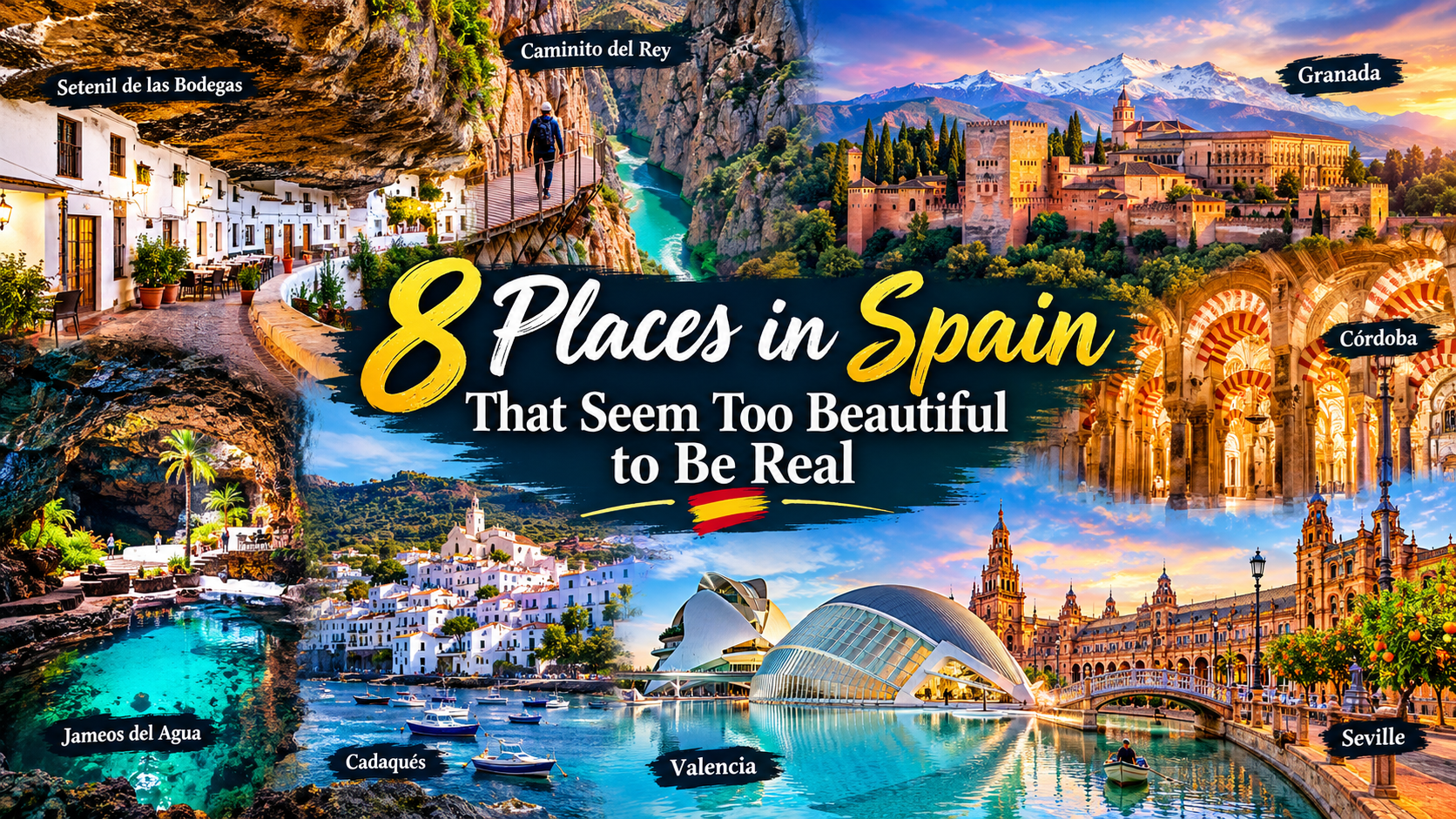
1. Setenil de las Bodegas — The Village beneath Giant Rocks: Imagine walking through a village where enormous slabs of rock form the roofs above everyday homes, cafés and narrow streets. This is the extraordinary sight that awaits visitors in Setenil de las Bodegas.
Unlike traditional Spanish villages built entirely with stone or brick, many of Setenil’s houses have been constructed into natural rock shelters along a river gorge. The result is an unusual settlement where nature and human architecture appear to have become one.
Its famous streets, Cuevas del Sol and Cuevas de la Sombra, offer contrasting experiences of sunlight and deep shade beneath the overhanging stone. Visitors can wander between whitewashed façades, sample traditional Andalusian tapas and admire a way of life shaped by the surrounding landscape.
Why visit? Setenil is ideal for photographers, architecture enthusiasts and travellers seeking an authentic village experience far removed from crowded beach resorts.
2. Caminito del Rey — A Walkway Suspended Above a Dramatic Gorge: For those who enjoy adventure, Caminito del Rey offers a journey through one of Spain’s most striking natural landscapes. This famous walkway follows the steep walls of the Desfiladero de los Gaitanes gorge, with towering cliffs rising above the path.
The original walkway was built to provide access for workers at nearby hydroelectric facilities. Over time, it became known for its dangerous condition before undergoing extensive restoration and reopening to visitors in 2015.
Today, the route allows visitors to experience the gorge from specially maintained paths and elevated walkways. The views of rugged limestone walls, the river far below and the surrounding countryside make it a remarkable destination for outdoor enthusiasts.
Why visit? It combines spectacular scenery, a fascinating industrial past and an unforgettable walking experience. Book ahead, follow safety instructions and check current access requirements before travelling.
3. Granada — A City Where Moorish Architecture Meets Mountain Scenery: Granada is a destination where history feels present in every courtyard, archway and winding street. Set against the backdrop of the Sierra Nevada mountains, the city is particularly famous for the Alhambra, an extraordinary palace and fortress complex that reflects centuries of Islamic art and architecture.
Inside the Alhambra, intricate geometric patterns, carved plasterwork, peaceful courtyards and carefully designed gardens reveal the sophistication of the Nasrid dynasty. Nearby, the historic Albaicín district offers narrow lanes, traditional houses and sweeping views towards the palace.
Granada also has a distinctive food culture, lively squares and a mixture of Spanish and Moorish influences that make it rewarding to explore beyond its best-known monument.
Why visit? Granada is an excellent choice for anyone interested in architecture, history, photography and mountain landscapes. Reserve Alhambra tickets in advance, particularly during busy travel periods.
4. Córdoba — The City of Arches, Courtyards and Living History: Córdoba offers a different kind of beauty: one built around remarkable architecture, quiet courtyards and the legacy of several cultures.
The city’s most famous landmark is the Mosque-Cathedral of Córdoba, renowned for its seemingly endless rows of red-and-white striped arches. Its architecture reflects the city’s important place in medieval Islamic civilisation, alongside the later Christian additions that transformed the building over the centuries.
Beyond the monument, the historic centre is well worth exploring at a leisurely pace. Whitewashed houses, flower-filled patios, traditional lanes and the Roman Bridge create a setting that feels particularly enchanting in the softer light of early morning or evening.
Why visit? Córdoba is perfect for cultural travellers who want to discover Spain’s layered history and enjoy beautiful streets without relying entirely on conventional sightseeing.
5. Seville — Orange Trees, Grand Palaces and Andalusian Charm: Seville is one of Spain’s most captivating cities, combining grand historic buildings with lively neighbourhoods, traditional music and a relaxed outdoor culture.
The spectacular Plaza de España is among its most recognisable sights, with sweeping curves, decorative bridges and colourful tiled details. Another highlight is the Real Alcázar, a royal palace celebrated for its intricate Mudéjar design and beautiful gardens.
Yet Seville’s appeal extends well beyond its monuments. Its narrow old-town streets, shaded squares, orange trees and bustling tapas bars invite visitors to slow down and enjoy the city’s everyday rhythms.
Why visit? Seville is a brilliant destination for couples, culture lovers, food enthusiasts and anyone seeking a city break filled with architecture, history and atmosphere.
6. Valencia — Where Turquoise Waters Meet Modern Architecture: Valencia offers an appealing blend of traditional Spanish culture and striking contemporary design. Its most futuristic attraction is the City of Arts and Sciences, a collection of distinctive buildings surrounded by reflective pools that can appear almost otherworldly in bright sunlight.
Away from this modern complex, Valencia has a historic centre filled with grand façades, lively markets and atmospheric streets. The city is also closely associated with paella, which originated in the wider Valencian region.
Its beaches, green spaces and Mediterranean climate add another dimension to the experience, making it suitable for travellers who want culture and coastal relaxation in one trip.
Why visit? Valencia is an excellent option for architecture enthusiasts, food lovers, families and visitors looking for a varied Mediterranean holiday.
7. Cadaqués — A Whitewashed Village on the Costa Brava: On Spain’s northeastern coastline, Cadaqués stands out for its white houses, small waterfront and beautiful Mediterranean setting. Surrounded by rugged terrain and clear coastal waters, the village has a distinctive character that feels different from the country’s larger resort towns.
Its compact streets lead towards the harbour, where fishing boats and waterfront cafés contribute to a peaceful seaside atmosphere. The changing light across the bay also makes Cadaqués particularly appealing to photographers and artists.
The village is closely associated with surrealist artist Salvador Dalí, whose nearby home in Portlligat offers visitors a glimpse into his life and creative world.
Why visit? Choose Cadaqués for coastal walks, relaxed meals beside the sea, art history and beautiful views of the Costa Brava.
8. Jameos del Agua — A Volcanic Wonder in the Canary Islands: Far from mainland Spain, the Canary Islands offer landscapes shaped by volcanic activity. One of the most unusual attractions is Jameos del Agua on Lanzarote, where a natural lava tunnel has been transformed into a remarkable combination of geological wonder and artistic design.
Created within a volcanic formation, the attraction features dramatic rock structures, an underground lagoon and carefully integrated architectural elements associated with local artist and architect César Manrique.
The contrast between dark volcanic stone, water and designed spaces gives the site an atmosphere unlike that of a conventional tourist attraction. The wider island of Lanzarote also offers lava fields, volcanic viewpoints and distinctive coastal scenery.
Why visit? Jameos del Agua is a memorable destination for travellers interested in geology, architecture, unusual natural formations and the volcanic landscapes of the Canary Islands.
The best time to explore these beautiful places in Spain: Spain’s climate varies considerably between the Mediterranean coast, the mountains, Andalusia and the Canary Islands. For many mainland destinations, spring and autumn offer a comfortable balance of sightseeing weather and manageable temperatures.
- Spring: Excellent for exploring historic cities, gardens and walking routes.
- Summer: Ideal for beach holidays and coastal scenery, although inland Andalusia can become extremely hot.
- Autumn: A rewarding time for photography, cultural visits and exploring villages.
- Winter: Often mild along parts of the Mediterranean coast and in the Canary Islands, although mountain areas can be cold.
If you plan to visit several of these destinations on one trip, remember that they are spread across different parts of Spain. Setenil de las Bodegas, Granada, Córdoba, Seville and Caminito del Rey can be combined into an Andalusian itinerary, while Valencia, Cadaqués and Lanzarote require separate travel planning.
Final thoughts: Spain is far more than its famous cities. Spain’s beauty lies in its contrasts. One moment, you might find yourself beneath a colossal rock overhang in Setenil de las Bodegas; the next, walking beside the cliffs of Caminito del Rey or exploring the extraordinary architecture of Granada.
From the Mediterranean charm of Cadaqués to the volcanic formations of Lanzarote, each destination offers a different reason to look beyond the usual tourist trail.
These eight places demonstrate that unforgettable travel experiences do not always come from visiting the biggest or most famous attractions. Sometimes, the most remarkable discoveries are the places that make you stop, look around and wonder how somewhere so extraordinary can be real.