

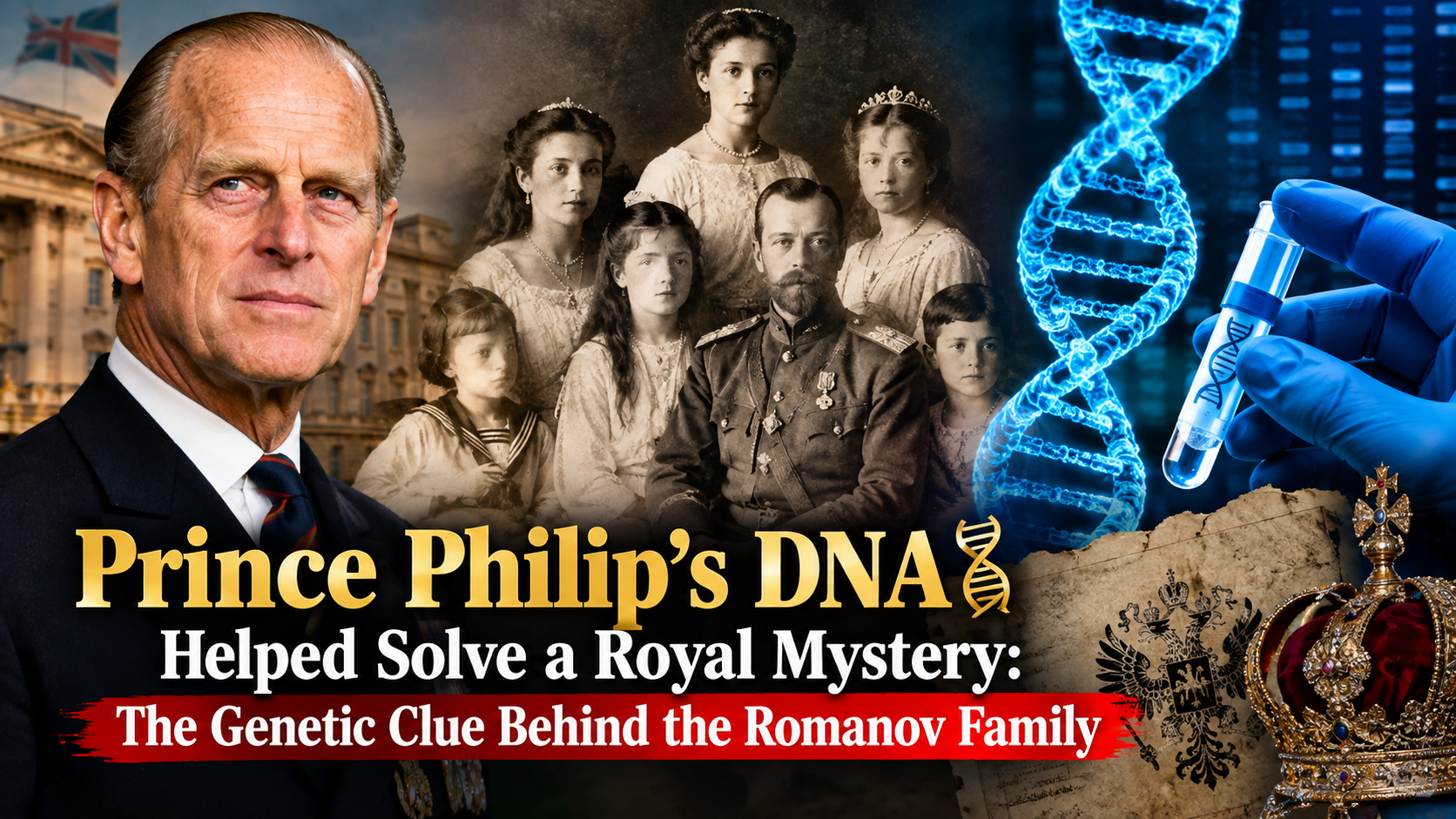
For decades, one of the most haunting mysteries surrounding European royalty remained unsolved: what happened to Russia’s last imperial family after their murder in 1918?
The fate of Tsar Nicholas II, his wife Alexandra and their children became surrounded by rumours, missing remains and claims that some members of the family had survived.
Then, more than 70 years later, an unlikely royal connection helped scientists uncover the truth — a blood sample from Prince Philip, Duke of Edinburgh.
His DNA became an important piece of evidence in one of the most remarkable forensic investigations of the 20th century.
The Romanov Mystery: On 17 July 1918, Tsar Nicholas II, Tsarina Alexandra and their children were killed in Yekaterinburg during the Russian Revolution.
But the location of their remains remained uncertain for decades.
In 1991, investigators recovered nine skeletons from a burial site near Yekaterinburg. Scientists believed the remains could belong to Nicholas II, Alexandra and several of their children, but historical identification alone was not enough.
This was where modern forensic science entered the story.
DNA testing established that the skeletons represented a closely related family group, including a father, mother and three daughters.
Why Prince Philip Was Important?: The crucial connection came through Alexandra’s maternal family line.
Prince Philip was descended from Princess Alice of the United Kingdom, while Alexandra was also descended from Alice through the female line. This meant that Philip carried mitochondrial DNA inherited through that maternal ancestry.
Mitochondrial DNA, commonly called mtDNA, is passed from mothers to their children. Because of this distinctive inheritance pattern, it can be particularly useful when scientists are trying to establish whether unidentified remains are connected to a maternal family line.
Scientists therefore compared DNA from the recovered remains with a sample provided by Prince Philip.
The result was a match between Philip’s mitochondrial DNA and the remains believed to belong to Alexandra and her daughters.
DNA Turned a Royal Family Tree into Forensic Evidence: This is what makes the story so fascinating. Philip was not simply identified as a distant relative on a family tree. His biological connection provided scientists with a living reference point against which ancient remains could be tested.
The 1994 study published in Nature Genetics reported that mitochondrial DNA from the presumed Tsarina and three daughters matched a living maternal relative, supporting the identification of the Romanov remains.
Further research strengthened the conclusion.
Scientists also examined a distinctive mitochondrial DNA variation found in Nicholas II and compared it with additional Romanov relatives. The investigation helped resolve questions that had initially surrounded the identification.
What about Anastasia?: One of the most enduring legends surrounding the Romanovs was the possibility that Grand Duchess Anastasia had escaped the execution.
Stories about women claiming to be Anastasia appeared over the decades, most famously the case of Anna Anderson.
The later discovery of additional remains in 2007 changed the picture again. DNA testing of those remains, combined with earlier genetic evidence, identified them as the missing Romanov children — Tsarevich Alexei and one of his sisters.
The genetic evidence therefore provided a powerful answer to a mystery that had fuelled speculation for generations.
The Remarkable Role of Forensic DNA: The Romanov investigation was important far beyond royal history. Researchers had to work with extremely old and degraded biological material, while also dealing with questions about contamination, unusual DNA variations and the reliability of the remains.
The original scientific research was published in Nature Genetics, demonstrating how DNA analysis could be used to investigate historical identities as well as modern forensic cases.
The Science Museum has also described the Romanov investigation as an important development in forensic genetics, noting that the work contributed to the development of techniques for analysing small DNA samples.
A Royal Connection with an Unexpected Purpose: Prince Philip’s connection to the Romanovs was therefore much more than an interesting genealogical detail. His maternal ancestry gave scientists access to a living genetic reference that helped establish the identity of several members of the Russian imperial family.
It is a remarkable example of how a royal family tree, modern genetics and a century-old murder investigation came together.
The Romanov mystery had survived through revolutions, changing governments and decades of speculation. Eventually, part of the answer came not from a lost document or a forgotten witness, but from something far more fundamental: DNA passed through generations of a family.
The Key Takeaway: Prince Philip did not single-handedly solve the Romanov mystery. Rather, his mitochondrial DNA was an important piece of a much larger forensic investigation involving multiple relatives, DNA techniques and independent scientific analyses.
And that is what makes this episode of royal history so extraordinary: the family connections that once existed only on paper eventually became biological evidence capable of identifying the dead.