

Some books entertain you. Others teach you. And then there are books that quietly change the way you think about people, power, conflict, success and even yourself.
China has produced an extraordinary literary and philosophical tradition stretching back thousands of years. Some of its most influential works were never designed as modern self-help books, yet their ideas continue to appear in military strategy, politics, business, leadership and everyday life.
Calling them “dangerous” is, of course, metaphorical. These books are not dangerous objects. Their power comes from the fact that they can challenge assumptions you may have never questioned before.
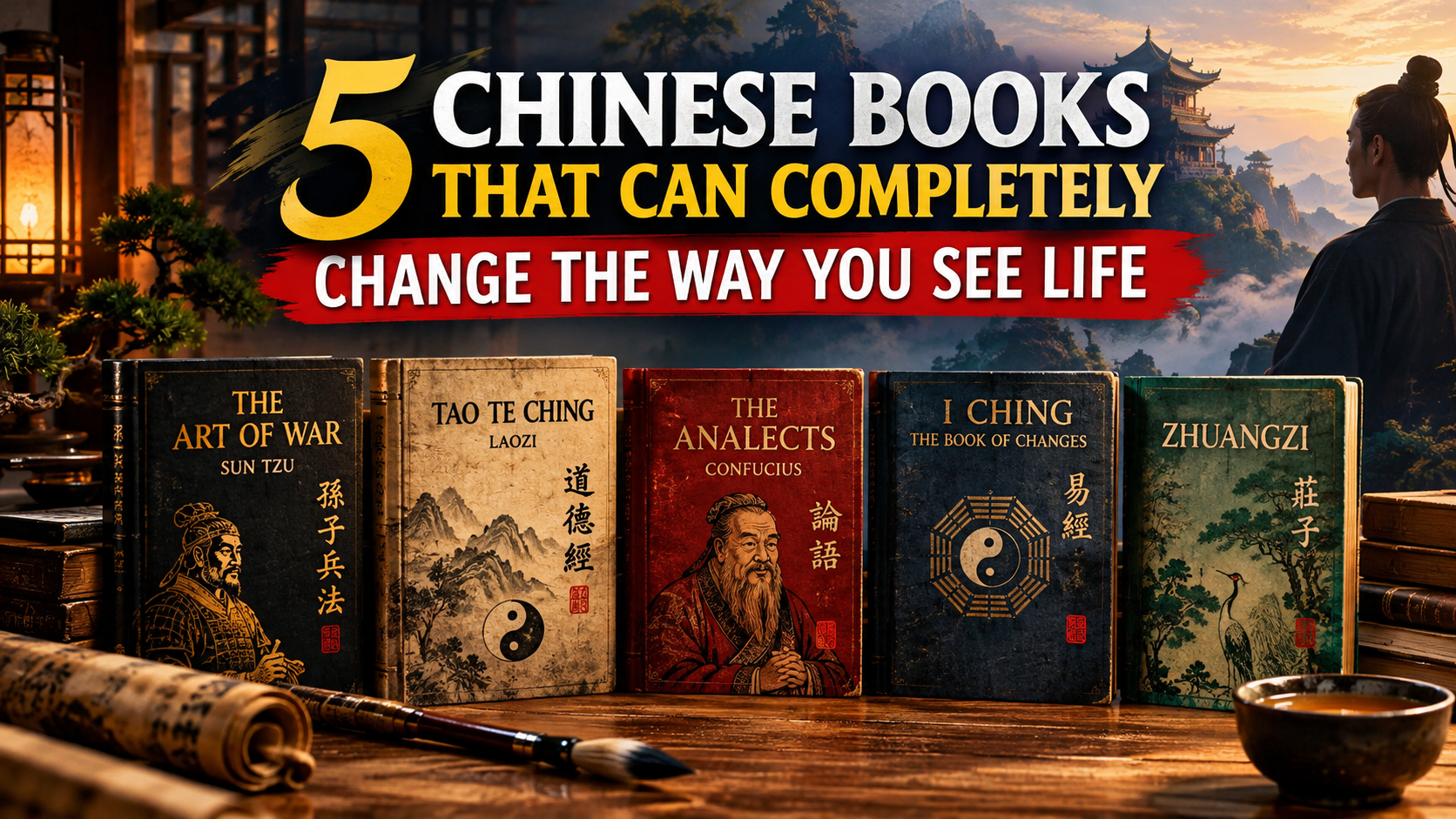
Here are 5 Chinese classics that can genuinely alter the way you look at the world:
1. The Art of War — Sun Tzu: Few Chinese books have travelled further across the world than Sun Tzu’s The Art of War. Written more than two thousand years ago, the book examines warfare, strategy, deception, preparation and the psychology of conflict. But its influence has long escaped the battlefield.
Today, its principles are discussed in business strategy, negotiation, leadership and competitive decision-making. One of its most famous ideas is that understanding both yourself and your opponent is fundamental to success.
The deeper lesson is not simply about defeating an enemy. It is about recognising that the smartest conflict may be the one you avoid altogether. That makes the book surprisingly relevant to modern life. Instead of asking, “How do I win this fight?” Sun Tzu encourages a different question: “Do I need to fight it at all?”
2. Tao Te Ching — Laozi: At first glance, Tao Te Ching seems almost the opposite of a book about power. Attributed traditionally to Laozi, this ancient Chinese text explores the Tao — often translated as “the Way” — and ideas surrounding simplicity, balance, humility and natural action.
One of its central concepts is wu wei, commonly understood as “effortless action” or acting without unnecessary force. That does not mean doing nothing. Instead, it suggests that constantly forcing situations can sometimes create the very problems we are trying to solve.
In a world obsessed with productivity, competition and control, the philosophy offers an alternative: Sometimes less resistance produces better results. That simple idea has influenced generations of thinkers and continues to attract readers searching for a different approach to life.
3. The Analects — Confucius: What happens when a civilisation builds an entire philosophy around how people should behave towards one another? You get the teachings associated with Confucius.
The Analects is a collection of sayings and conversations associated with Confucius and his students. Rather than offering a simple formula for success, it explores morality, education, responsibility, family relationships, leadership and personal character.
A recurring theme is that society cannot function properly if individuals refuse to improve themselves. For Confucius, becoming a better person was not merely a private project. Your behaviour affected your family, community and wider society. That makes the book particularly interesting today.
It asks questions that remain surprisingly modern:
- What makes someone a good leader?
- How should we treat other people?
- Is education about knowledge or character?
- What responsibilities do we have towards society?
- Can a society improve without individuals improving themselves?
The answers are ancient, but the questions are still very much alive.
4. I Ching — The Book of Changes: The I Ching, or Book of Changes, is one of China’s oldest and most influential classical texts. It is traditionally associated with a system of 64 hexagrams, which represent different patterns and changing circumstances.
For centuries, people have consulted the text for guidance and reflection. But its broader philosophical importance goes beyond divination. The underlying idea is that change is unavoidable. Situations shift. Fortunes rise and fall. Strength can become weakness, while weakness can eventually become strength.
That perspective can completely alter how someone interprets difficult periods. Instead of thinking: “This is how things will always be.” The philosophy encourages a different perspective: “What is changing, and how should I respond?” That is a powerful mindset in both personal life and an unpredictable world.
5. Zhuangzi — The Philosophy of Perspective: If you want a Chinese classic capable of making you question reality itself, Zhuangzi is difficult to ignore. Attributed to the philosopher Zhuang Zhou, the text is filled with strange stories, humour, paradoxes and thought experiments.
One of its most famous stories involves Zhuangzi dreaming that he was a butterfly. When he woke, he wondered whether he was a man who had dreamed of being a butterfly — or a butterfly dreaming that it was a man. The story is not simply about dreams. It raises a much bigger question: How certain are we about the way we perceive reality?
Zhuangzi repeatedly challenges rigid distinctions between right and wrong, success and failure, usefulness and uselessness. Its message can be unsettling because it encourages readers to question their own assumptions. And sometimes, that is exactly what a powerful book should do.
Why These Books Can Feel “Dangerous”:
- None of these works is dangerous in the conventional sense.
- Their potential power lies somewhere else.
- They can make you question ideas you previously accepted without thinking.
- The Art of War can change how you understand conflict.
- Tao Te Ching can challenge your obsession with control.
- The Analects can make you reconsider responsibility and character.
- I Ching can change how you think about uncertainty and change.
- Zhuangzi can make you question your own perception of reality.
Together, they demonstrate something remarkable about Chinese philosophy: power does not always come from having more force. Sometimes it comes from understanding situations more deeply.
The Bigger Lesson: The most fascinating thing about these books is their age. They were written or compiled centuries — and in some cases millennia — before modern psychology, management theory and popular self-improvement literature existed.
Yet their questions remain remarkably relevant:
- How should we deal with conflict?
- How much control do we really have?
- What makes a good leader?
- How should we respond to change?
And perhaps the most uncomfortable question of all:
- How much of our view of life is shaped by what we’ve been taught?
- That may be the real reason these ancient books continue to feel so powerful.
- They do not simply give you answers.
- They can change the questions you ask.