

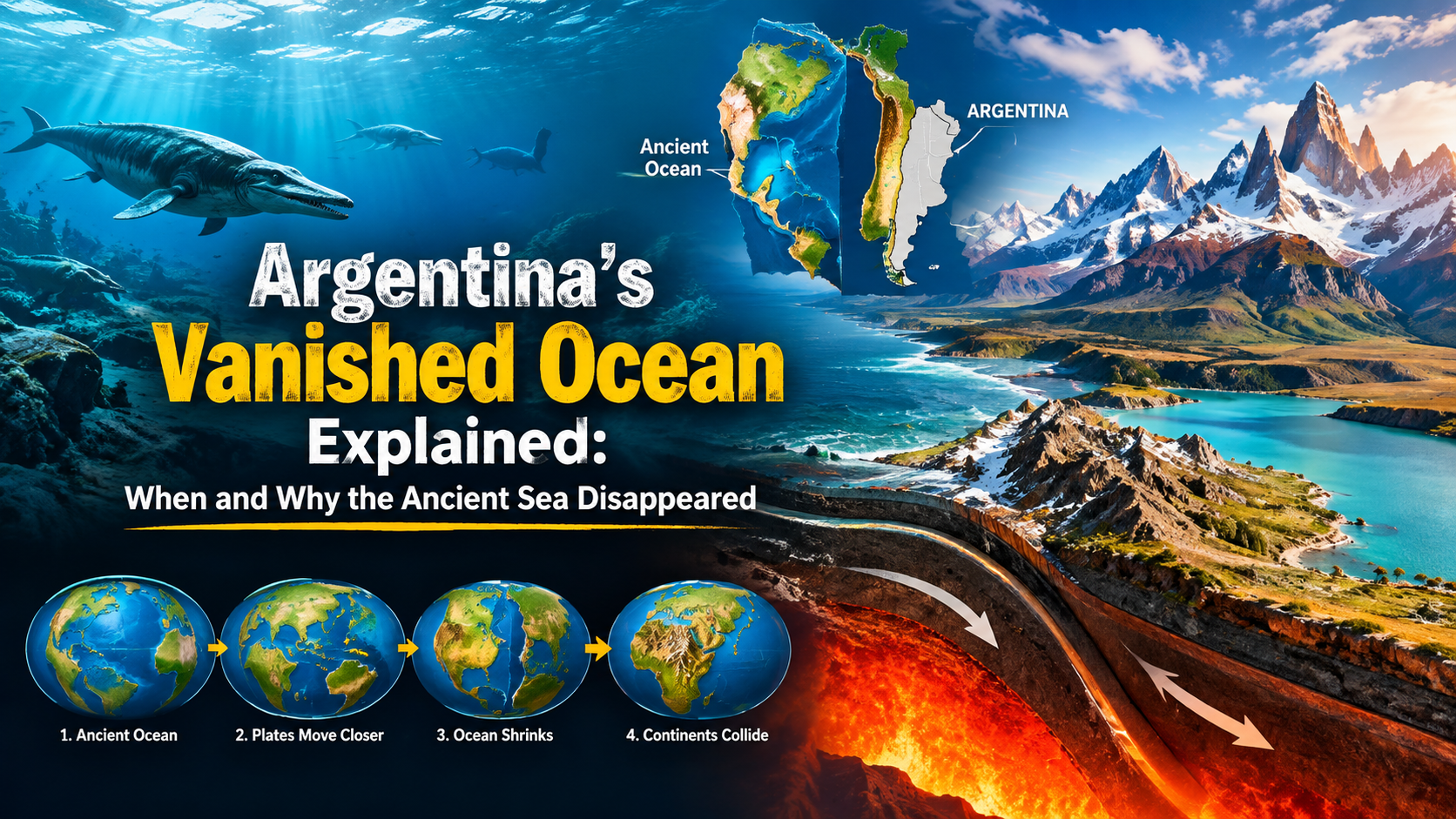
Imagine standing on the land that is now Argentina and looking across a vast ocean that no longer exists.
This sounds like science fiction, but Earth’s geological history tells a far more dramatic story. Long before modern Argentina, the Andes or even the Atlantic coastline existed; enormous ancient oceans separated fragments of the continents. Over hundreds of millions of years, the moving crust of our planet slowly destroyed some of these oceans.
So, when people say “Argentina’s ocean vanished”, it is important to understand one thing: Argentina has not lost the Atlantic Ocean today. Instead, the land that eventually became part of Argentina contains geological evidence of ancient oceans that disappeared as continents collided and the supercontinent Gondwana was assembled. One of the most important examples is the ancient Clymene Ocean.
The Ocean That Existed Before Argentina: More than half a billion years ago, the world map would have been completely unrecognisable.
South America did not exist in its modern form. Instead, ancient blocks of continental crust were separated by oceans. Geological research suggests that the Clymene Ocean lay between major ancient continental regions, including the Amazon, São Francisco and Río de la Plata cratons—the latter being an important piece of crust connected with parts of present-day Argentina and Uruguay.
The sea was not something that simply evaporated. It was a genuine ocean basin created and eventually destroyed by the enormous forces of plate tectonics.
How Did Argentina’s Ancient Ocean Vanish?: The answer lies beneath our feet. Earth’s outer shell is broken into massive tectonic plates. These plates move extremely slowly, usually by only centimetres each year. However, over millions of years, those tiny movements can completely redraw the planet.
The disappearance of an ocean generally follows a dramatic geological sequence:
- Continents Begin Moving Together: Ancient continental blocks gradually moved towards one another. The ocean trapped between them became narrower as the distance separating the continents decreased.
- The Ocean Floor Began to Sink: Oceanic crust is constantly recycled by Earth. At destructive plate boundaries, dense oceanic crust can be forced beneath another tectonic plate in a process called subduction. The crust descends deep into the Earth, where it is gradually recycled into the mantle. Argentina’s own geological institutions explain that oceanic lithosphere can disappear through subduction zones, balancing the creation of new ocean floor elsewhere on Earth.
- The Ocean Became Smaller and Smaller: As subduction continued, more of the ancient seabed disappeared beneath the surrounding continental crust. Over geological time, an enormous ocean can be reduced to a narrow sea.
- The Continents Collided: Eventually, the continental blocks reached one another. Continental crust is relatively buoyant and difficult to force deep into the mantle. Instead of one continent simply disappearing beneath the other, the collision compresses, folds and deforms the crust.
This process can create mountain belts, fault zones, volcanic activity and deep geological scars known as sutures.
Research into the Sierras Australes of Argentina links geological evidence in the region with the wider collision processes associated with the closure of the Clymene Ocean and the assembly of western Gondwana.
When Did the Ocean Disappear?: The disappearance was not a single event. It was a geological process lasting millions of years during the late Precambrian and early Cambrian periods, as ancient continental blocks collided during the formation of Gondwana.
The geological evidence associated with Argentina includes late Ediacaran and Cambrian tectonic and magmatic activity. These events form part of the immense continental rearrangement that eventually helped create the southern supercontinent of Gondwana.
In simple terms:
- The ocean did not disappear overnight.
- It was slowly consumed by the Earth itself.
Why Did It Vanish?: The main reason was plate tectonics. Earth is not a fixed planet. Continents drift, ocean floors are created and destroyed, and mountains rise where ancient land masses collide.
The ancient ocean vanished because:
- Continental blocks moved towards each other.
- Oceanic crust was consumed through subduction.
- The ocean basin became progressively narrower.
- Continental collision closed the remaining ocean.
- The collision helped assemble larger continental land masses.
This is one of the most powerful forces shaping our planet. Today’s continents are only temporary arrangements in Earth’s Geological History.
What Does This Have to Do With Modern Argentina?: The Argentina we know today sits on a landscape built from an extraordinarily complicated geological history.
Some of its oldest rocks and geological structures preserve evidence of ancient continental collisions, volcanic events and crustal movements. The Sierras Australes of central-eastern Argentina, for example, have been studied as part of the evidence used to understand the southern extent of these ancient tectonic events.
The modern country did not suddenly lose an ocean. Rather, the land beneath modern Argentina remembers oceans that disappeared long before humans, dinosaurs and even most complex life on Earth existed.
But Did the Sea Recently “Vanish” From Argentina?: Recent viral claims about the ocean suddenly disappearing from Argentina should not be confused with this ancient geological story.
Reports circulating online have claimed that the Atlantic Ocean near Argentina suddenly dried up or vanished. However, such claims can exaggerate temporary coastal water retreats caused by tides and weather conditions.
A temporary retreat of seawater is completely different from an ocean being permanently destroyed by plate tectonics.
The Fascinating Truth – Oceans Are Not Permanent: Perhaps the most astonishing lesson from Argentina’s geological past is that oceans themselves are temporary. We often think of oceans as permanent features of Earth. Yet geological history tells us otherwise.
Oceans can:
- Open when continents split apart.
- Grow wider for millions of years.
- Change their shape as tectonic plates move.
- Begin closing through subduction.
- Eventually disappear when continents collide.
The Atlantic Ocean beside Argentina exists today because of continental movements that separated South America from Africa. Argentina’s geological history also records for older tectonic systems in which other ocean basins were gradually destroyed.
Final Thoughts – The Ocean Did Not Simply Disappear — Earth Recycled It: The story of Argentina’s vanished ocean is not really a story of water disappearing. It is the story of a living planet.
Over immense periods of time, continents moved across the Earth, ancient ocean floors sank into the mantle, volcanoes erupted, mountains formed and entirely new supercontinents emerged.
The water moved and changed, but the ancient ocean basin itself was destroyed. Modern-day Argentina stands on a landscape shaped by a geological world that once looked completely different. Where there is now land, mountains and plains, there were once ancient seas. Where there were oceans, continents eventually collided and that may be the most extraordinary part of the story: On Earth, even an ocean can have a beginning—and an end.