

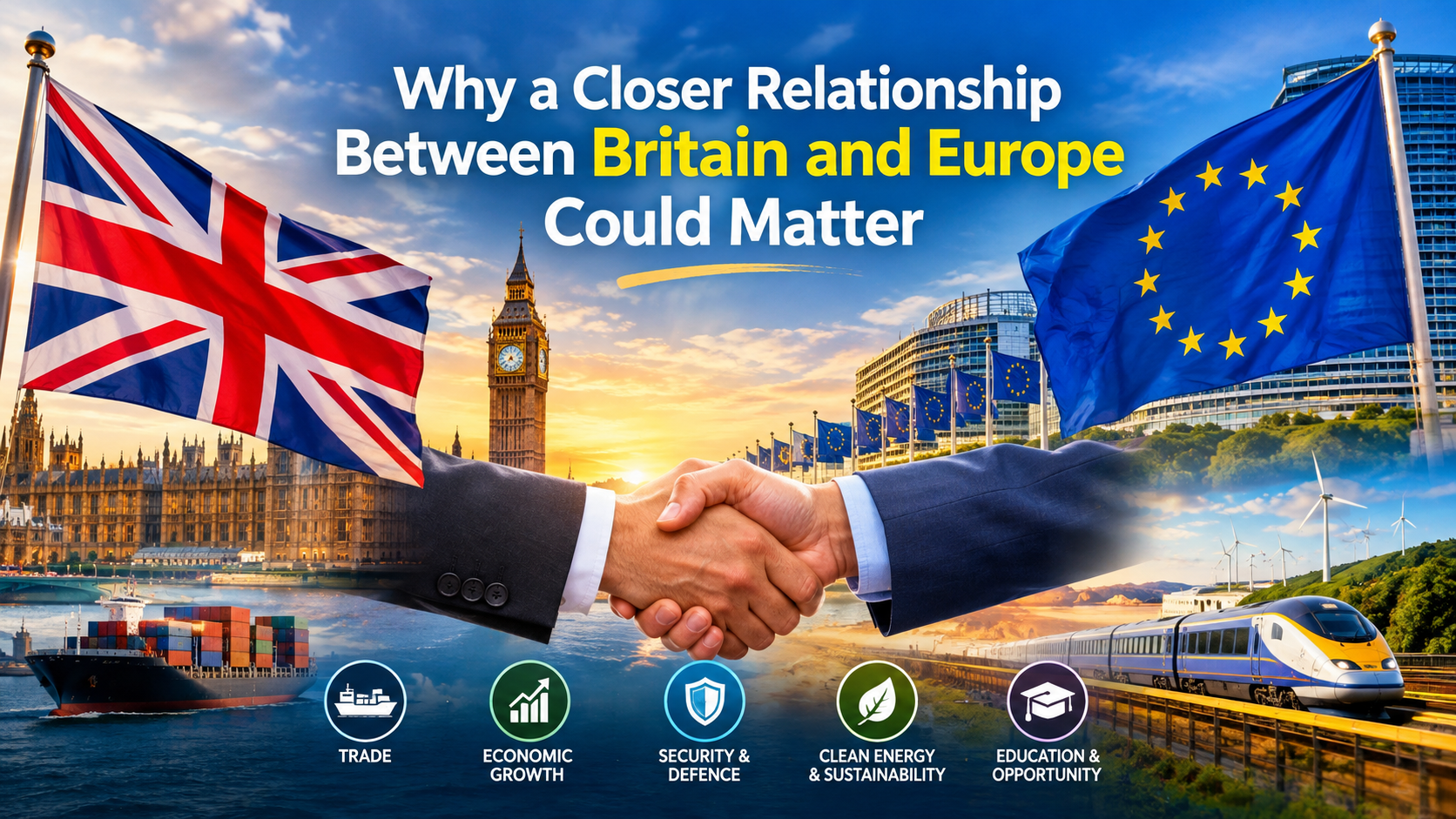
For years, Britain’s relationship with Europe has been dominated by one enormous political event: Brexit. But the conversation is gradually changing. Rather than asking whether the United Kingdom should simply return to the European Union, attention is increasingly turning towards a different question: Can Britain build a closer, more practical relationship with Europe without rejoining the EU?
That distinction matters.
In 2026, the UK government has been openly pursuing closer cooperation with European countries and the European Union, particularly in areas such as trade, security, energy, education and economic growth. The government has described closer European cooperation as a way of creating opportunities while protecting Britain’s national interests.
What Does “Closer to Europe” Actually Mean?: A closer relationship does not automatically mean Britain is rejoining the European Union. The UK remains outside the EU, and the existing relationship is governed largely by the post-Brexit Withdrawal Agreement and the Trade and Cooperation Agreement. However, both sides are exploring additional areas of cooperation.
These discussions include subjects such as:
Trade in agricultural and food products
Energy and electricity
Emissions trading
Defence and security
Youth mobility
Scientific research
Northern Ireland
Cross-border cooperation
The European Council has also authorised work towards UK participation in Erasmus+ from 2027, while discussions have progressed around electricity cooperation and other areas.
In other words, the debate is increasingly about practical cooperation rather than old political arguments.
Why Trade Is Such an Important Part of the Story: Britain and the European continent are geographically close and have deeply connected economies. Businesses on both sides depend on predictable supply chains, customers, workers, transport links and regulatory arrangements. Making those relationships easier to manage can potentially reduce some of the administrative friction that developed after Brexit.
That does not mean every problem disappears through closer cooperation. Negotiations involve compromises, financial arrangements and regulatory questions, and individual sectors can be affected differently.
The European Union and UK are therefore working through a number of separate agreements rather than creating one enormous replacement for the Brexit settlement.
Security Is another Major Reason for Cooperation: Trade is only one part of the relationship. Britain remains an important military and diplomatic power in Europe, while European countries face shared security challenges. The war in Ukraine has also demonstrated the importance of countries working together on defence, intelligence, military equipment and sanctions.
In June 2026, Britain joined France, Germany, Italy and Poland in an E5 leaders’ meeting focused on Euro-Atlantic security and closer defence-industrial cooperation.
The UK has also been strengthening bilateral defence relationships with European countries, including the Netherlands. This illustrates an important point: Britain can remain outside the EU while still being deeply involved in European security cooperation.
Young People Could See Practical Benefits: European relationships are not just about governments and large companies. They also affect students, researchers and young people who want to study, work or gain experience abroad.
The planned UK participation in Erasmus+ from 2027 is particularly significant because the programme supports international learning mobility. The EU Council says the arrangement is intended to strengthen people-to-people links and create opportunities for young people.
For a British student considering a period of study in Europe, easier access to European educational opportunities could make a meaningful difference.
Energy Could Become Increasingly Important: Britain and continental Europe are also connected through energy infrastructure and markets. The EU and UK have been discussing cooperation involving the internal electricity market. Greater coordination could become increasingly relevant as Europe attempts to improve energy security, develop cleaner power systems and reduce vulnerability to international shocks.
Energy policy is rarely glamorous, but it affects household bills, industrial competitiveness and national resilience.
Northern Ireland Makes the Relationship Especially Sensitive: There is another reason Britain cannot simply treat its relationship with the EU as an ordinary foreign-policy matter: Northern Ireland.
The Windsor Framework remains an important part of the post-Brexit arrangements. UK and EU officials continue to work on its implementation, particularly around the movement of goods between Great Britain and Northern Ireland. That means the quality of UK-EU relations has consequences inside the United Kingdom itself.
Is Closer Cooperation the Same as Rejoining the EU?: No, This is perhaps the most important distinction when discussing the subject. A closer UK-EU relationship could involve specific agreements on trade, research, education, energy, defence or security without changing Britain’s status as a non-EU country. The current direction is therefore better described as closer cooperation after Brexit, rather than an automatic return to EU membership.
The EU itself describes Britain as a strategic partner and says both sides agreed to deepen cooperation following the first EU-UK summit in 2025.
What Could Be Gained — and What Are the Trade-Offs?: Supporters of closer cooperation point to potentially smoother trade, greater economic cooperation, improved security coordination, educational opportunities and stronger relationships with Britain’s nearest neighbours.
But there are also genuine questions.
Closer agreements can involve financial contributions, regulatory alignment or compromises over national policy. Different industries may experience the effects differently. And supporters of Britain’s post-Brexit independence may argue that maintaining greater regulatory freedom is itself an important objective.
So the real debate is not simply “Britain or Europe?” Britain is already geographically, economically and strategically connected to Europe. The more useful question is: How closely should the UK cooperate with its European neighbours, and in which areas?
Britain and Europe – A Relationship That Is Evolving: The political temperature surrounding Brexit may have changed, but the underlying geography has not.
Britain is still only a short distance from continental Europe. British companies still trade with European markets. Families travel across the Channel. Universities collaborate with European institutions. And Britain and European countries share major security challenges.
Recent government activity shows that London is pursuing closer engagement with the EU and individual European governments. In September 2026, the UK government again described closer cooperation with Europe as an important objective during discussions with Ireland, Sweden, France and other European partners.
That does not settle the political debate about Brexit. It does, however, suggest that the next chapter of Britain’s European story may be less about leaving or remaining and more about how Britain works with its neighbours and for many people, that is where the practical consequences will ultimately be felt — in jobs, trade, travel, education, security and the everyday relationship between Britain and the rest of Europe.