

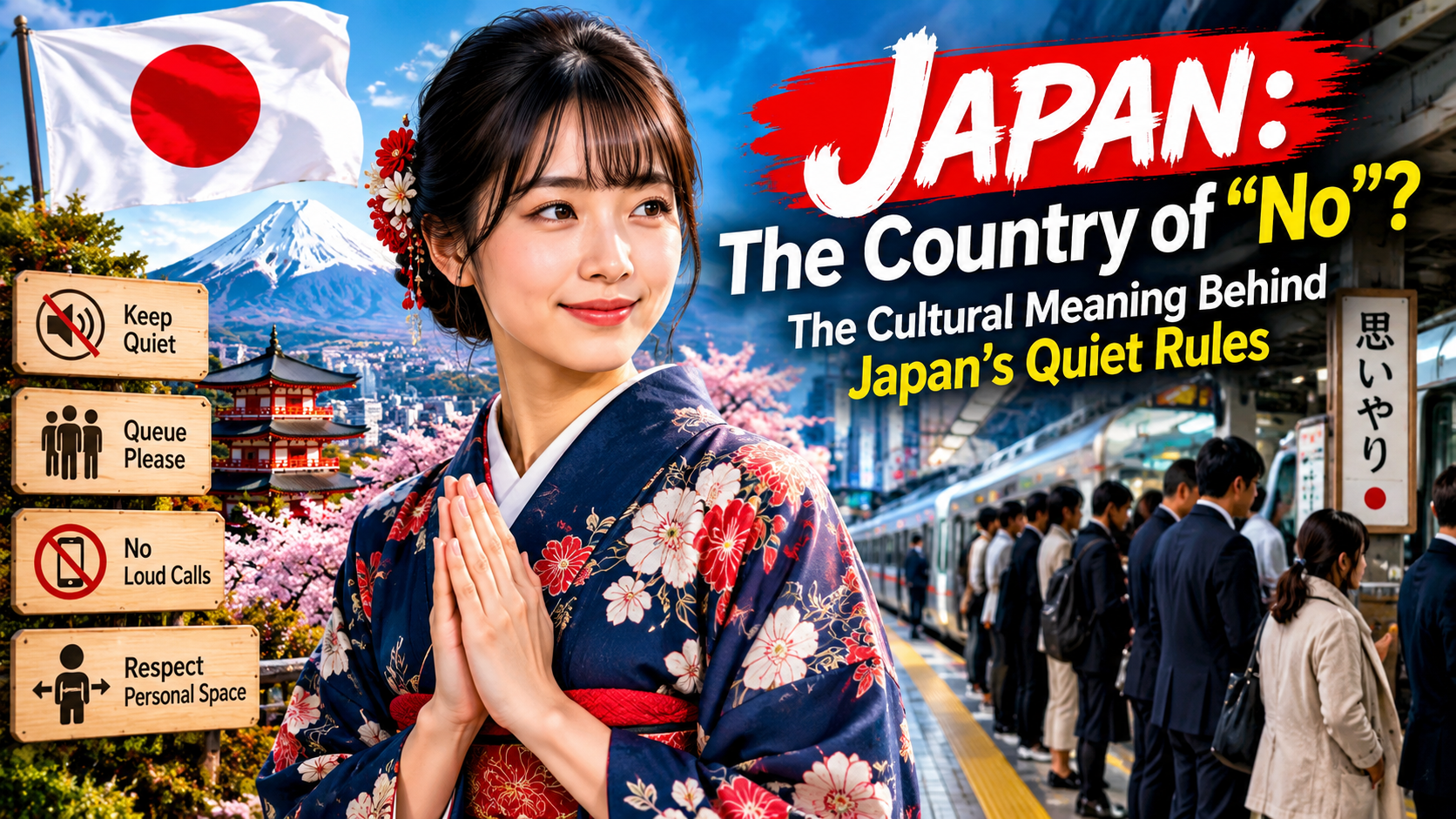
At first glance, the phrase “Japan is officially the country of ‘No’” sounds like an intriguing national rule. But there is an important detail that viral social-media posts often leave out: Japan is not officially called the “Country of NO”.
The phrase is better understood as a catchy description of a cultural habit — Japan’s preference for politeness, social harmony, restraint and consideration for other people. Rather than constantly saying “no” directly, Japanese society often communicates boundaries through behaviour, indirect language and unspoken social expectations.
Why Does Japan Seem Like a Country of “No”?: Japan has a highly developed culture of social etiquette. People are generally expected to think about how their actions affect those around them.
This can be seen in everyday situations:
- Keep your voice down on trains.
- Avoid blocking entrances and walkways.
- Queue patiently rather than pushing ahead.
- Respect other people’s personal space.
- Follow instructions in public places.
- Avoid creating unnecessary disturbance.
- Be mindful of people around you.
For visitors, some of these expectations can feel surprisingly strict. However, they are less about saying “NO” and more about saying “please consider everyone else.”
The Japanese Idea of Social Harmony: One important concept behind Japanese behaviour is wa, commonly associated with harmony within a group. The idea encourages people to avoid unnecessary confrontation and disruption. In practical terms, this can mean controlling one’s behaviour in public so that other people are not inconvenienced.
For example, speaking loudly on a crowded train might attract unwanted attention, even if nobody directly tells you to stop. That is where the viral “country of no” idea becomes interesting. The “no” is often implicit rather than spoken.
Why Japanese People May Avoid Saying “No” Directly: Japanese communication can sometimes be indirect, particularly when refusing a request or avoiding confrontation. Instead of a blunt “No”, someone might use a softer expression or explain that something is difficult or inconvenient.
To a foreign visitor, this can occasionally be confusing.
A response that sounds like “That may be difficult” could effectively mean that the answer is no — without the person having to use a direct refusal. This approach can help preserve politeness and prevent unnecessary embarrassment.
Public Transport Shows This Culture Clearly: Japan’s railway system provides one of the clearest examples of this social discipline. Passengers commonly queue before boarding, allow others to leave the train first and avoid unnecessarily disturbing fellow travellers.
On some trains, passengers are also encouraged to keep phone conversations to a minimum. None of this means that Japanese people are constantly being told what they cannot do. Instead, social expectations have become part of everyday behavior.
“No” Can Mean Respect: What appears restrictive from the outside can have another interpretation.
- Don’t block the way can mean respect people’s movement.
- Don’t shout on public transport can mean respect other passengers.
- Don’t pushes into a queue can mean respect everyone’s time.
- Don’t invade someone’s space can mean respect personal boundaries.
In this sense, Japan’s unwritten “no’s” are often connected to a much bigger cultural idea: consideration for others.
Is Japan Really “Officially” the Country of No?: No, There is no official Japanese national designation that makes Japan the “country of no”. The wording in the image is essentially a social-media headline, designed to turn several Japanese etiquette practices into one memorable idea.
Japan is officially known as Nihon or Nippon in Japanese, meaning Japan, and it has no governmental title declaring it the “country of no”. So the viral claim should not be taken literally.
Why This Makes Japan Fascinating: Japan’s social culture demonstrates something quite unusual: rules do not always need to be written down to influence behaviour. People learn expected behaviour through family, school, workplaces and society. Over time, these expectations can become almost automatic.
For tourists, understanding these unwritten rules can make travelling around Japan considerably easier. You do not necessarily need to memorise hundreds of regulations — simply being observant, considerate and willing to follow the people around you can go a long way.
Final Thoughts: Calling Japan “the country of No” makes for a powerful social-media headline, but it misses the deeper story.
Japan is not officially a country of “no”. Rather, it has a culture where self-control, courtesy and consideration for others can strongly influence everyday behaviour.
What looks like a long list of restrictions may actually be a different way of expressing a simple principle: Your freedom matters — but so does everyone else’s comfort and perhaps that is the real lesson hidden behind the viral image: sometimes a society does not need to repeatedly say “no” because people already understand what respectful behaviour looks like.