

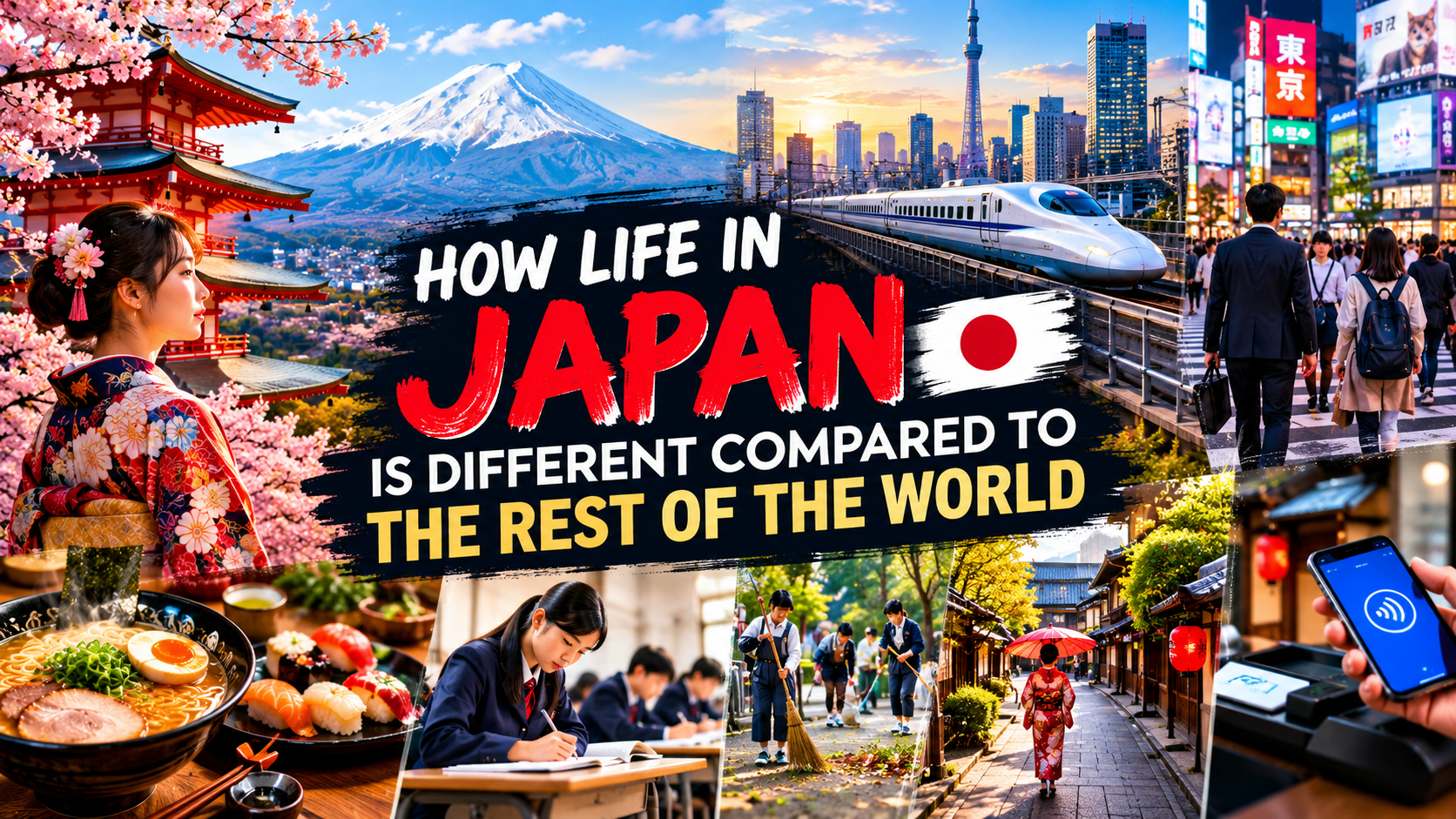
Japan is often described as a country where ancient traditions and futuristic technology exist side by side. From quiet neighbourhood streets and punctual trains to distinctive social customs and demanding work culture, everyday life in Japan can feel noticeably different from what visitors may be accustomed to elsewhere.
But what really makes Japanese life different? The answer is not one single tradition. It is the combination of social expectations, public behaviour, technology, food, transport, education and a strong sense of community.
Respect Is Built Into Everyday Life: One of the most noticeable differences is the importance placed on respect and consideration for others.
Bowing is commonly used when greeting, thanking or apologising. Language itself also changes depending on the level of politeness and the relationship between people. This emphasis on courtesy can be seen in ordinary situations — from shops and restaurants to workplaces and public transport. The idea is often to avoid causing unnecessary inconvenience to another person.
Public Transport Runs on Precision: Japan’s railway system is famous for its efficiency and punctuality. In major cities, trains provide a practical alternative to driving, while stations can become enormous transport hubs connecting railways, underground services, shops and restaurants.
For many people, commuting is simply part of the daily routine. Passengers generally keep conversations quiet, queues are organised and mobile-phone etiquette is taken seriously on many services. This creates a very different atmosphere from cities where public transport can be considerably noisier or less predictable.
Small Spaces Encourage Clever Living: Japan has some densely populated urban areas, particularly around Tokyo and other major cities. As a result, homes and businesses may make impressive use of limited space.
Compact furniture, efficient storage and carefully planned interiors are common themes. Even restaurants, cafés and accommodation can sometimes operate within surprisingly small premises. Rather than simply seeing a small space as a limitation, Japanese design often focuses on making every part of it useful.
Cleanliness Is More Than Just Appearance: Clean streets and well-maintained public spaces are frequently associated with Japan. An interesting aspect is that public rubbish bins can sometimes be surprisingly difficult to find, yet people are generally expected to take responsibility for their own rubbish.
Schools also have a distinctive approach to cleanliness. Students can participate in cleaning classrooms and other areas, helping to reinforce the idea that maintaining a shared environment is everyone’s responsibility.
Food Culture Goes Far Beyond Sushi: When people think about Japanese cuisine, sushi is usually the first thing that comes to mind. Yet Japanese food culture is far broader.
Ramen, udon, soba, tempura, curry rice, yakitori, onigiri and countless regional dishes form part of everyday eating. Seasonal ingredients are also highly valued, and presentation can be almost as important as flavour. Another fascinating feature is the attention given to convenience food. Japanese convenience shops are not simply places to buy snacks; many offer surprisingly varied meals and ready-to-eat foods.
Technology Is Everywhere — But Tradition Has Not Disappeared: Japan has a global reputation for technological innovation. High-speed trains, advanced manufacturing, robotics and sophisticated consumer electronics have all contributed to that image.
Yet modern Japan has not abandoned its past. Temples, shrines, traditional festivals, tea culture, crafts and centuries-old customs continue to exist alongside skyscrapers, gaming centres and cutting-edge technology. That mixture is one of Japan’s most distinctive characteristics: old and new are not necessarily competitors — they can exist together.
Silence Can Be a Form of Courtesy: In some cultures, lively conversation in public places is perfectly normal. In Japan, keeping noise under control can be considered a sign of consideration.
On trains, for example, passengers are generally expected to avoid loud conversations and disruptive behaviour. This does not mean Japanese people never socialise loudly or have fun. It simply reflects a cultural distinction between private and public behaviour.
Work Culture Can Be Intense: Japan’s working culture has long attracted international attention. Historically, some employees have faced long working hours and strong expectations surrounding commitment to their employer.
At the same time, Japanese workplaces have been changing, with greater attention being given to work-life balance, flexible working arrangements and employee wellbeing. It is therefore important not to treat the old stereotype of the endlessly working Japanese employee as a complete picture of modern Japan.
Education Teaches More Than Academic Subjects: Japanese schools place considerable emphasis on discipline, cooperation and responsibility.
Students learn academic subjects, but school life can also involve cleaning duties, clubs and group activities. These experiences can encourage teamwork and a sense of belonging to the wider school community. The educational experience can therefore feel different from systems that concentrate more heavily on individual achievement.
The Concept of “Meiwaku”: One useful idea for understanding Japanese social behaviour is meiwaku — causing trouble, inconvenience or disturbance to others.
It helps explain why certain behaviours may be discouraged in public spaces. Speaking loudly, ignoring queues or creating unnecessary disruption can be viewed negatively because they affect people around you. This doesn’t mean everyone behaves identically. Japan is, of course, made up of millions of individuals with different personalities and lifestyles. But social awareness remains an important part of understanding everyday Japanese culture.
Why Does Japan Feel So Different?: The biggest difference is perhaps the balance between individual behaviour and collective responsibility. Many aspects of Japanese life encourage people to consider how their actions affect those around them. Queueing, public transport etiquette, cleanliness and respectful communication are all connected by this broader principle.
At the same time, Japan is not a frozen traditional society. It is a modern country facing familiar challenges such as an ageing population, changing employment patterns, expensive housing in major cities and the pressures of modern urban life.
Final Thoughts: Japan’s uniqueness is not simply about sushi, bullet trains or futuristic technology. Its real fascination lies in the ordinary details of daily life — how people travel, work, eat, communicate and share public spaces.
For an international visitor, these small differences can make Japan feel unfamiliar at first. Spend more time there, however, and a pattern begins to emerge: efficiency, respect, cleanliness, tradition and innovation are woven into everyday life in ways that make Japanese society particularly distinctive.