

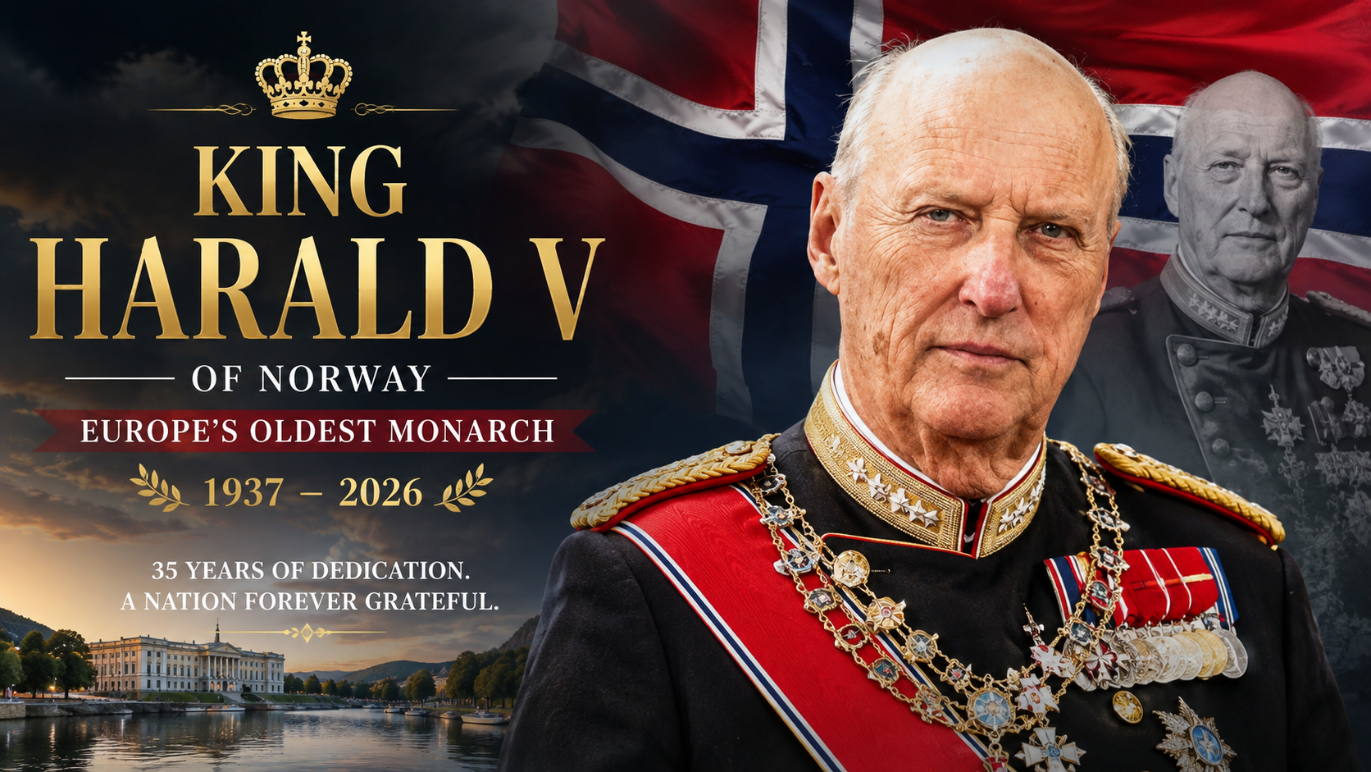
Norway is mourning the death of King Harald V, who passed away peacefully at Oslo University Hospital on Friday, 28 August 2026, at the age of 89. The Royal Court of Norway confirmed his death, bringing an end to a remarkable reign that began in 1991 and lasted more than three decades.
The news marks more than the passing of a monarch. For many Norwegians, Harald represented continuity, calmness and a familiar presence through some of the country’s most difficult moments.
A King Who Ruled for 35 Years : Harald became King of Norway in January 1991, succeeding his father, King Olav V. Over the following 35 years, he became one of Europe’s longest-serving and oldest reigning monarchs.
Unlike monarchs who wield direct political authority, Norway’s king serves primarily as a constitutional head of state. Harald’s influence was therefore less about political power and more about representing the country, supporting national institutions and providing a sense of unity. His long reign stretched across enormous social and technological changes, from the early days of the internet to today’s digital age.
From Wartime Childhood to the Norwegian Throne : Harald’s childhood was shaped by the Second World War. When Nazi Germany occupied Norway, the young prince and his family went into exile. He spent part of the war years in the United States before eventually returning to Norway.
That experience remained an important part of his personal story and helped shape the generation of Norwegian royalty that followed the war.
He later became an accomplished sportsman, particularly known for sailing. He represented Norway at three Olympic Games, demonstrating a competitive side that was rather different from the formal image usually associated with royalty.
A Royal Marriage That Broke With Tradition : One of the defining chapters of Harald’s private life was his relationship with Sonja Haraldsen, a commoner. Their romance faced considerable resistance because marrying a non-royal was far from conventional at the time. Nevertheless, Harald and Sonja eventually married in 1968. When Harald became king, Sonja became Queen of Norway.
Their marriage became an important example of how Norway’s monarchy gradually moved away from some of the rigid traditions associated with European royal families.
A Monarch Known for His Humanity : Harald’s greatest strength was arguably not ceremony but connection. He frequently spoke about equality, tolerance and the importance of standing together as a nation. Following the 2011 terrorist attacks in Norway, his public response helped reinforce his reputation as a compassionate and unifying national figure.
Rather than presenting the monarchy as distant from ordinary people, Harald often sought to portray the royal family as part of Norwegian society. That approach helped him maintain strong public affection during much of his reign.
His Final Years : Harald’s final years were increasingly affected by health problems, and he had several periods of hospital treatment.
In August 2026, his health deteriorated significantly after he was hospitalised with a bacterial bloodstream infection. The Royal Court announced that his condition had become very serious shortly before his death. The Norwegian royal announcement subsequently confirmed that he died peacefully at Rikshospitalet in Oslo at 6:35am on 28 August.
Norway Has a New King : Harald’s death immediately brought a historic transition. His son, Crown Prince Haakon, succeeded him as king. He became King Haakon VIII, beginning a new chapter for the Norwegian Monarchy. The succession follows Norway’s constitutional system, in which the throne passes through direct descent.
For Norway, therefore, the moment is both an ending and a beginning: the country says farewell to a monarch who spent 35 years on the throne while welcoming a new king who has already served as regent during his father’s periods of illness.
The Legacy of King Harald V : King Harald’s legacy is unlikely to be measured simply by the number of years he wore the crown.
He inherited a traditional institution and helped make it feel more approachable and modern. His marriage to Sonja challenged old royal conventions, his sporting interests revealed a less formal side of his character, and his public appearances during national tragedies showed a monarch who understood the emotional responsibility of his position.
For three and a half decades, his reign provided a steady thread through changing times. King Harald V is gone, but the Norway he represented will carry his Legacy Forward.