

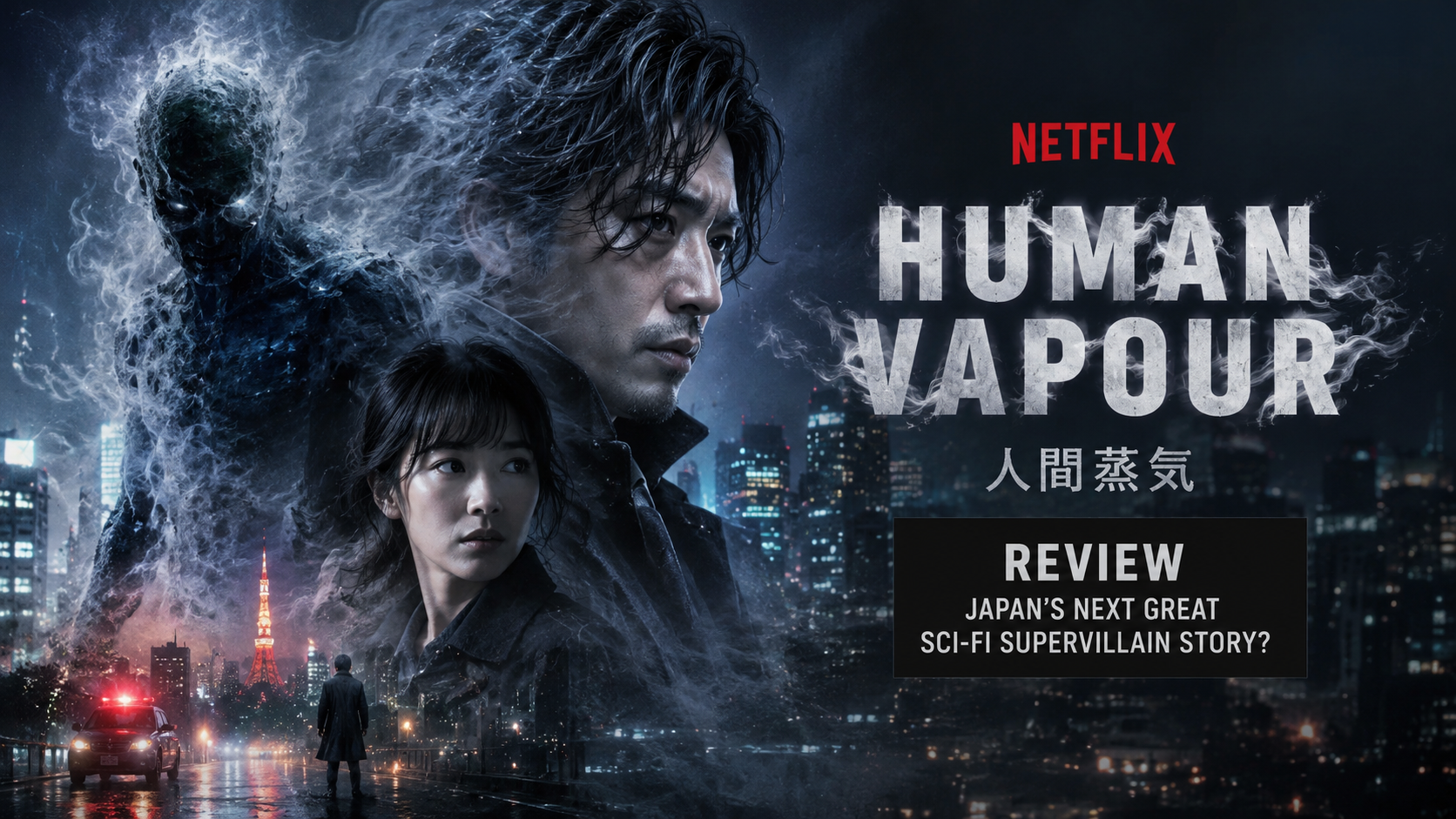
Human Vapor is a gripping Japanese sci-fi thriller that successfully blends mystery, horror and emotional drama into an eight-episode series. Inspired by Toho’s 1960 classic, the story follows Detective Kenji Okamoto and reporter Kyoko Kono as they hunt a mysterious killer who can transform into vapour and strike without warning. While the supernatural premise is extraordinary, the series keeps its focus firmly on human suffering, revenge and the devastating consequences of unethical scientific experiments. The performances, particularly from Shun Oguri and Yu Aoi, are compelling, while the visual effects and cinematography give the series a cinematic quality rarely seen on television.
The series unfolds at a measured pace, gradually revealing the truth behind the sinister “White Center” project and the tragic origins of the Human Vapor. Each episode raises the stakes with new revelations, emotional flashbacks and increasingly dangerous confrontations, culminating in a tense and satisfying finale that answers most major questions while leaving the door open for future stories. Although the middle episodes occasionally slow the momentum, the intelligent storytelling, strong character development and haunting atmosphere make Human Vapor one of Netflix’s standout sci-fi dramas of 2026. Rating: 4.5/5 stars
Episode Guide (Short Story Summary)
Episode 1 – The Interview : A respected professor dies in a horrifying live television broadcast after being attacked by an unseen force. Reporter Kyoko Kono and suspended detective Kenji Okamoto begin investigating a mysterious killer capable of transforming into vapour, uncovering the first clues to an impossible crime.
Episode 2 – Informant : As another target emerges, investigators discover links to the secretive White Center project. A former director realises he is next on the killer’s list, while evidence points towards organised crime and a much larger conspiracy.
Episode 3 – The Journal : A confidential journal detailing White Center’s experiments falls into dangerous hands. Criminal groups attempt to exploit the information, forcing both the police and the mysterious killer into a race to control the truth.
Episode 4 – Terror Zone : Kenji and Kyoko uncover more about the Human Vapor’s tragic past, revealing how betrayal and unethical experiments transformed an ordinary man into a deadly force seeking revenge against those responsible.
Episode 5 – Bunko Ramen : The investigation intensifies as hidden alliances are exposed and personal sacrifices are made. Emotional backstories deepen the conflict while the Human Vapour edges closer to completing his deadly mission.
Episode 6 – Mufu : The conspiracy behind White Center begins to unravel completely. As the authorities close in, Kenji must confront painful memories while Kyoko risks everything to uncover the full truth.
Episode 7 – Ellie My Love : With society descending into panic, the Human Vapour launches his most dangerous attacks yet. The detectives race against time to stop a final act of vengeance before more innocent lives are lost.
Episode 8 – Wish : The final confrontation reveals the complete truth behind the Human Vapour and the White Center experiments. Justice, sacrifice and redemption collide in a dramatic ending that resolves the central mystery while hinting that the story may not be entirely over.
Master the Art of Creating Original Comic Characters That Stand Out
When creating a new superhero or villain, the character needs an internal logic that makes them believable, memorable, and different from existing comic-book icons. A strong character is not defined by powers alone, but by the reasons behind those powers, the limits they face, and the choices they make.
Here are the key elements:
- Origin Story : Explain how they gained their abilities. This could come from advanced technology, a scientific accident, alien DNA, magic, ancient relics, artificial intelligence, or evolution. The origin should fit the world they live in.
- Core Motivation : Every great hero or villain has a purpose.
- Hero: Protect people, seek justice, redeem past mistakes, or defend the planet.
- Villain: Revenge, ambition, ideology, survival, or a belief that their actions will create a better world.
- Power with Limits : Unlimited powers remove tension. Every ability should have weaknesses or costs. For example, using powers may drain energy, shorten lifespan, require a rare resource, or only work under certain conditions.
- Personality and Conflict : Give them strengths and flaws. A fearless hero might struggle with guilt, while a ruthless villain may genuinely care for one person. Internal conflict makes characters more human.
- Visual Identity : Their costume, colours, symbol, and appearance should reflect their story. A hero born from electricity might wear glowing blue circuitry, while a shadow-based villain could appear with constantly shifting black smoke.
- Moral Philosophy : The best characters challenge ideas, not just people.
- Hero: Everyone deserves a second chance.
- Villain: Peace only comes through absolute control. Example: Villain – Chrono Wraith.
Once a brilliant physicist, Dr Elias Voss attempted to stop time to prevent global disasters. The experiment shattered his body, turning him into living temporal energy. He can slow, rewind, or accelerate time within a limited area, but every use erases part of his own memories. Believing history is humanity’s greatest enemy, he seeks to rewrite the past, regardless of the lives destroyed in the process. His tragic sacrifice gives him depth, while his memory loss creates both vulnerability and emotional stakes.
The strongest original superheroes and villains are built on consistent rules, meaningful motivations, and real consequences. Their powers create spectacle, but their choices create unforgettable stories.
Review: What Makes a Great Original Superhero or Villain?
Creating a new superhero or villain is far more challenging than inventing flashy powers. The strongest characters are driven by believable motivations, clear moral values, and realistic limitations. Their abilities should follow consistent rules and come with meaningful consequences, ensuring that every battle feels earned rather than effortless. Whether the character is a noble protector or a ruthless antagonist, audiences connect most with those who have emotional depth, personal struggles, and a compelling reason for their actions.
The finest comic-book icons are remembered not because they are the most powerful, but because they represent something greater. A memorable hero inspires hope despite overwhelming odds, while a great villain believes they are justified, even if their methods are destructive. By combining a distinctive origin story, unique powers, genuine weaknesses, and a striking visual identity, creators can develop characters that feel fresh, believable, and capable of standing alongside the greatest legends of the superhero genre. Rating: 4.5/5 – A strong concept that rewards thoughtful world-building and character development.