
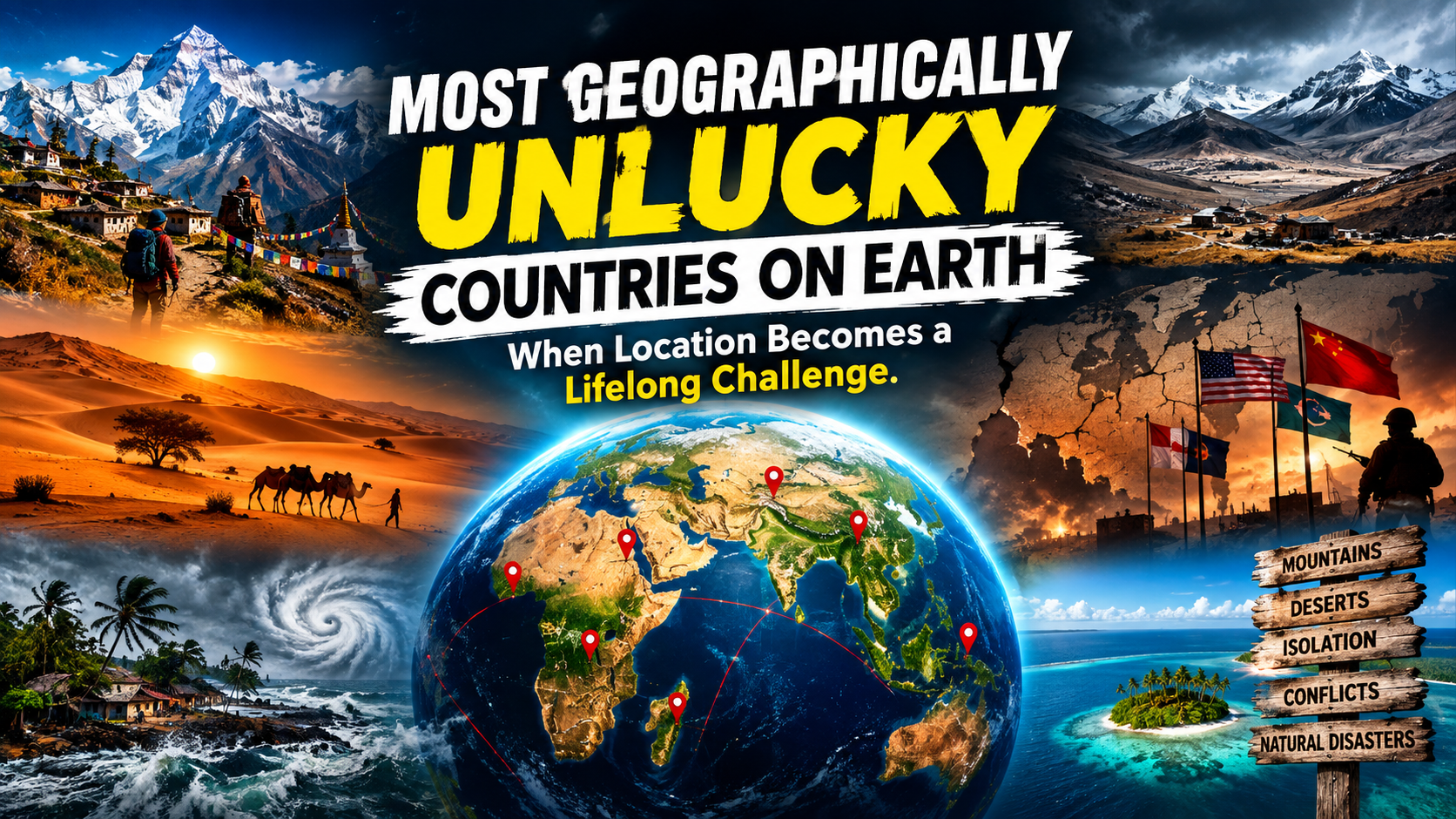
Geography can be a blessing or a burden. Some nations are positioned beside busy oceans, fertile rivers and wealthy trading partners. Others, however, seem to have drawn the short straw on the world map.
Being one of the most geographically unlucky countries on Earth does not mean a country is poor or unsuccessful. In many cases, people have built remarkable societies despite enormous natural and geographical disadvantages. Yet location can make development, trade, security and survival considerably more difficult.
From landlocked states surrounded by unstable neighbours to countries dominated by deserts, mountains, isolation or hostile climates, here are some of the places where geography has created extraordinary challenges.
1. Nepal – A Mountain Kingdom between Two Giants: Nepal is one of the world’s most spectacular countries, but its geography is also incredibly demanding.
The country is squeezed between two enormous powers, India and China. Unlike coastal nations, Nepal has no direct access to the sea, meaning international trade depends heavily on relationships and transport routes through neighbouring countries.
Then there is the landscape itself.
The Himalayas dominate much of northern Nepal, creating breathtaking scenery but making roads, railways and infrastructure extremely difficult and expensive to build. Landslides, earthquakes and harsh weather can regularly disrupt transport.
Yet Nepal’s geography also provides extraordinary advantages, including tourism, hydropower potential and some of the most dramatic natural landscapes on Earth. Perhaps Nepal is not simply geographically unlucky—it is geographically difficult.
2. Mongolia – A Vast Landlocked Nation between Russia and China: Mongolia possesses enormous open spaces, but its position presents serious economic challenges.
The country is landlocked between Russia and China, meaning access to global markets depends on passing through one of these two powerful neighbours.
Mongolia also experiences extreme temperatures. Winters can be brutally cold, while summers can be dry and harsh. Large distances between settlements make infrastructure costly.
Despite this, Mongolia has substantial mineral resources and a unique cultural identity. Its challenge is not a lack of land—it is the difficulty of turning such vast and remote territory into easily connected economic opportunity.
3. Bolivia – Landlocked and High above the Sea: Bolivia’s geography creates a particularly unusual problem.
It is landlocked, meaning it lost direct access to the Pacific coast following the War of the Pacific in the nineteenth century. International trade therefore requires cooperation with neighbouring countries and access to foreign ports.
Much of Bolivia is also located at high altitude, including areas of the Andes and the Altiplano. This creates additional difficulties for transport, agriculture and infrastructure.
However, Bolivia’s position has also given it extraordinary natural resources, including lithium reserves and mineral wealth. Geography has challenged the country—but it may also play a major role in its future.
4. Afghanistan – The Crossroads That Became a Battlefield: Afghanistan sits at a strategically important crossroads between Central Asia, South Asia and the Middle East.
That sounds like an advantage. Historically, however, being located at the intersection of powerful regions has often meant becoming involved in the ambitions and conflicts of larger powers.
The country is also heavily mountainous. The Hindu Kush creates formidable barriers, making national infrastructure and communication difficult.
Afghanistan’s geographical position has made it strategically important, but strategic importance is not always a blessing. Sometimes being located in the middle of competing powers can be one of the most dangerous positions on Earth.
5. Chad – A Landlocked Country in the Heart of Africa: Chad faces a combination of geographical difficulties.
It is landlocked, large and environmentally diverse, stretching from the Sahara Desert in the north to more fertile regions in the south. Long distances and limited transport connections make trade expensive.
A significant part of the country faces extreme heat and desert conditions, while access to international shipping routes requires crossing neighbouring states.
For countries without coastlines, every imported product can potentially become more expensive because goods must travel across additional borders before reaching consumers.
6. Niger – Trapped by Desert: Niger is one of the clearest examples of how climate and geography can shape national challenges.
Much of the country lies within the Sahara or Sahel regions, where water scarcity and extreme temperatures can make agriculture difficult.
Niger is also landlocked, meaning it has neither easy maritime access nor a particularly forgiving climate.
When drought strikes, it can have serious consequences for food production, livestock and local communities. The country’s geographical challenge is therefore not simply about being far from the sea—it is about living in one of the world’s most demanding environments.
7. The Gambia – A Country Built around a River: The Gambia has one of the most unusual shapes of any country.
It is a narrow strip of land following the Gambia River and is almost entirely surrounded by Senegal, apart from its Atlantic coastline.
This geography creates a fascinating political map, but it also means the country has limited territorial depth and depends heavily on connections with its much larger neighbour.
Its location is not necessarily disastrous, especially because it has access to the Atlantic Ocean, but its unusual borders demonstrate how historical boundaries can create geographical limitations long after they were originally drawn.
8. The Democratic Republic of the Congo – Rich in Resources, Difficult to Connect: Few countries demonstrate the complexity of geography better than the Democratic Republic of the Congo.
The nation is enormously rich in natural resources and contains vast areas of rainforest, rivers and mineral wealth. Yet its enormous size and difficult terrain make national infrastructure incredibly challenging.
Dense forests, large rivers and long distances can make building and maintaining roads and transport networks a monumental task.
In this case, the problem is not a lack of resources. It is the physical difficulty of connecting those resources, communities and economic centres.
9. The Philippines – Beautiful but Vulnerable: The Philippines enjoys access to important maritime routes, but its island geography creates another kind of challenge.
The country consists of thousands of islands, making transport and national infrastructure more complicated than in a single connected landmass.
It also sits in a region vulnerable to powerful typhoons, earthquakes and volcanic activity.
The same geography that creates beautiful beaches and extraordinary biodiversity also exposes communities to some of nature’s most powerful forces.
10. Tuvalu – When Geography is threatened by the Ocean: For small island nations, geography can become an existential issue.
Tuvalu is made up of low-lying islands in the Pacific Ocean. Its beauty is undeniable, but its limited land area and low elevation make it particularly vulnerable to environmental changes and rising sea levels.
Unlike large countries that can relocate infrastructure inland, small island nations have very little space to move.
For them, geographical bad luck is not merely about difficult trade routes or mountain roads. It can become a question about the future of the country itself.
What Makes a Country Geographically “Unlucky”?: There is no official ranking, because geography is complicated. However, several factors can make a country’s location more difficult:
- Being landlocked, particularly when neighbouring countries have poor transport connections.
- Extreme climates, including deserts, severe cold or frequent drought.
- Difficult terrain, such as massive mountain ranges and dense rainforest.
- Natural disaster zones, including earthquakes, volcanoes and powerful storms.
- Isolation from major markets.
- Being located between powerful rival nations.
- Limited natural resources or freshwater access.
- Small land area and vulnerability to environmental change.
The greatest geographical disadvantage often comes when several of these problems occur at the same time.
Geography Is Not Destiny: History repeatedly proves that a difficult location does not guarantee failure.
Countries with mountains can develop tourism and hydropower. Landlocked nations can become important trading hubs. Desert countries can discover new methods of managing water and energy. Island nations can build powerful maritime economies.
The real story behind the world’s most geographically unlucky countries is therefore not simply one of hardship.
It is also a story of adaptation, survival and human determination.
A map can give a nation mountains, deserts, hostile neighbours or thousands of kilometres of isolation. What geography cannot decide is how people respond.
Final Thought: Some countries were given natural harbours. Others were given deserts. Some inherited fertile plains, while others inherited mountains that seem impossible to cross.
But perhaps the most fascinating nations on Earth are those that have faced the worst geographical odds—and continued to build, survive and move forward anyway. Their location may be difficult. Their future, however, is never written by geography alone.