
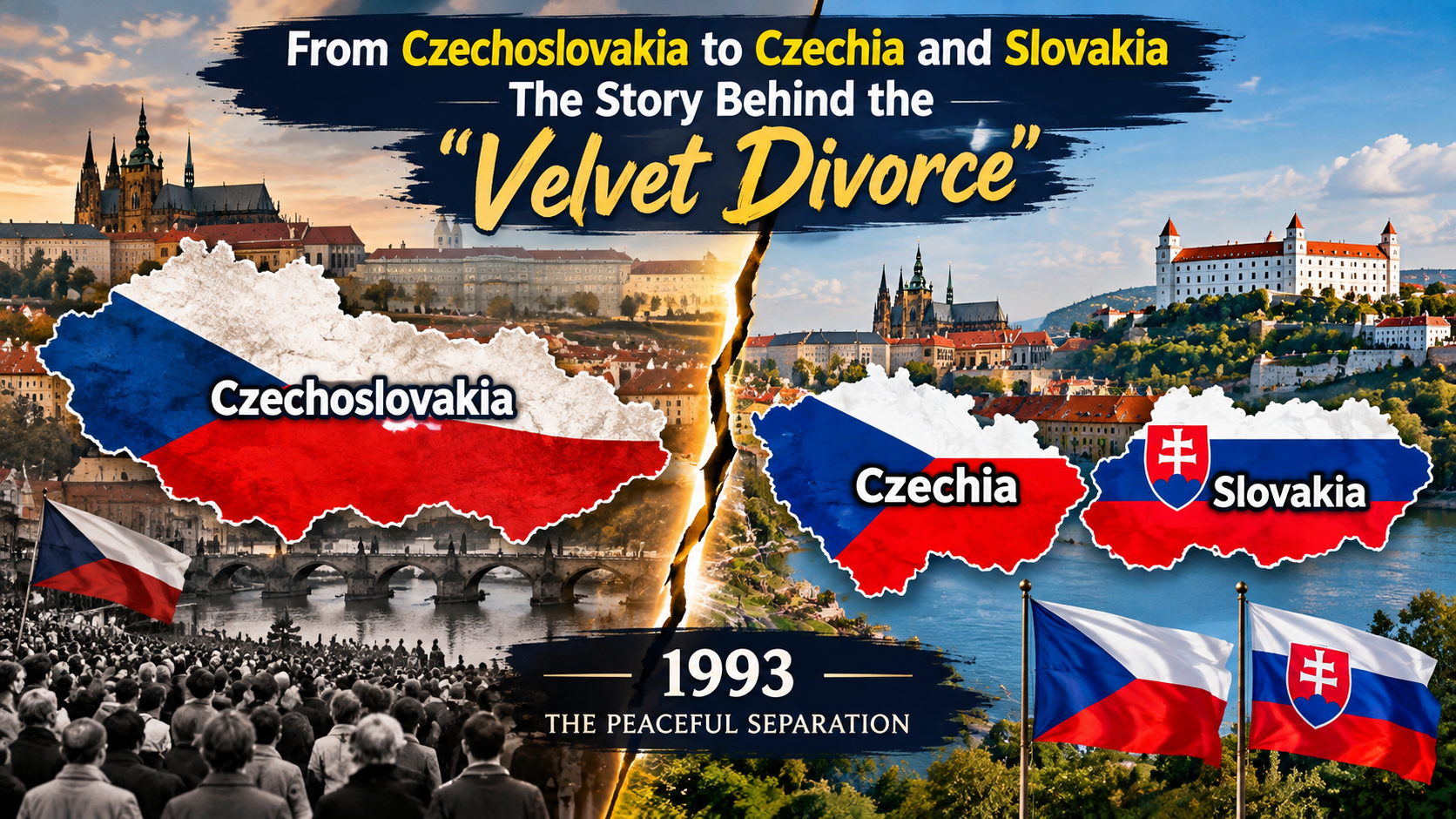
The map in the image shows one of Europe’s most peaceful political transformations: the separation of Czechoslovakia into two independent countries — Czechia and Slovakia — in 1993. Unlike many historical break-ups, this one did not involve a civil war or a major military confrontation. Instead, the country divided through political negotiations, earning the memorable name “Velvet Divorce”, a reference to the peaceful nature of the process.
Czechoslovakia: One Country, Two Nations: Czechoslovakia was created in 1918, following the collapse of the Austro-Hungarian Empire after the First World War. It brought together predominantly Czech and Slovak populations within a single state.
Although Czechs and Slovaks shared important cultural and historical connections, they also had different political experiences and economic structures. Over the decades, debates about how power and resources should be distributed between the Czech and Slovak parts of the country continued.
After the Second World War, Czechoslovakia became part of the Soviet-led communist bloc. The political landscape changed dramatically in 1989, when the Velvet Revolution helped bring an end to communist rule.
Why Did Czechoslovakia Split?: The end of communism opened the door to competing political visions for the country’s future. Political leaders in the Czech and Slovak parts increasingly disagreed over questions such as:
- How much autonomy Slovakia should have?
- How the economy should be reformed?
- How political power should be shared?
- Whether the country should remain a federation or become two separate states?
Rather than allowing these disagreements to develop into violent conflict, political representatives negotiated the country’s future.
The Velvet Divorce of 1993: The final separation took effect on 1 January 1993. Czechoslovakia ceased to exist, and two sovereign states emerged:
🇨🇿 Czech Republic (Czechia)
🇸🇰 Slovakia
The process became known internationally as the Velvet Divorce, deliberately echoing the peaceful Velvet Revolution of 1989. Importantly, the split was not simply a matter of drawing a new line across a map. The two sides had to reach agreements covering government institutions, property, currency, borders and other practical matters associated with becoming independent countries.
What Happened to the Old Czechoslovak Map?: The image illustrates the transformation particularly well.
- Before 1993: A single country — Czechoslovakia — occupied the territory.
- After 1 January 1993: The same territory was divided between two internationally recognised states, Czechia and Slovakia.
The border between them largely followed the existing administrative boundary between the Czech and Slovak parts of the federation, rather than being created through a military conquest.
Was the Separation Completely Tension-Free?: The phrase “peaceful divorce” can sometimes make the process sound simpler than it actually was. There were substantial disagreements among politicians and citizens about whether Czechoslovakia should remain united, become a looser federation, or separate altogether. The political leadership ultimately negotiated the dissolution rather than holding a nationwide referendum on independence.
That distinction is important when looking at the map: the change was politically negotiated, not the result of a battlefield victory.
Why Is the Velvet Divorce Historically Important?: The dissolution of Czechoslovakia is often studied as an example of how a multinational state can undergo a major constitutional transformation without descending into large-scale armed conflict.
It also demonstrates that national borders are not necessarily permanent. Political systems, public opinion, negotiations and historical circumstances can reshape the map of Europe.
Today, Czechia and Slovakia remain separate countries, while their shared history continues to influence their languages, cultures, economies and relations.
The Bigger Lesson Behind the Map: At first glance, the image looks like a simple “before and after” comparison. But behind those coloured shapes lies a much bigger story about the end of communism, national identity, political negotiation and the changing map of post-Cold War Europe.
Czechoslovakia did not disappear because of a war. It disappeared through a negotiated political separation — one that became known as the Velvet Divorce.