
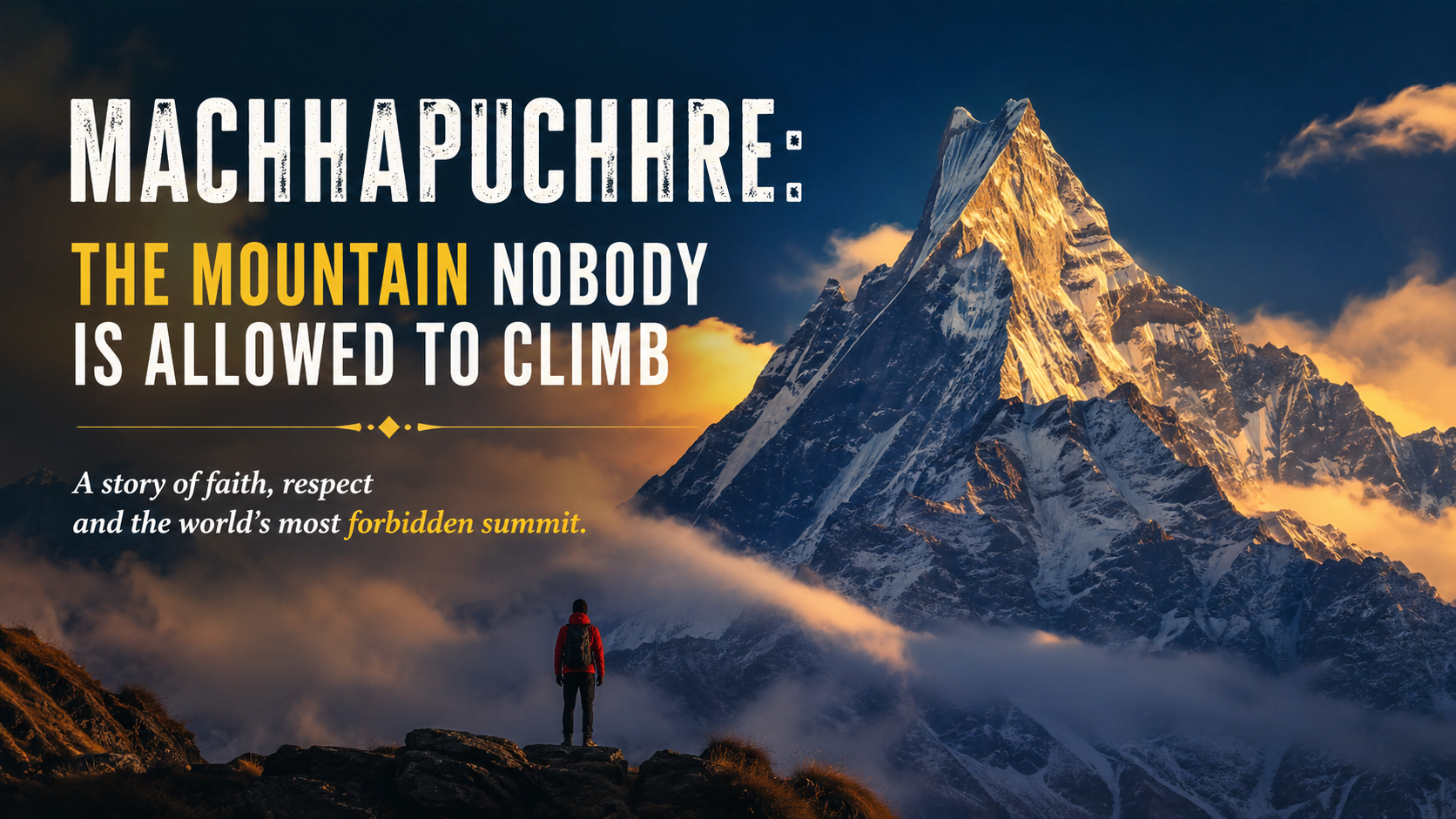
Machhapuchhre, also spelled Machapuchare or Machhapuchhre Himal, is one of the most mysterious mountains in Nepal. Rising to about 6,993 metres (22,943 ft) in the Annapurna Himalayas, it is instantly recognizable by its dramatic twin summit that resembles a fish’s tail—hence its Nepali name, Machha-puchhre, meaning “fish tail.”
But its greatest distinction is not its height. Machhapuchhre is officially unclimbed because Nepal does not permit expeditions to its summit. That makes it unusual in modern mountaineering: a mountain that is technically a climbing objective, yet whose summit has effectively been placed beyond the reach of climbers—not simply because it is difficult, but because of law, culture, religion and respect for a sacred landscape.
Why Can’t Anyone Climb Machhapuchhre? : There are really three different answers: the legal answer, the cultural-religious answer, and the mountaineering answer.
Nepal does not issue climbing permission for the summit : Nepal’s mountaineering system requires climbers to obtain government permission before attempting a mountain. The regulations also require expedition teams to respect the religious, social and cultural traditions of communities in the climbing area.
- Machhapuchhre’s summit is not an ordinary permitted climbing objective. Consequently, climbers cannot simply arrive in Nepal, pay a royalty and obtain a permit to attempt the summit.
- Machhapuchhre has no officially recognized summit ascent, and climbing permits to the summit are not issued. There have been historical reports and rumors of an unauthorized ascent, but no such claim has become an accepted official first ascent.
The 1957 Expedition: The Closest Climbers Came. The story becomes even more fascinating when you look at its climbing history. In 1957, a British expedition led by Lieutenant Colonel Jimmy Roberts attempted Machhapuchhre. Climbers Wilfrid Noyce and A. D. M. Cox climbed the mountain’s north ridge and reached extremely close to the summit.
They deliberately stopped short rather than stepping onto the summit. Accounts place their high point roughly 50 metres below the top. For a mountaineer, that is an extraordinary situation. Imagine spending weeks approaching a Himalayan summit, fighting altitude, cold, unstable snow and technical terrain—and then deliberately refusing the final metres. That is precisely what makes Machhapuchhre different.
The expedition effectively created one of mountaineering’s great paradoxes: The summit was close enough to attempt, but culturally it was not considered a summit worth taking.
Is Machhapuchhre Really a “Holy Mountain”? : Yes—but there is an important nuance. Machhapuchhre is widely associated with Lord Shiva, particularly in Hindu traditions and regional beliefs surrounding the Annapurna Sanctuary. Stories describe the mountain and surrounding sanctuary as a sacred realm associated with deities.
For many people who live around the Annapurna region, the mountain is therefore not merely a geological object. It is part of a sacred landscape.
Some popular accounts say that Lord Shiva lives on Machhapuchhre, while other traditions associate the mountain’s distinctive twin peaks with divine figures. These beliefs vary among communities and should not be presented as though every local person holds exactly the same belief.
There is also an important historical caveat: In 2001, Nepali Times article challenged the simple modern narrative that Machhapuchhre’s climbing prohibition originated solely from an ancient Gurung taboo. The article argued that the history of the mountain’s sacred status and the 1960s closure is more complicated than tourism literature often suggests. That’s an important distinction between folklore and documented history.
What Does Machhapuchhre Have to Do With Shiva? : The Hindu connection is particularly powerful. In regional belief, Shiva’s presence is associated with the Annapurna Sanctuary and Machhapuchhre. Traditional interpretations have even connected the mountain’s snow and clouds with divine activity.
This creates a completely different philosophy of mountaineering.
- Western-style climbing often begins with the question: “Can we reach the summit?”
- A sacred-mountain tradition can begin with: “Should humans stand on the summit at all?”
That difference is fundamental. For a climber, a summit is normally an objective.For a believer, a summit can be a sanctuary.
The Geology Behind the Fishtail : From a geological perspective, Machhapuchhre is just as fascinating as it is culturally important. The mountain belongs to the Annapurna Himalaya, part of the enormous Himalayan mountain system created by the continuing collision of the Indian and Eurasian tectonic plates.
The Himalayas are essentially the geological result of the Indian plate pushing northward into the Eurasian plate. Rock that was once buried deep within the Earth’s crust has been uplifted to extraordinary elevations.
That is why Himalayan mountains can contain rocks and geological structures that tell stories about environments vastly different from today’s frozen high-altitude landscape.
The surrounding Himalayan geology also preserves evidence of the ancient Tethys Ocean, including marine sedimentary rocks and fossils in parts of the greater Himalayan geological sequence. The presence of marine material at Himalayan elevations is one of the clearest reminders that today’s mountains have an extraordinary geological history.
In other words:
- The mountain was not always a mountain.
- Its rocks record a story that began long before humans existed.
Why Does It Look Like a Fish Tail? : The answer is surprisingly simple: its twin summit architecture. Machhapuchhre has two prominent summits separated by a pronounced notch. From certain directions, those summits resemble the two sides of a fish’s tail.
The Nepali name reflects exactly this visual impression:
- Machha = fish
- Puchhre = tail
Its dramatic shape is enhanced by steep ridges, glacial erosion and the way sunlight and shadow emphasize the two summit towers. This also explains why Machhapuchhre can appear disproportionately impressive from Pokhara despite not being one of the world’s highest mountains.
At 6,993 m, it is much lower than Everest’s 8,849 m—but its distinctive profile and enormous relief make it one of Nepal’s most visually recognizable peaks.
Is Machhapuchhre Actually Dangerous to Climb? : If the government prohibition disappeared tomorrow, Machhapuchhre would still not be an easy mountain. The mountain has steep terrain, exposed ridges, snow and ice, rapidly changing Himalayan weather and significant altitude. Its dramatic summit architecture also creates technical climbing challenges.
But saying “Nobody climbs it because it is too dangerous” would be misleading. That is not the main reason it remains unclimbed. There are many mountains considerably more technically difficult that have been climbed.
Machhapuchhre’s unusual status comes from the combination of technical difficulty + sacred significance + government prohibition + mountaineering ethics.
Is Machhapuchhre the Only Mountain Humans Cannot Climb? : No, It is one of several famous mountains around the world whose summits are prohibited, restricted or culturally protected. A useful comparison is Mount Kailash in Tibet, which is sacred in Hinduism, Buddhism, Jainism and the Bon tradition and is not treated as an ordinary mountaineering objective.
Another famous example is Gangkhar Puensum, the highest mountain in Bhutan. Bhutan has historically restricted high-altitude mountaineering because of religious and cultural considerations, although its regulatory history differs from Machhapuchhre’s.
Machhapuchhre is particularly remarkable because it sits in one of the world’s greatest trekking and mountaineering destinations while its own summit remains off-limits.
The Mountain Climbers Can See—but Cannot Summit : This is perhaps the most beautiful irony of Machhapuchhre. You don’t have to climb it to experience it. Trekkers can approach the mountain through the Annapurna Sanctuary and surrounding trekking routes, while the peak dominates views from the Pokhara region and other locations in the Annapurna landscape.
The mountain therefore occupies an unusual place in Himalayan tourism:
- Everest represents the conquest of a summit.
- Machhapuchhre represents the decision not to conquer one.
- That distinction makes it far more than another Himalayan peak.
Why Machhapuchhre Remains Unclimbed: The Real Answer is that if we strip away the myths and look at the mountain from four perspectives, the answer becomes clear that Why Machhapuchhre still remains unclimbed:
- Law: Nepal does not issue permission for a summit expedition.
- Religion: It is widely regarded as a sacred mountain associated with Shiva.
- Culture: The surrounding Himalayan landscape has deep spiritual significance.
- Mountaineering: A 1957 expedition approached the summit but stopped short.
- Geology: It is a young, dramatically uplifted Himalayan peak shaped by tectonics and erosion.
- Ethics: Many climbers regard respecting a sacred prohibition as more important than claiming a first ascent
Nepal’s own mountaineering regulations explicitly require climbers to avoid actions that harm the religious, social and cultural traditions of local communities.
The Most Powerful Lesson of Machhapuchhre : Modern mountaineering has often been driven by achievement; first ascent, fastest ascent, hardest route, highest summit. Machhapuchhre offers the opposite idea. Its greatest mountaineering story may be the fact that climbers stopped.
In 1957, Wilfrid Noyce and A. D. M. Cox came remarkably close to the summit and did not take those final steps. More than half a century later, the mountain remains an extraordinary symbol of restraint. Some mountains are measured by how high humans climb. Machhapuchhre is measured by the height humans are willing to leave untouched.